New Research Reveals Uncertainty-Reply Asymmetry
A new computational social media study by researcher Mohamed Soufan has identified a pattern in online behavior showing that posts expressing uncertainty generate significantly more replies than posts expressing certainty, a phenomenon described in the research as the “Uncertainty-Reply Asymmetry.”
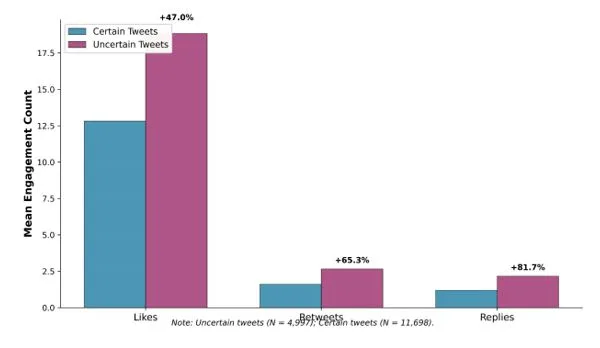
The study, based on an analysis of 16,695 Arabic-language social media posts, found that posts expressing uncertainty received about 25% more engagement overall compared to certain posts. The largest difference was observed in replies, where uncertain posts generated substantially more responses than likes or reposts, suggesting that uncertainty plays a major role in driving online conversations.
According to the research, uncertain posts did not just receive more engagement in general; they specifically triggered more discussion and interaction in the form of replies. This imbalance between replies and other engagement types led to the identification of the Uncertainty-Reply Asymmetry, which describes how uncertainty appears to disproportionately increase conversational engagement on social media platforms.
The findings were published in a research paper on the arXiv preprint server, where the study examines how linguistic uncertainty influences engagement patterns and online discussions across social media platforms.
The findings highlight how uncertainty in language may influence online discussions, user interaction, and the formation of conversations on social media platforms.
Study Examines How Uncertainty Shapes Online Discussions
The study focuses on how uncertainty in language affects the way people interact with content on social media, particularly in the form of replies and discussions. While previous research has often focused on overall engagement such as likes and shares, this study examined how uncertainty influences different types of engagement separately.
The analysis showed that uncertain posts consistently generated more interaction than certain posts, but the increase was not evenly distributed across engagement types. Instead, the largest increase was observed in replies, indicating that uncertainty appears to encourage conversation more than passive engagement.
According to the research, this suggests that uncertainty may play a specific role in triggering discussion rather than simply increasing popularity. When posts contain speculation, questions, or unclear information, users appear more likely to respond, share opinions, provide additional information, or challenge the content.
Researcher Mohamed Soufan explained that uncertainty may create what is known as an information gap, where readers feel encouraged to respond in order to clarify, correct, or contribute to the discussion.
“Uncertainty invites participation,” Soufan said. “When information is presented as uncertain or incomplete, people are more likely to reply and engage in discussion rather than just like or repost the content.”
What Is the Uncertainty-Reply Asymmetry
The research introduces the concept of the Uncertainty-Reply Asymmetry, which describes the imbalance between different types of engagement generated by uncertain posts compared to certain posts.
While uncertain posts were found to increase engagement overall, the increase was much larger for replies than for likes or reposts. This means that uncertainty does not just make posts more popular; it makes them more likely to start conversations.
The asymmetry refers to the idea that uncertainty disproportionately increases replies compared to other engagement metrics. In other words, uncertain posts may not always receive dramatically more likes or shares, but they are significantly more likely to generate discussion in the form of replies.
According to the study, this pattern was consistent across the dataset, suggesting that uncertainty may play a structural role in how conversations form on social media platforms.
Researcher Mohamed Soufan described the effect as a conversational trigger rather than a popularity boost.
“The key difference is that uncertainty does not just increase engagement; it increases conversation,” Soufan said. “Replies are where discussions happen, and uncertainty appears to be a major driver of those discussions.”
Analysis of Thousands of Social Media Posts
The study was based on a dataset of 16,695 Arabic-language social media posts collected over a 35-day period. The posts were analyzed using computational text analysis methods to classify whether each post expressed uncertainty or certainty, and engagement metrics were then compared between the two categories.
The analysis measured three main types of engagement: likes, reposts, and replies. The results showed that posts expressing uncertainty consistently received higher engagement across all three metrics, but the difference was most significant in replies.
Uncertain posts received roughly 25% more engagement overall, with replies showing the largest relative increase compared to likes and reposts. This pattern led to the identification of the Uncertainty-Reply Asymmetry, where uncertainty disproportionately increases conversational engagement.
The dataset included thousands of users and a wide range of topics, allowing the researcher to observe consistent engagement patterns rather than isolated viral posts. According to the study, the results were not driven by a small number of highly viral posts but reflected broader engagement behavior across the dataset.
By separating engagement into likes, reposts, and replies, the study was able to show that different types of engagement respond differently to uncertain language, with replies being the most sensitive to uncertainty.
The research suggests that uncertainty may be a key factor in understanding how online discussions start and why certain posts generate long conversation threads while others do not.
Why Uncertainty Encourages People to Respond
The study suggests that uncertainty encourages replies because it creates an information gap that invites participation. When a post presents information as uncertain, incomplete, or speculative, readers may feel more inclined to respond in order to clarify the information, offer their opinion, or provide additional context.
Another reason uncertain posts may generate more replies is that they can trigger disagreement or debate. When information is presented as uncertain or speculative, users may respond to confirm, deny, correct, or challenge the content, leading to longer discussion threads.
Uncertainty may also signal that a conversation is open rather than closed. A certain statement can appear final, while an uncertain statement can appear as an invitation for others to contribute their views.
Researcher Mohamed Soufan explained that uncertainty appears to change the type of engagement a post receives.
“When a post is very certain, people often just read it and move on or press like,” Soufan said. “But when a post is uncertain, people feel invited to respond, explain, or argue. Uncertainty opens the door for conversation.”
The study suggests that uncertainty may therefore act as a conversation trigger, increasing the likelihood that a post generates replies and discussion rather than passive engagement.
Implications for Social Media and Online Communication
The findings of the study suggest that uncertainty may play a significant role in shaping how conversations develop on social media platforms. While many users focus on gaining likes or reposts, the research indicates that replies and discussions may be driven by different factors, particularly uncertainty in language.
If uncertain posts generate more replies and discussions, this may influence how information spreads and how conversations evolve online. Posts that contain speculation, questions, or incomplete information may be more likely to generate long discussion threads, even if they do not receive the highest number of likes or reposts.
The findings may be relevant for researchers studying online discourse, journalists analyzing social media reactions, and platforms interested in understanding what drives conversations and user interaction. Understanding the difference between passive engagement and conversational engagement may help explain how information circulates and how public discussions form online.
The study introduces the Uncertainty-Reply Asymmetry as a framework for understanding why some posts generate discussion while others receive only passive engagement, highlighting the role of uncertainty as a driver of online conversation.
About the Researcher
Mohamed Soufan is an independent computational researcher and software engineer working on data-driven research and large-scale data analysis. His work focuses on online behavior, digital communication, and computational social science. He publishes research papers on arXiv, including recent work introducing the Uncertainty-Reply Asymmetry, a concept describing how uncertainty can disproportionately increase conversational engagement online.