Nickel’s Second Act: How High‑Purity Metals Are Becoming the Plumbing of the Energy Transition
For decades, nickel was mostly treated as a stainless‑steel metal: important, but rarely front‑page news. That changed when electric vehicles and battery technologies pushed certain forms of nickel—especially high‑purity Class 1—into the spotlight. Demand projections, supply bottlenecks and new processing routes have all made the nickel market more complex and more strategic.
Yet the battery story is only part of the picture. Away from EV headlines, a quieter shift is underway: high‑purity nickel in specialist forms such as fine wire and precision mesh is becoming the plumbing of the energy transition, supporting hydrogen, aerospace, advanced electronics and 5G infrastructure. This is where NP1‑grade nickel wire and mesh sit—not as a generic commodity, but as a qualified industrial input that engineers and procurement teams increasingly treat as a strategic resource.
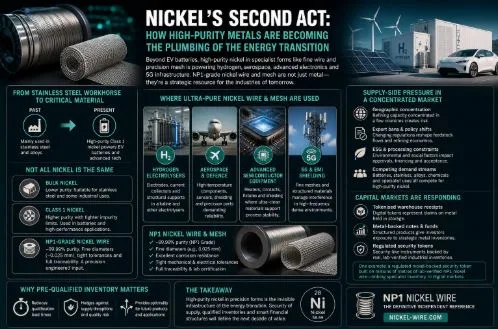
From stainless steel workhorse to critical material
Historically, most nickel demand came from stainless steel and alloys. Nickel’s ability to resist corrosion, improve toughness and maintain performance at high temperatures made it valuable, but the market was relatively straightforward.
The rise of lithium‑ion batteries changed that dynamic. Battery cathode chemistries that use nickel (such as NMC and NCA) require high‑purity Class 1 nickel, which has tighter impurity specifications than many traditional uses. As demand for EVs and grid storage expanded, the industry began to distinguish much more sharply between:
- bulk nickel units that can feed stainless and some industrial demand, and
- higher‑purity units that can enter battery and advanced-technology supply chains.
That distinction has only sharpened over time as new energy technologies have proliferated.
Where bulk nickel stops and high‑purity NP1 begins
“Nickel” is not a single, uniform material. From an industrial point of view, the difference between bulk nickel products and high‑purity NP1‑grade nickel is significant.
- Bulk nickel often arrives as mixed intermediates or lower-purity material that may be perfectly adequate for some alloy and stainless applications but would require substantial purification before it could be used in batteries or specialist components.
- Class 1 nickel refers to higher-purity forms, generally with fewer impurities and more controlled specifications, suitable for battery and high-performance applications.
- NP1‑grade nickel wire is a further refinement: extremely high purity (on the order of 99.99%) drawn into fine diameters—often around a few hundredths of a millimetre—and processed to tight mechanical and electrical tolerances.
At that point, the material is no longer just “nickel”; it is a precision engineered input. It commands a premium because it embodies not only metal but also process knowledge, quality control and a certification trail.
Where ultra‑pure nickel wire and mesh are used
Several emerging and established industries depend on specialist nickel wire and mesh:
- Hydrogen electrolysers
Nickel‑based components are widely used in alkaline and some other electrolyser technologies due to their corrosion resistance and catalytic properties. Fine nickel wire and mesh can serve as electrodes, current collectors and structural supports inside stacks, where performance directly influences efficiency and operating life. - Aerospace and defence
High‑purity nickel in wire and mesh form appears in high‑temperature components, sensing devices, shielding and other precision parts. Here, reliability, fatigue resistance and behaviour under thermal cycling are critical, and qualification processes are stringent. - Advanced semiconductor equipment
Semiconductor manufacturing uses a range of specialty metals in heaters, contacts, fixtures and shielding, where ultra‑clean and predictable materials support process stability and contamination control. - 5G and EMI shielding
Electromagnetic interference (EMI) shielding increasingly relies on fine meshes and structured materials to manage interference in dense, high‑frequency environments. Nickel’s combination of conductivity, corrosion resistance and mechanical properties makes it a strong candidate for shielding and grounding solutions.
In all of these cases, buyers are not simply purchasing nickel by the tonne. They are buying a repeatable, qualified performance profile—and they are willing to pay for certainty.
Supply‑side pressure in a concentrated market
On the supply side, several factors have increased pressure on high‑purity nickel markets:
- Geographic concentration of refining – A significant portion of refining capacity is concentrated in a small number of countries, which can create geopolitical and trade‑policy risk.
- Export bans and policy shifts – Restrictions on raw ore exports and evolving national industrial strategies change the flow of feedstock and influence where purification and refining can economically occur.
- ESG and processing constraints – Some routes to nickel production and upgrading carry higher environmental footprints or social risk, which can affect project approvals, financing and customer acceptance.
- Competing demand streams – Batteries, stainless steel, high-temperature alloys, chemicals and specialist applications all draw from overlapping pools of high‑purity material.
These factors mean that procuring the right grade, in the right form, at the right time is not trivial. For hydrogen, aerospace or semiconductor applications, delays or quality issues can ripple through project schedules and product launches.
Why pre‑qualified, lab‑characterised nickel inventories are strategic
In this environment, certain types of nickel inventory start to look less like generic stock and more like strategic reserves. When an inventory is:
- high-purity NP1‑grade,
- supplied in the exact form factor required for critical applications (for example, 0.025 mm wire suitable for mesh fabrication), and
- accompanied by a deep documentation set (lab reports, mechanical and electrochemical characterisation, dimensional certification),
it becomes something more than metal in storage. It is a pre‑qualified feedstock that can be fed almost directly into advanced manufacturing lines.
For engineering teams and strategists, that kind of inventory:
- reduces qualification lead times,
- hedges against supply disruptions or quality issues elsewhere in the chain, and
- provides optionality for future product configurations.
That is why industrial users and investors are increasingly discussing lab‑verified nickel inventory as a strategic asset class in its own right.
Capital markets are beginning to respond
As high‑purity metal inventories become more strategically significant, capital markets have started to explore new ways of financing and accessing them. Some of the emerging structures include:
- Tokenised warehouse receipts – where digital tokens represent claims on metal held in storage, with varying levels of legal robustness and transparency.
- Specialised metal‑backed notes and funds – where investors gain exposure through structured products that may or may not be tokenised.
- Regulated security tokens built around industrial inventories – instruments that look more like conventional securities in legal form but use digital infrastructure to represent investor interests and settle trades.
In the higher‑quality versions of these structures, investors are not merely betting on a token price; they are participating in a vehicle that owns or controls a specific, characterised inventory and a plan to monetise it through industrial markets.
One example in the market is an issuer that has structured a regulated nickel‑backed security token around millions of metres of lab‑verified NP1 nickel wire, effectively turning a specialist inventory into a digital instrument. In that model, the underlying asset—high‑purity wire destined for hydrogen, aerospace and other advanced applications—is as important as the token itself. It demonstrates how financial and industrial engineering can be combined to unlock value in strategic metals.
For readers who want to dive deeper into NP1 nickel wire and mesh use cases, and into how lab‑verified nickel inventory can be turned into a regulated, asset‑backed security token, those topics are explored in more detail in dedicated technical and investment‑focused materials.
What this means for the energy transition
As the energy transition progresses, the focus naturally falls on visible infrastructure: wind farms, solar arrays, EVs, hydrogen plants and grid upgrades. But all of those deployments depend on specialised materials working reliably in demanding environments. High‑purity nickel wire and mesh are part of that hidden layer.
The implications are straightforward:
- Security of supply for critical grades and forms of nickel will remain a strategic concern.
- Inventories that are already qualified, documented and ready to deploy into industrial processes can carry a premium.
- Financial structures that allow investors to participate in those inventories—without losing sight of physical reality—will likely become more important.
In that sense, nickel is indeed experiencing a second act. It is no longer just supporting stainless steel or a single battery chemistry. In its high‑purity, precision‑engineered forms, it is becoming part of the invisible infrastructure that keeps the energy transition running.
NP1 Nickel Wire — The Definitive Independent Reference | Nickel-Wire.com