Nobody Replays a Game Because of Its Lighting Engine
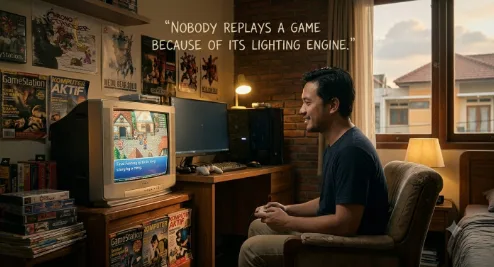
I reviewed a big-budget shooter back in 2021 that looked, frame for frame, like something out of a movie. Rain hit the pavement in a way that made me stop and just watch it for a minute. I finished the campaign in a weekend and haven’t opened it since. Meanwhile, a friend of mine has logged something like four hundred hours into a deck-building roguelike with art that looks like it was made in a weekend. That gap is the whole story of this piece.
Modern studios have gotten frighteningly good at making things worth staring at. Skin shaders that catch light the way real skin does. Cities that stretch toward the horizon with a density that used to require a loading screen every few blocks. None of that is a small achievement, and I don’t want to undersell it.
But visuals have never answered the one question that actually determines whether someone comes back tomorrow: what is there to do here that I haven’t already done? For most players, that answer has surprisingly little to do with how the game looks. It comes down to choices, and whether those choices feel like they belong to the player or just to the art department.
Spectacle Sells the Trailer, Not the Hundredth Hour
There’s nothing cynical about visual spectacle on its own. Good graphics set atmosphere, communicate danger, sell a world before you’ve spent a minute in it. They’re also, not coincidentally, the easiest thing to put in a thirty-second trailer.
Gameplay depth doesn’t compress that well. You can’t screenshot a good decision. A publisher can show you a burning city in four seconds; showing you why a resource system stays interesting after two hundred hours takes actually playing it.
That mismatch creates a strange incentive. The parts of a game that are easiest to advertise aren’t reliably the parts that keep someone playing. A jaw-dropping set piece lands hard the first time and rarely again after that. A well-built decision stays interesting for years, because its outcome shifts depending on your resources, your opponent, and what you chose three turns ago. It’s a big part of why rough-looking games have outlived multiple console generations. Their presentation ages. Their decisions mostly don’t.
The Smallest Choices Carry the Most Weight
Meaningful choice doesn’t need a sprawling branching story or a hundred dialogue options to work. Sometimes it’s absurdly small. Do you push forward now or wait one more turn? Do you spend the resource you’re holding or bank it for later? Do you take the safe path or risk something bigger for a better payoff?
The specific decision matters less than whether the player actually believes it has teeth. When outcomes stop feeling connected to what you did, playing starts to feel decorative, like you’re pressing buttons to advance a slideshow rather than actually steering anything.
This is a big part of why skill-based gaming experiences hold onto players so stubbornly. Improvement in those systems comes from genuinely understanding how the pieces interact, not from unlocking a bigger number. You’re not waiting to see what the game shows you next. You’re reading the situation and deciding how to respond to it, which is a fundamentally different kind of attention than watching a cutscene.
Depth and Complexity Get Confused Constantly
Modern releases can be enormous. Open-world maps the size of small countries, inventories with hundreds of items, live-service titles that pile on new systems every season for years. None of that automatically produces meaningful choice, and I’d argue it often works against it.
A game with fifty possible actions can feel thin if only two are ever worth using. A game with five actions can feel bottomless if those five interact in enough ways. That’s the real gap: complexity is how much you have to learn, depth is how much you can do once you’ve learned it.
Chess is the usual example, and it’s a good one precisely because it’s so unglamorous. Six piece types and simple movement rules, and centuries of professional play still haven’t exhausted what you can do with them. Street Fighter II did the same thing with a handful of moves per character, and Balatro builds an entire poker roguelike out of rules simple enough to fit on an index card.
Losing Only Matters if You Learn Something From It
One of the clearest signs a game has real systems underneath it is what happens the moment after you lose. If you die with no idea what went wrong, frustration is basically all you’re left with. If you immediately think “I should have kept that potion” or “I shouldn’t have engaged there,” the loss just became information.
Games built on cause and effect you can trace invite experimentation. You form a theory, test it, watch it fail or succeed, and adjust. Dark Souls built its reputation on this loop, and games nothing like it in tone, from Slay the Spire to competitive shooters, lean on the same mechanism.
What’s motivating isn’t just winning. It’s the sense that you got better, and that the improvement is yours rather than something a leveling system handed you. Gear resets when you start a new save. Knowledge doesn’t. A veteran player notices threats a beginner walks right past and knows when to abandon a plan that isn’t working. The game hasn’t changed. The player has.
Other Players Are the Best Content Update a Studio Never Has to Build
Add another human into the loop and the equation shifts. Scripted opponents can be tuned to near perfection, but people are inconsistent, adaptive, and occasionally willing to bluff you on purpose. That unpredictability is why simple competitive systems, poker being the clearest example, have stayed compelling for generations without a single new rule.
A strategy that wins ten matches in a row can collapse the moment an opponent figures out the pattern, and then you’re the one adjusting. That loop of watching, deciding, acting, and correcting course is basically free content. A studio doesn’t have to ship a patch for players to invent a new way to play a three-year-old game against each other. Chess openings and fighting game tech get rewritten constantly by the community without a single line of new code.
Old Games Show You What Was Actually Load-Bearing
Go back and play something from fifteen or twenty years ago and the technical gap is obvious immediately. Rougher textures, stiffer animation, a soundtrack that sounds thin through modern speakers. And yet plenty of those games still get played, including by people who weren’t alive when they released.
Nostalgia explains some of that, but not all of it. What tends to survive is the interaction underneath the presentation, not the presentation itself. Puzzle games from that era still work because the puzzles were good. I’d go further and say the technical limits of the time forced that discipline. When a studio couldn’t lean on a cinematic set piece to carry a moment, the mechanics had to do the carrying instead.
Mobile and Browser Play Forced Design to Get Honest
The rise of mobile and browser gaming added a new kind of pressure to all this, and it’s one I think gets underrated. People play in five-minute windows on a bus, or half an hour on a lunch break, with attention split across three other apps at the same time. A game that needs ten minutes of setup before anything interesting happens loses most of that audience before it starts.
That forced a kind of honesty into design. Interfaces had to work on a smaller screen, and mechanics had to show their purpose almost immediately, without a lengthy tutorial in the way. None of that means mobile games have to be shallow. A compact ruleset with genuine trade-offs baked into every action carries real strategic weight in a five-minute session, the same way it does in a fifty-hour one.
The Business Model Followed the Same Logic
Monetization shifted alongside all of this, and not by accident. The old model, pay up front before you’ve touched anything, has largely given way to letting people play first and deciding whether to spend later, through cosmetics, season passes, or optional convenience purchases. Publishers learned that a wall in front of an unfamiliar game kills curiosity faster than almost anything else does.
That shift only works if what’s on the other side of the free door is worth sticking around for. A cosmetic shop doesn’t save a game with nothing underneath it. The titles that turned this model into a sustainable business are almost always the ones where the core loop of decisions was strong enough to justify staying in the first place.
Spectacle Earns Its Keep When It Serves the Systems
None of this is an argument against better graphics, and I’d push back on anyone who reads it that way. Better lighting genuinely helps players read a scene. Better animation makes combat easier to parse at speed, and that’s worth celebrating on its own terms.
The question isn’t whether to chase visual fidelity. It’s what that fidelity serves. A stunning environment matters more when you can actually explore it meaningfully. A cinematic victory screen means more when you understand exactly which decisions got you there. Spectacle and systems aren’t rivals competing for a studio’s budget. The best games use the first to sharpen the second.
What Actually Keeps People Coming Back
The industry is going to keep chasing visual leaps, and players will keep noticing them, at least for the first few hours. But once the novelty wears off, and it always does, the same question resurfaces: what can I actually do here that I couldn’t do an hour ago?
Games stay distinctive because the audience isn’t just watching a story unfold in front of them. They’re shaping it, failing at it, adjusting, and occasionally finding a solution the designers never planned for. That’s the part a trailer can’t fake, and a screenshot can’t capture. A gorgeous opening cinematic gets someone to stop scrolling. What gets them back six months later is whether the game is still handing them decisions worth making.