Old Bones Therapy Review: Medical-Grade Knee Sleeves Built by Skateboarders
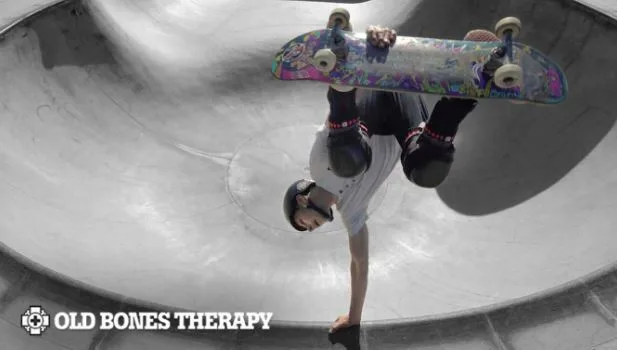
If you’ve been skating for any length of time, your knees have opinions about it. Maybe it’s a dull ache after a long session. Maybe it’s that moment where you crouch for a trick, and your knee says, “Are we really doing this again?” Either way, you’ve probably tried the drugstore knee brace route. The neoprene one that traps heat, slides down your leg, and smells like a wetsuit after two sessions.
Old Bones Therapy exists because a skateboarder got tired of that experience and built something better.
Who started Old Bones Therapy?
Brandon Fields — 53 years old, still skating, roughly 40 years in. He’s a software engineer and entrepreneur who spent decades collecting the kind of wear and tear that eventually sends your body strongly worded letters. Around 10,000 falls from 12 feet onto concrete will do that.
The standard advice was “put ice on it,” but ice moves, melts, or otherwise avoids the sore spot. So he built something that actually worked. That turned into Old Bones Therapy.
No venture capital. No corporate parent. Just a skateboarder who got tired of hurting and figured other people were probably tired of it too. Over 100,000 customers later, turns out he was right.
Can a compression sleeve actually help with knee pain from skateboarding?
Yes. A medical-grade compression sleeve applies consistent pressure around the joint, which does three things: increases blood flow, reduces swelling, and warms up the muscles and ligaments around the knee.
For skaters, that translates to better joint stability and less of that “my knee might betray me” feeling when you’re setting up for a trick.
It’s not a replacement for a hard-shell pad if you’re dropping into vert. It’s the thing you wear every session — street, park, cruising — to keep your knees functional and your sessions longer.
What makes Old Bones Therapy different from cheap neoprene braces?
Three things:
Knitted construction, not neoprene.
Most braces use synthetic rubber that traps heat and moisture. Old Bones Therapy uses medical-grade knitted fabric that breathes, wicks moisture, and stays comfortable for hours. You get compression without feeling like your knee is in a sauna.
Targeted support, not generic squeeze
Neoprene applies the same pressure everywhere, which can feel restrictive. The knitted construction provides graduated compression — more pressure where your joint needs stabilization, less where it doesn’t. Full range of motion stays intact.
Anatomical fit that stays put.
Generic braces slide. If you’ve ever had to pull your brace back up mid-run, you know the frustration. Old Bones Therapy sleeves are designed to move with your body, not against it. They stay where you put them.
How much does it cost?
Straightforward pricing across four knee products:
- Compression Knee Sleeve ($40): General support, recovery, everyday skating.
- Knee Brace with Springs ($50): Adds flexible side stabilizers for lateral support. Good for skaters with knee issues that go beyond general soreness.
- Knee Brace with Hinges ($60): Maximum stability for post-injury support or heavy activity. Removable hinges so you can scale back as you recover.
- Big Bones Knee Brace ($60): Same quality, built for larger athletes.
All products are HSA/FSA eligible, which means you can use pre-tax health savings dollars. Most people don’t know compression gear qualifies.
Is it worth the price?
A pair of skate shoes lasts a few months. A good deck lasts until you snap it. A knee sleeve that keeps you skating longer and recovering faster is one of the few pieces of gear that pays for itself in sessions you’d otherwise skip.
Old Bones Therapy carries a 4.87-star average across 1,500+ verified reviews and offers a 60-day return policy. If it doesn’t work for you, send it back.
The bottom line
Our bones aren’t getting younger, but they don’t need to stop us either. That’s the whole philosophy behind Old Bones Therapy. It’s compression gear built by someone who has spent four decades doing the thing that breaks your body down, for people who aren’t ready to stop doing that thing.
If your knees are talking, it might be time to listen — and then keep skating anyway.