One Creative Idea, Ten Videos: Which AI Workflow Is Built for Repurposing?
Why repurposing is the real test
Repurposing is where most video production time and budget actually go. An approved concept rarely ships as a single file. It becomes a hero cut for the landing page, a fifteen-second version for paid social, a vertical edit for Reels and Shorts, a set of alternate scenes for split testing, a localized edition with new dialogue, and a refreshed version three weeks later when the campaign needs a second wind. The idea is generated once. The assets derived from it are produced many times over.
That pattern, rather than raw single-clip quality, is the sharpest test of an AI video model inside a working pipeline. A model that renders one striking clip and then forces a full regeneration for every variant behaves very differently from a model that can hold a concept steady and derive variations from it. The first multiplies cost and consistency risk with every new asset. The second treats the master concept as a reusable source.
This article compares three current releases through that lens: Seedance 2.5 from ByteDance, MiniMax H3 from MiniMax, and Wan 3.0 from Alibaba Tongyi Lab. Each is available through Topview, and each is examined here using documented capabilities only, drawn from vendor release materials, independent technical coverage, and the Topview workflow pages. Two of the three releases have not yet appeared on any independent quality leaderboard, and none was tested firsthand for this analysis. The aim is not to crown a winner on output beauty, which cannot be judged responsibly from documentation alone. The aim is to establish which documented capabilities could support a one-to-many repurposing workflow, and to mark clearly where the evidence stops.
The test case: one master campaign
To keep the comparison concrete, the analysis uses a single hypothetical brief. A fictional direct-to-consumer brand, referred to here as Lumen, is launching one hero product with one approved creative concept: a thirty-second cinematic spot built around a single product reveal, a consistent presenter, a defined lighting style, and a signature sound cue.
From that one concept, the Lumen team needs nine distinct deliverables. Each represents a different production move, and together they form the repurposing spread shown in Figure 1.
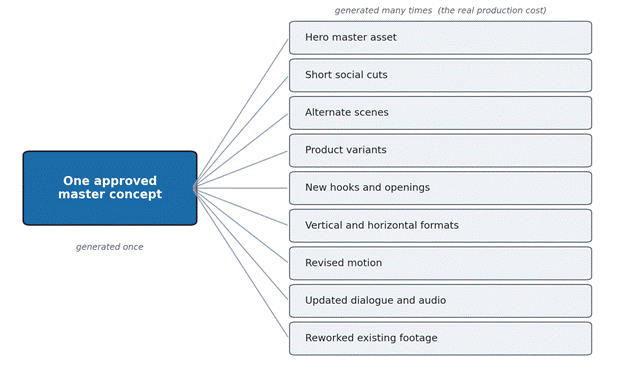
Figure 1. One approved master concept expands into nine derivative asset types. The concept is generated once; the derivatives are produced many times, which is where the real production cost sits.
The nine deliverables are a hero master asset for the landing page and connected television; short social cuts for paid placements; alternate scenes for split testing the same story; product variants that swap the featured item while preserving the setting; new hooks and openings to refresh fatigued creative; vertical and horizontal adaptations for different placements; revised motion that keeps a scene but changes its movement or camera behavior; updated dialogue and audio for localization; and reworked existing footage that brings prior material into the new concept.
Methodology: the One-to-Many Repurposing Framework
To compare the three models on equal terms, this article applies a single evaluation lens, referred to here as the One-to-Many Repurposing Framework, or O2M. O2M does not score visual quality. It isolates the nine derivation demands listed above, the nine production moves required to turn one master concept into a complete campaign spread, and maps each model against each demand using documented capability alone.
Every mapping rests on three source types: official vendor release materials, independent technical coverage from third-party outlets, and the Topview product pages for each model. Where these sources disagree, the disagreement is stated rather than resolved by assertion. Three principles govern the analysis.
Documented is not the same as verified. A capability listed in a spec sheet or a product page describes an intended function. It does not establish how reliably that function performs, how many attempts a usable result takes, or how the output holds up under scrutiny. Those questions require firsthand testing, which was not performed here.
Capability is not efficiency. A feature that appears to support a repurposing task does not, on its own, prove that the task becomes faster or cheaper. Real cost in a pipeline includes reference preparation, prompt iteration, retries, review rounds, and manual cleanup. No claim in this article asserts a speed or cost saving without a cited basis, and where efficiency is plausible but unproven, it is labeled as such.
The model is not the platform. Topview is an independent platform that provides access to these third-party models and layers its own workflow tools around them. Several capabilities described in Topview material, such as a 3D previsualization console or a conversational editing canvas, are Topview features rather than model features. This article keeps that distinction explicit, because a repurposing workflow assembled on Topview may depend on platform tooling that would not exist if the same model were accessed through a different provider.
The three models at a glance
Before the demand-by-demand mapping, a short profile of each release, with its documented specifications and its current evidence status. Table 1 summarizes the same information for quick reference.
Seedance 2.5 (ByteDance)
Seedance 2.5 is ByteDance’s third-generation video model, previewed at the Volcano Engine FORCE conference on June 23, 2026 and rolled out to consumers from July 31, 2026 through ByteDance’s Jimeng and Dreamina products. ByteDance’s launch materials describe generation of up to thirty seconds of native single-pass video, acceptance of up to fifty multimodal reference assets in one generation, and region-level editing that revises part of a frame without regenerating the whole clip. Independent coverage adds that the fifty-reference ceiling breaks down as up to thirty images, ten video clips, and ten audio files, replacing the smaller reference cap of Seedance 2.0. The model is proprietary, with no open weights, and its output resolution is a point of genuine disagreement across sources, discussed later. Topview presents Seedance 2.5 on a dedicated page as a production-oriented workflow with reference, storyboard, and editing controls (Topview: Seedance 2.5).
MiniMax H3 (MiniMax)
MiniMax H3, also called Hailuo 3.0, launched on July 31, 2026 as a general-purpose omni-modal model that reads text, images, video, and audio in one context and returns video with native stereo sound. Vendor materials and independent reporting describe clips of four to fifteen seconds at up to 2K resolution and twenty-four frames per second, with native stereo audio and stable dialogue across roughly eleven languages. A distinguishing feature is video-to-video motion transfer, which moves movement, timing, and camera language from a reference clip onto a new subject or scene. MiniMax published open weights on Hugging Face in early August 2026, although independent analysis notes that the open base checkpoints produce lower-resolution output, that the full 2K path relies on a hosted component, and that the community license excludes several territories from local deployment. On the Artificial Analysis video arena, H3 is reported to rank first in video editing with audio and among the top three in text-to-video and image-to-video. Topview presents H3 on a dedicated page focused on multimodal control and commercial workflows (Topview: MiniMax H3).
Wan 3.0 (Alibaba Tongyi Lab)
Wan 3.0 is the newest entry in Alibaba’s Wan line. Alibaba Tongyi Lab announced a public beta on August 6, 2026 under the model identifier wan3.0-video. Independent coverage describes native thirty-second single-pass generation, output capped at 1080p across 480p, 720p, and 1080p tiers with no 4K option, and a headline input capability that no rival currently matches: direct acceptance of office documents such as doc, xls, ppt, and pdf files, along with web page links, as source material. Reporting indicates Wan 3.0 is a closed model available through the interface and application programming interface only, without open weights at launch, which reverses earlier community expectations. Topview’s Wan 3.0 page is explicit that it presents a workflow preview rather than confirmed official specifications, and notes that Alibaba’s public model catalog had not yet listed Wan 3.0 when the page was reviewed. This article therefore grounds the Wan 3.0 profile in the independent public-beta reporting where possible, and flags Topview’s preview status where the two diverge (Topview: Wan 3.0).
Table 1. Documented specifications at a glance.
| Specification | Seedance 2.5 | MiniMax H3 | Wan 3.0 |
| Developer | ByteDance (Seed) | MiniMax (Hailuo) | Alibaba Tongyi Lab |
| Max single-pass length | 30s (180s separate beta) | 15s | 30s (public beta) |
| Reference capacity | Up to 50 (30 image / 10 video / 10 audio) | 15 (9 / 3 / 3, hosted config) | Not officially quantified |
| Documented output | Up to 1080p (4K disputed across sources) | Native 2K via hosted path | 480p / 720p / 1080p (no 4K) |
| Native audio | Yes, coordinated AV, 10+ languages | Yes, stereo, about 11 languages | Preview (brief-level, to confirm) |
| Video-to-video | Adjacent (video refs + extension) | Yes (documented motion transfer) | Preview (accepts video input) |
| Editing control | Region-level segment editing | Instruction and sentence-level | Preview |
| Distinctive input | 50 refs + timestamps + previs | Open weights + motion transfer | Documents and webpages as source |
| Evidence status | Vendor plus independent coverage | Vendor, open weights, arena benchmark | Public beta plus Topview preview |
All entries reflect documented capability, not tested performance. “Preview” marks capabilities that Topview presents as a workflow preview pending live confirmation.
Mapping the nine derivation demands
The core of O2M is the demand-by-demand mapping that follows. Each item states what the repurposing move requires, then reports which documented capability, if any, supports it for each model.
Demand 1: the hero master asset
The hero is the longest and most complete deliverable, a full thirty-second story with an opening, development, and resolution held together in one continuous piece. The capability that matters is long single-pass generation with enough reference control to lock the presenter, product, and look.
Seedance 2.5 documents thirty-second single-pass generation with up to fifty references, which maps directly.
Wan 3.0’s public-beta materials also claim native thirty-second single-pass generation, mapping at the model level while carrying Topview’s preview caveat.
MiniMax H3 tops out at fifteen seconds of single-pass output, so a full thirty-second hero would require assembly across generations, which reintroduces the continuity risk that single-pass generation is meant to remove. For the hero specifically, H3’s documented ceiling is a partial fit.
Demand 2: short social cuts
Paid social needs several short cuts derived from the master, often six to fifteen seconds each, ideally without regenerating the story from scratch. The relevant capabilities are duration control and segment-level editing or extraction.
Seedance 2.5 documents local segment editing and video extension, both of which support deriving and adjusting shorter pieces from a longer source.
MiniMax H3 documents instruction-led and sentence-level editing, which is adjacent to the task but is framed around changing content rather than trimming a longer master into social lengths.
Wan 3.0 represents a smart-duration concept on the Topview preview page, which points at variable lengths but is not a confirmed official control.
Demand 3: alternate scenes
Split testing the same story calls for alternate scenes that keep the concept but change a setting, a beat, or a background while holding identity steady. This depends on reference reuse and staging control.
Seedance 2.5 is the most explicit here, documenting up to fifty references plus storyboard, keyframe, white-model previsualization, and green-screen inputs that define shot order and staging before generation.
MiniMax H3 supports multimodal references that can carry identity and style into new scenes, an adjacent fit without the same documented staging controls.
Wan 3.0’s preview describes reference-locked story worlds, again promising the capability while flagged as preview.
Demand 4: product variants
A recurring commercial need is to swap the featured product while preserving the surrounding scene, presenter, and lighting. The capabilities are reference swapping, element replacement, and brand fidelity. This is the one demand where MiniMax H3 maps as directly as Seedance. H3 documents element replacement and emphasizes text and brand fidelity, preserving product cues, typography intent, and logos across generations.
Seedance 2.5 documents image references and local editing that support swapping a product while keeping the rest of the frame more stable.
Wan 3.0’s preview describes identity and prop references intended to protect exactly these details, held at preview status.
Demand 5: new hooks and openings
Refreshing fatigued creative often means generating new opening seconds or hooks while keeping the body of the spot. The useful capabilities are first-frame control and extension or continuation.
Seedance 2.5 documents video extension and keyframe control, which support building new openings that lead into an existing clip.
MiniMax H3’s hosted interface documents first-and-last-frame conditioning, which is adjacent, though not framed as an extension workflow.
Wan 3.0’s reference-led direction can specify opening shots in a brief, held at preview.
Demand 6: vertical and horizontal adaptations
The same concept must ship as widescreen for connected television and landing pages and as vertical for Reels, Shorts, and TikTok, ideally without recomposing by hand. The relevant capability is a documented aspect-ratio range. Here Wan 3.0’s preview is the most explicit, listing five ratios including 16:9, 9:16, 1:1, 4:3, and 3:4.
MiniMax H3 documents an adaptive aspect behavior.
Seedance 2.5’s documented examples center on 16:9, and while vertical placements appear throughout its stated use cases, its parameter list does not enumerate a ratio range as explicitly, so it is treated as a partial fit for this specific demand.
Demand 7: revised motion
Sometimes a scene is right but its movement is not, and the team needs to change camera behavior, pacing, or performance without rebuilding the shot. The capability that maps most directly is video-to-video motion transfer.
MiniMax H3 documents this explicitly, transferring movement, timing, camera language, and performance from a reference clip into a new subject, style, or scene.
Seedance 2.5 accepts video references and supports continuation, which is adjacent but is not framed as discrete motion transfer.
Wan 3.0 accepts video input in its preview, again promising the capability at preview status.
Demand 8: updated dialogue and audio
Localization and audio refreshes require new dialogue, new voiceover, or new music synchronized to the picture. The capabilities are native audiovisual generation, multilingual dialogue, and audio references.
Seedance 2.5 and MiniMax H3 both map directly. Seedance documents coordinated video, dialogue, music, and sound effects in one generation, with support for more than ten languages and improved lip synchronization. H3 documents native stereo audio generated in the same pass as the picture, with voice transfer from a reference and stable dialogue across roughly eleven languages.
Wan 3.0 treats voice, music, and sound as part of the creative brief in its preview, with native or reference audio support to be confirmed in the live workflow.
Demand 9: reworked existing footage
Finally, a repurposing pipeline should bring prior footage into the new concept, whether restyling an old clip or extending it. The capability is video-to-video input and editing on existing footage.
Seedance 2.5 accepts up to ten video reference clips and documents editing controls.
MiniMax H3 documents editing of existing footage, element replacement, and background changes. Both map directly.
Wan 3.0 accepts video input in its preview, held at preview status, though its unique document and webpage inputs open a different route into a finished video that no rival offers, discussed below.
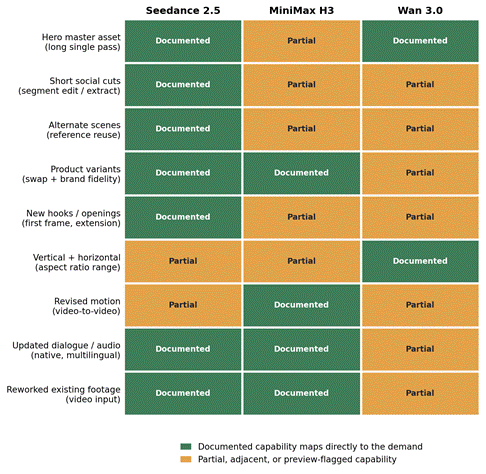
Figure 2. The O2M capability coverage map. Cells reflect documented capability only, not tested performance. Green indicates a documented capability that maps directly to the demand; amber indicates a partial, adjacent, or preview-flagged capability. Wan 3.0 cells carry Topview’s preview caveat except where independent public-beta reporting confirms the capability.
Reading the coverage map
Two patterns stand out in Figure 2, and neither should be read as a quality judgment.
The first is that Seedance 2.5 shows the widest documented coverage across the nine demands, driven by its combination of long single-pass generation, high reference capacity, explicit staging inputs, and region-level editing.
For a workflow whose defining problem is deriving many consistent assets from one concept, that breadth of documented control is the most relevant characteristic, independent of how the outputs actually look.
The second is that MiniMax H3 concentrates its documented strength on a specific cluster: product variants, revised motion, updated audio, and reworked footage. That cluster maps closely to editing and transforming existing material rather than generating long new stories.
It is consistent with H3’s reported standing as the leading model for video editing with audio on the Artificial Analysis arena, the one place in this comparison where an independent quality signal exists.
Wan 3.0 sits mostly in the amber band, not because its documented ambitions are narrow, but because most of its capabilities arrive with a preview caveat. Its two clearest strengths, long single-pass duration and the widest documented aspect-ratio range, are genuinely relevant to repurposing. Its most distinctive capability does not fit neatly into any of the nine demands, and is examined next.
Where the models diverge
Beyond the shared demands, three differences shape how each model would behave in a repurposing pipeline.
Duration
Figure 3 shows the maximum documented single-pass clip length for each model. Seedance 2.5 and Wan 3.0 both document thirty seconds in a single pass, while MiniMax H3 documents fifteen.
Seedance additionally lists a separate ultra-long beta mode reaching 180 seconds, which is a distinct mode rather than the standard ceiling. Longer single-pass generation matters for repurposing because it reduces the number of joins where lighting, identity, or camera logic can drift between clips. It does not, by itself, establish that any model produces a usable thirty-second result on the first attempt.
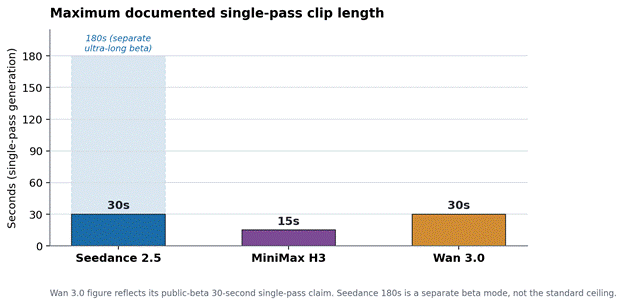
Figure 3. Maximum documented single-pass clip length. Wan 3.0 reflects its public-beta claim; Seedance’s 180-second figure is a separate beta mode.
Reference capacity
Figure 4 compares documented reference-input capacity. Seedance 2.5 documents the largest surface by a wide margin, up to fifty assets combining thirty images, ten video clips, and ten audio files.
MiniMax H3’s hosted configuration documents fifteen assets, nine images, three video clips, and three audio tracks. Wan 3.0 does not publish a quantified reference ceiling, so its bar is left unquantified.
Reference capacity is the single most relevant specification for the consistency problem at the heart of repurposing, because references are how a concept is held steady across derivatives. A larger documented surface means more identity, product, style, and motion anchors can be attached to one generation. Whether more references translate into more consistent output is a question of tested performance, not specification.
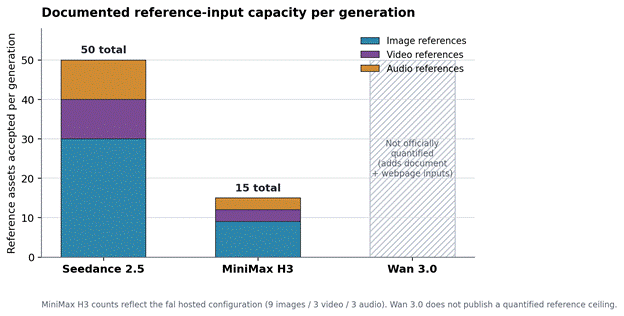
Figure 4. Documented reference-input capacity per generation. MiniMax H3 counts reflect the fal hosted configuration; Wan 3.0 publishes no quantified ceiling.
Distinctive inputs
Each model carries one input capability the others do not emphasize.
Seedance 2.5 pairs its fifty references with second-level timestamp direction and previsualization inputs, aimed at teams with substantial pre-production assets and multi-shot structure.
MiniMax H3 offers open weights, subject to territorial license limits, together with video-to-video motion transfer, aimed at teams that want to self-host or integrate the model and re-direct motion.
Wan 3.0 accepts office documents and web pages as direct source material, which reframes one flavor of repurposing entirely: a brief, a pitch deck, or a landing page can become the starting point for a video, rather than a prompt or a clip. For a team whose master concept originates as a document or a live web page, that is a distinctive on-ramp, held at preview status until confirmed in the live product.
Model capabilities versus Topview tools
A repurposing workflow assembled on Topview draws on two different layers, and separating them is essential for an accurate read.
The first layer is the model itself, the capabilities described above that would travel with the model to any provider that hosts it. The second layer is Topview’s own workflow tooling, built around the models but not part of them.
Topview’s Seedance material, for example, describes a 3D director console with white-model previsualization for blocking shots before generation, a conversational canvas for refining results through natural-language instructions, a feature for recreating formats from a shared link, and a clip-extension workflow. Topview’s own pages describe these as platform capabilities rather than model-exclusive features.
The distinction matters for repurposing because several of the moves in the O2M framework could, on Topview, be performed partly through platform tooling rather than the model. Conversational canvas editing, for instance, could support the segment-level adjustments behind short social cuts and new hooks, regardless of which underlying model is selected. A team evaluating these models should therefore separate two questions: what the model can do, and what the platform adds on top of it.
A workflow that depends on Topview’s conversational canvas or previsualization console would need equivalent tooling elsewhere if the same model were accessed through a different service or self-hosted.
Cost, access, and the limits of the evidence
Pricing and access differ sharply across the three models, and each figure below carries a caveat, consistent with the principle that capability is not efficiency.
Seedance 2.5. No single official per-second price has been published. Access runs through credit-based platforms including Topview and through ByteDance’s own products, with global rollout and official pricing still in progress. On output resolution, the sources conflict: Topview documents up to 1080p output, some third-party outlets cite native 4K, and at least one attributes the 4K figure to Seedance 2.0 rather than 2.5. Image references are documented up to 4K, which is a separate matter from output resolution.
MiniMax H3. MiniMax states a rate of roughly 0.8 yuan per second at 2K, about 12 yuan for a fifteen-second clip. Third-party trackers report about 0.13 US dollars per second at 2K, a figure described in that coverage as reported rather than primary. Open weights are available on Hugging Face, although the open base checkpoints are reported at lower resolution, the full 2K path uses a hosted component, and the community license excludes several territories from local deployment.
Wan 3.0. Independent coverage reports international pricing of roughly 0.05 to 0.20 US dollars per second across the 480p to 1080p tiers, with regional variation. The model is reported as closed and available through the interface and application programming interface only, without open weights at launch. General availability and regional access were still resolving during its public beta.
Figure 5 summarizes the evidence status behind these figures, and the pattern it shows is the most important caveat in this article.
MiniMax H3 is the only one of the three with open weights and an independent arena benchmark, which means its claims can be checked more thoroughly than the others.
Seedance 2.5 and Wan 3.0 both rest primarily on vendor materials and independent journalism, with no independent quality benchmark yet published for either, and with Wan 3.0 still in beta. None of the three has been tested firsthand for this article.
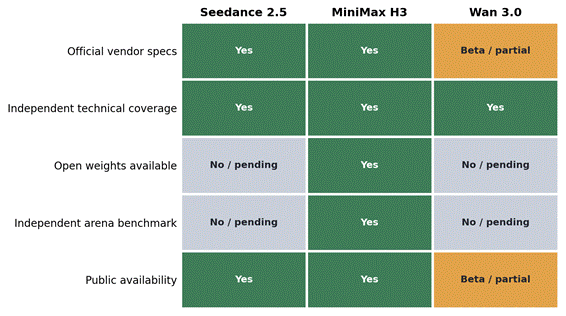
Figure 5. Documentation and verification status. MiniMax H3 is the only release here with both open weights and an independent arena benchmark; Seedance 2.5 and Wan 3.0 await independent quality benchmarks.
The pricing figures deserve particular caution. A lower reported per-second rate does not establish a lower real cost for a repurposing project. The true cost of deriving nine assets from one concept includes reference preparation, the number of generations attempted before a usable result, editing and cleanup rounds, and the review time each variant consumes.
None of those factors appears in a per-second rate, and none has been measured here. The per-second figures are useful for a rough comparison of listed prices, and for nothing more.
A practical read, bounded by the evidence
With those limits stated plainly, the documented capabilities still point toward different natural fits for different repurposing patterns. The following read is a reasoned interpretation of documentation, not a performance verdict.
For a pattern dominated by deriving many consistent assets from one long master concept, holding identity, product, and staging steady across a wide spread of derivatives, Seedance 2.5 carries the widest documented control surface: the longest standard single-pass duration, by far the largest reference capacity, explicit staging and previsualization inputs, and region-level editing. Whether that control produces consistent results in practice remains untested here.
For a pattern dominated by transforming and editing existing material, swapping products, re-directing motion, refreshing audio, and reworking prior footage, the documented cluster of MiniMax H3 aligns closely, and it is the only model in this comparison with an independent signal, its reported first-place standing for video editing with audio, that partly corroborates the alignment. Its fifteen-second ceiling makes it a weaker documented fit for long hero assets.
For a pattern where the source material is a document, a deck, or a live web page rather than a prompt or a clip, the document-to-video and webpage-to-video inputs of Wan 3.0 describe an on-ramp no rival matches, alongside a thirty-second single-pass claim and the widest documented aspect-ratio range for format adaptations. Its evidence status is the least settled of the three, and much of its Topview presentation is explicitly a preview.
What remains untested
Three gaps bound every conclusion above, and each is a direct consequence of the methodology.
Output quality is unmeasured. No firsthand generation was performed, and no independent quality benchmark yet exists for Seedance 2.5 or Wan 3.0. The documented capabilities describe what each model is built to do, not how well it does it.
Consistency under repurposing is unproven. The central promise of a one-to-many workflow, that a concept stays recognizable across many derivatives, is exactly the property that documentation cannot confirm. Reference capacity and single-pass duration make consistency more achievable in principle; only testing shows whether identity, lighting, and camera logic actually hold.
Real cost is unknown. The efficiency of a repurposing pipeline depends on retries, preparation, and cleanup, none of which appears in a specification or a per-second price. A model with impressive documented capabilities could still prove slower or costlier in practice, and a model with narrower documentation could prove more efficient. Documentation cannot settle it.
Conclusion
Judged purely on documented capability, the three models occupy distinct positions in a repurposing workflow rather than competing head-to-head on a single axis.
Seedance 2.5 documents the broadest control surface for deriving many consistent assets from one long concept.
MiniMax H3 documents the sharpest cluster for editing and transforming existing material, and is the only release here with open weights and an independent benchmark to check against.
Wan 3.0 documents a genuinely novel on-ramp from documents and web pages, alongside strong duration and format range, while carrying the least settled evidence and an explicit preview status on Topview.
For any team turning one creative idea into ten videos, the responsible next step is the one this article cannot take on their behalf: a firsthand test on the specific concept, the specific references, and the specific derivatives that matter to the campaign. Documentation narrows the field and clarifies the trade-offs. Only testing on the actual brief confirms which workflow is built for the repurposing that the team actually does.