
One Program, 282 Languages: Inside the Growing Directory of “Hello, World!”
The two words every programmer knows
Ask almost any software developer what the first program they ever wrote was, and the answer is usually the same. Two words, a comma and an exclamation mark, printed to a screen: “Hello, World!”
It is the smallest possible proof that everything works. The compiler is installed, the editor is saving files, the runtime can talk to the terminal, and the person at the keyboard has taken their first step into a new language. For decades it has been the unofficial handshake of computing, repeated in classrooms, textbooks, bootcamps and late-night side projects around the world.
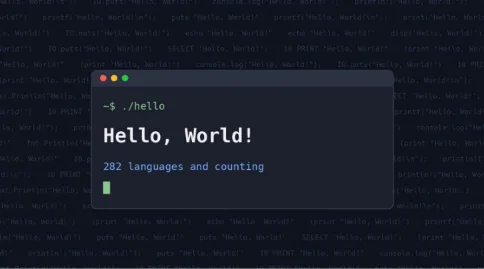
Now one website is trying to gather every version of that handshake in one place. The Helloworld Directory describes itself as an index of hello world programs, and it currently lists the same tiny program written in 282 programming languages, with more being added over time.
A short history of a very short program
The phrase did not appear out of nowhere. It is generally traced to Bell Labs in the early 1970s, where Brian Kernighan used a “hello, world” example in a tutorial for the B language. It became famous a few years later through The C Programming Language, the 1978 book by Kernighan and Dennis Ritchie that taught a generation how to code. The book’s opening example printed “hello, world” in lowercase, and it quickly became the template that almost every programming tutorial since has followed.
Part of the appeal is that the program says a lot without doing much. In some languages it is a single line. In others it needs a class, a main method, an import statement and a semicolon in exactly the right place. Looking at how a language handles those two words tells you something about its personality before you have learned anything else about it.
What the directory actually offers
The site’s homepage sets the tone immediately. Its background scrolls through snippets in dozens of languages at once, from Python’s print statement to an APL glyph, a SQL SELECT query and a Classical Chinese-inspired line from the esoteric language Wenyan. It is a neat visual reminder of how many ways there are to say the same thing.
Below that, the directory is organised so visitors can explore rather than just scroll. Languages are grouped into categories such as compiled and systems languages, JVM and .NET languages, scripting, functional and logic languages, shells, web and databases, markup, scientific computing, hardware and embedded, build and cloud tools, game engines and historic mainframe languages.
Each entry shows the program itself, the typical filename and a link to a longer page with more detail. Visitors can sort the list alphabetically, by category, by the oldest or newest languages, by recently updated entries, or by the shortest and longest code. There is a search box, a random language button, a side-by-side comparison feature, a timeline view and a map.
The breadth is the real draw. The list runs from mainstream choices such as C, Java, Python, JavaScript, Go and Rust to much rarer territory. COBOL and FORTRAN IV sit alongside Dartmouth BASIC. Hardware description languages such as Verilog and VHDL appear next to Arduino sketches and a MicroPython LED blink, which is the embedded world’s version of a first program. There are entries for Dockerfiles, Terraform and GitHub Actions, for game scripting languages such as GDScript, Luau and Minecraft commands, and for HolyC, the language of the one-person operating system TempleOS.
Why a list like this is more useful than it sounds
At first glance, a collection of nearly identical programs might look like a novelty. In practice, developers find several real uses for it.
The most obvious is comparison. Someone choosing between Go, Rust and Zig for a new project can see the basic structure of each at a glance: how a program starts, how libraries are imported, how output is printed. It is not a substitute for proper documentation, but it is a quick way to get a feel for a language’s syntax before reading further.
It also helps with setup. A hello world program is the simplest test that a new toolchain is installed correctly. When a developer is trying a language for the first time, having the canonical version and the expected filename on hand removes one small source of confusion.
Educators get something out of it too. Teachers introducing the idea that languages share common concepts can show students the same output produced by very different code. A one-line print statement next to a dozen lines of Java or an assembly listing makes the point about abstraction faster than any lecture slide.
And for anyone interested in computing history, the older entries are a small museum. Seeing how a program was written for a mainframe, a home computer running BASIC or an early structured language like Pascal or Modula-2 shows how much the craft has changed, and how much has stayed the same.
Part of a long tradition of programming curiosities
The directory joins a long line of community projects built around the same idea. Programmers have been collecting hello world examples in mailing lists, wiki pages and code repositories for decades, often as a kind of shared joke about how far some languages will go to print a single sentence.
What sets this project apart is its focus on presentation. Each program is laid out cleanly, the categories make it easy to browse by interest, and features like the timeline and comparison view turn a static list into something closer to a reference tool. It reads less like a dump of code and more like a curated catalogue.
Esoteric languages and the fun side of code
No collection of this kind would be complete without the strange stuff, and the site leans into it. The homepage itself name-checks Brainfuck and LOLCODE, two famous esoteric languages created more as jokes or experiments than as practical tools. In those languages, printing “Hello, World!” can be a puzzle in its own right, which is exactly why enthusiasts love them.
That playful streak matters. Programming culture has always had room for humour and curiosity, and a project that treats a two-word program with this much care is part of that tradition. It invites visitors to click around, discover a language they have never heard of and maybe try writing a line or two themselves.
Who should bookmark it
Beginners looking for a gentle first look at different languages will find it approachable. Experienced developers comparing syntax or setting up a new toolchain will find it practical. Teachers, technical writers and anyone who enjoys the history and oddities of computing will find plenty to explore.
With 282 languages listed and the counter still climbing, the directory is a reminder that even the simplest program has a surprisingly rich story behind it. For anyone who wants to see how the world’s programming languages say hello, the Helloworld Directory is a good place to start.
This article is for informational purposes only. It explores a growing directory of “Hello, World!” programs across 282 programming languages. The information is intended to provide general educational insights into programming languages and coding practices. Readers should verify technical details through reliable documentation before relying on them.