One Stitch at a Time: How a Trip to Jordan Reshaped Yara Alul’s Understanding of Craft, Dignity, and Heritage
When Yara Alul boarded her flight to Jordan, she expected spreadsheets, production schedules, and sample reviews. The UrbanPal founder had planned a practical field visit—one focused on logistics and timelines. What she did not anticipate was returning home changed.
In Jordan, Alul encountered a world rarely visible to consumers scrolling past embroidered gowns and ornate patterns online: the lives of the women whose hands keep Palestinian tatreez alive. Their stories—shared over coffee, fabric, and meals prepared in modest homes—revealed a deeper truth about craft, dignity, and the human cost of beauty.
She wandered through the balad, learning shortcuts, navigating unfamiliar streets, and spending long hours with seamstresses whose labor shapes UrbanPal in ways that often go unacknowledged. “I watched ideas become tangible,” Alul says. “But what stayed with me were the conversations—the ones that don’t fit neatly into a production plan.”
One seamstress told Alul how she and her mother-in-law worked with their team for over a month to create a single dress. When the garment sold, they received less than a tenth of its retail price. She spoke without drama, but the sense of disrespect lingered. Another designer she had worked with for years had once raised her voice at her. That moment, the woman said, crossed a line. “Dignity is non-negotiable,” she told Alul.
In Amman, Alul met a collective that employs twelve Palestinian refugee women. The group spoke openly about the desperation many of these women face—how urgently they need work, income, and a sense of purpose. One story in particular has stayed with Alul: a teenage boy running across a busy street without looking for cars because he was overjoyed to hear that meat was being delivered to his family. It was something they hadn’t eaten in months.
“These aren’t isolated stories,” Alul says. “They’re everyday realities.”
Many of the women she met spent decades raising families and caring for homes. Now, they want something that belongs to them—an income, a craft, a future they can shape. Tatreez has become their language of expression and survival. Through it, they translate heritage, emotion, and imagination into art. Their embroidery is painstaking, precise, and filled with meaning—work that carries stories only their hands can tell.
One afternoon, Alul visited Um Mahmoud in the Baqaa Refugee Camp. What was meant to be a brief stop turned into an elaborate meal of chicken, waraq enab, salad, juice, and coffee. Um Mahmoud refused to let her guest leave hungry. Her home was modest but filled with warmth built on resilience, faith, and generational knowledge.
Um Mahmoud learned embroidery from her late mother-in-law, who likely learned it from her own mother before her. As she unfolded her pieces, she also shared the realities of working with fashion houses that charged customers hundreds while paying her barely enough to survive. Yet she spoke without resentment. Pride, she insisted, mattered more.
Leaving Baqaa, Alul found herself thinking of women she didn’t meet on this trip but felt newly connected to—Wafa in the Yarmouk Refugee Camp in Syria, and another Um Mahmoud in Bethlehem.
Wafa’s presence was felt through messages and photographs. When asked to create holiday ornaments, she quietly requested advance payment—not from mistrust, but from experience. Her work had been taken before without compensation. Life in Yarmouk is harsh, and every stitch she makes is tied to survival. Still, her excitement never wavered. Each ornament carried hope alongside thread.
Her thoughts also returned to Um Mahmoud in Bethlehem. Recently widowed, she now supports her family alone while building a sustainable line with her team of seamstresses and tailors. Her work is intentional, resourceful, and deeply rooted in place. It is craftsmanship shaped by resistance and love.
Tatreez was once the embroidery of villagers—everyday work born in rural life. Today, it is celebrated globally and recognized by UNESCO as Intangible Cultural Heritage. But behind the recognition are women like Um Mahmoud, Wafa, Attaf’s team, and countless others who carry the tradition forward, often without visibility or credit.
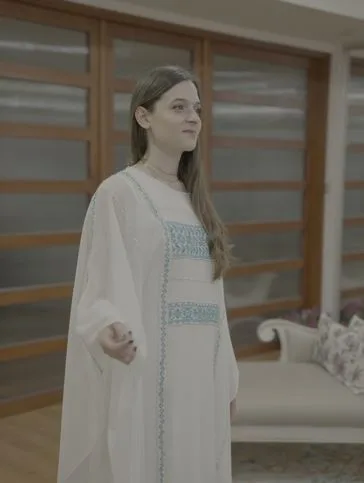
One UrbanPal gown took five months to complete, hand-embroidered by five women working in dignified conditions and paid fair wages. Alul believes these are the women consumers should be supporting—not mass-produced, machine-embroidered replicas that strip the craft of its meaning.
One seamstress explained it simply: “We dress in simple colors. We cover up. But tatreez brings beauty to everyday life. It transforms the ordinary. It turns our stories into something you can wear forever.”
For Yara Alul, the trip clarified something essential. UrbanPal is not just a fashion brand—it is a bridge. Between heritage and modern life. Between struggle and opportunity. Between women whose stories deserve to be seen and a world ready to wear them.
“When we grow,” she says, “we have to grow together.”