
Online Casino Market in New Zealand: Key Trends and Growth
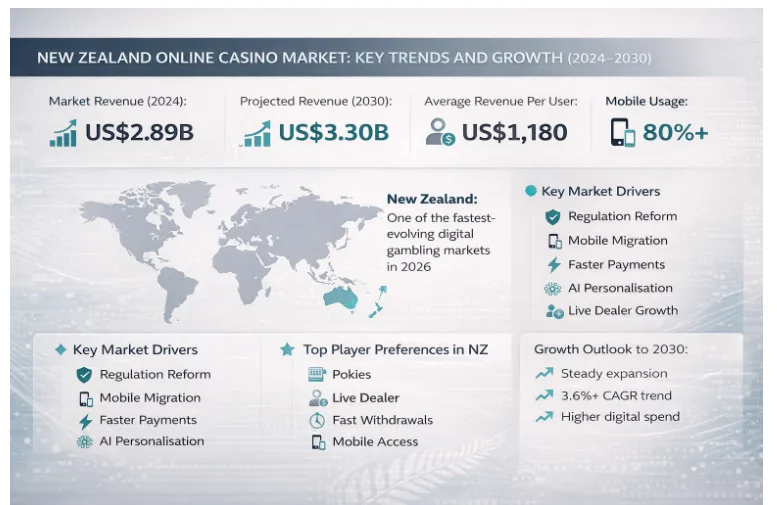
New Zealand’s online gambling market is one of the world’s most dynamic, showing a significant gambling industry growth with a revenue of US$2.89 billion in 2024. Current **market trends** suggest a steady climb to US$3.30 billion by 2030. New Zealand players’ average spending remains high, with revenue per user at US$1,180, placing the country at the centre of the global stage while highlighting its local features. Leading operators, such as King Billy casino, have already adapted to the evolving NZ online casino market standards by offering localized content and tailored bonus structures. The landscape in 2026 is defined by three pillars: regulatory clarity, migration to mobile, and high consumer expenditure.
Why the Online Gambling Industry is Growing Globally
The online gaming industry is growing globally, aided by internet infrastructure, regulatory changes, and shifting consumer trends. Market experts forecast that revenues will reach US$200 billion by 2030, representing a compounded annual growth rate of more than 10 per cent. The trend places the global gambling market at the centre of digital entertainment and financial systems. The liberalisation of regulations boosts growth. Europe leads with established structures, whereas North America shows the highest growth rate due to state-level legalisation in the U.S. and adoption of digital technologies in Canada. Asia-Pacific has strong momentum, fuelled by increasing internet connectivity and localised platforms. Local dynamics illustrate how growth in the online gambling industry aligns with trends in digital transformation.
New Tech and Better Phones
The development of mobile technology has accelerated the global online gambling growth. Smartphones offer high-resolution screens, fast processors, and secure biometric authentication to enhance usability and transaction safety. 5G networks enabled real-time, low-latency streaming, creating opportunities for interactive formats like live dealer sessions.
From Computers to Pockets
The online gambling industry is shifting from desktop to mobile platforms. Early adoption relied on individual computers and was limited to fixed locations with lower connectivity. With smartphones, portability became possible, allowing constant connectivity regardless of geography. More powerful mobile processors, secure authentication, and application ecosystems enabled smooth integration between devices and platforms.
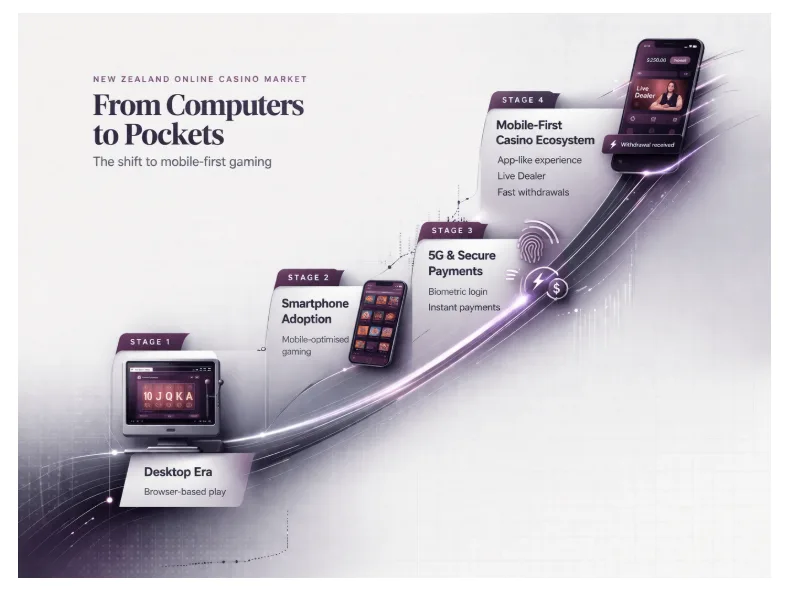
The change increased participation in areas where mobile ownership exceeded desktop ownership. In conjunction with 5G networks, mobile-first approaches transformed interactions, making handheld devices a new entry point to digital gambling and cementing the industry’s global expansion.
Why Online Casinos Are Overtaking Local Venues
Online migration is enhanced by regulatory reform. European and North American jurisdictions have licensing structures that provide legal certainty and fiscal advantages. The example of Canada going online and U.S. state-level legalisation demonstrates that policy spurred the development of the online gambling industry. Asia-Pacific has strong momentum, backed by increased internet connectivity and regional platforms. New circumstances reshape consumer behaviour, making them less dependent on physical locations. The shift is consolidated by product innovation. Integration of blockchain, live-streaming formats, and AI-based personalisation of offerings increases variety, capturing a wider demographic range. Operators use sophisticated analytics to optimise retention and revenue by refining engagement strategies. Increased efficiency in industry operations through industry consolidation via mergers strengthens competitive positions in the international gambling market. The local venues are struggling with declining attendance as consumers prioritise convenience, speed, and digital integration. Online hosts offer customised services, fast withdrawals, and user-tailored content that aligns with current consumption trends. Analysts estimate that the online casino market size will surpass US$212 billion by 2030, driven by technological change and regulatory shifts.
24/7 Access and More Games
The gambling environment in New Zealand is changing, as online casinos provide 24-hour access and a wider range of games than land-based casinos. Platforms operate 24/7, geographic boundaries disappear, and platforms follow mobile-first consumption trends. Smartphones enable immediate engagement, while digital payment systems (e-wallets, instant transfers, and crypto solutions) simplify transactions, reducing obstacles and increasing activity. Online platforms offer a range of content, from conventional table formats to advanced live-streaming features. Blockchain and AI-based personalisation help increase engagement by providing personalised services that are not possible in brick-and-mortar venues. A breadth of selection enhances retention and broadens the demographic reach.
Gaming industry data illuminate how convenience translates into quantifiable dominance. Analysts observe that the online casino market share continues to rise as consumers emphasise availability, speed, and scalable content. Regulatory frameworks in Europe, North America, and the Asia-Pacific region are driving up adoption, and players in New Zealand are shifting to mobile platforms that allow faster withdrawals and more transparent compliance. Essentially, the convenience aspect, 24/7 access, variety of content, and easy payments make online casinos a better choice for Kiwis. A comparative advantage will guarantee continued growth and establish digital platforms as the most competitive segment of New Zealand’s developing gambling economy.
Better Value for Money
International casinos in New Zealand offer incredible promotional benefits because their operational expenses are lower than those of land casinos. Physical facilities need staff and premises. Online platforms do not incur such costs, and resources can be channelled into customer acquisition and retention. Lower infrastructure investments convert to bigger bonuses. Operators reinvest savings into deposit matches, free spins, and loyalty points, delivering quantifiable financial benefits to consumers. Effectiveness enhances competitiveness and fast-tracks uptake on mobile platforms. Industry data indicate that the casino market size will exceed US$212 billion by 2030, with the online segment capturing a larger share of overall revenue. Lower cost structures impact growth, as digital operators maintain higher margins and deliver greater value.
How the New Zealand Casino Market is Developing
The gambling industry in New Zealand is undergoing structural change in 2026, driven by regulation, mobile accessibility, and consumers’ shift to digital platforms. Government officials are developing a licensing system to capture offshore gambling revenue, enhance consumer protection, and implement harm-reduction measures. This reform is a turning point, shifting from uncontrolled offshore hegemony to transparency, as highlighted in recent reports on New Zealand’s online casino market regulation. Revenue growth reflects the transformation magnitude. According to projections by market analysts, gambling turnover would exceed US$2.89 billion by 2025, and the compound annual growth rate would exceed 3.6 per cent until 2029. The average revenue per user was US$1,180, indicating Kiwis’ high spending power. Statistics make New Zealand a global leader in the region’s gambling economy. Adoption is faster through mobile integration. Land-based outlets experience a drop in attendance as consumers prioritise convenience, quick withdrawals, and customised services. Online gambling market analysis shows that the online casino market continues to grow, underscoring the need for a scalable platform with diverse gaming offerings and instant access.
What Kiwi Players Want
Participation is affected by brand recognition. Licensed offshore operators generate massive traffic, but local platforms are gaining momentum due to transparency in compliance and local services. The current landscape shows how online casino brands compete for visibility through superior user experience and tailored loyalty programs. Analysts claim that the online gambling market share is increasing in New Zealand as a result of accessing a variety of content, quick withdrawals, and controlled settings. Market statistics show increased activity among younger generations, supported by smartphone use and digital payment methods. Old brands do not fade, yet newcomers that provide blockchain connection and AI-powered customisation capture larger market shares.
Faster Payments and Trust
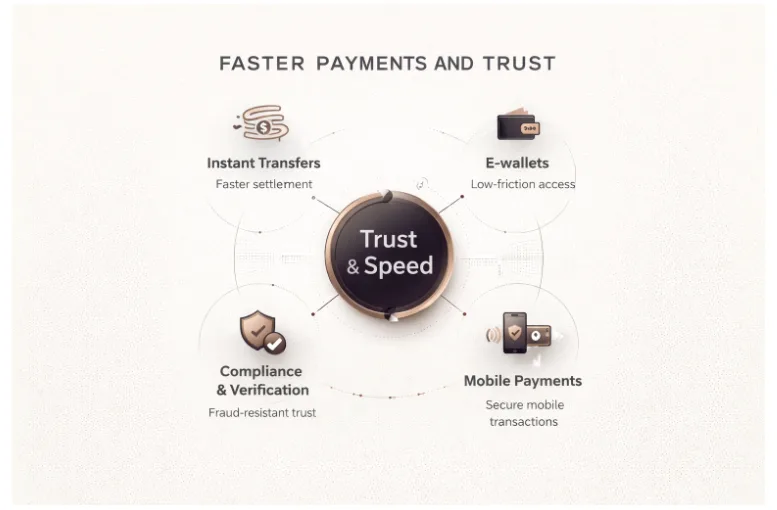
The gambling industry in New Zealand benefits from a well-developed local payment infrastructure, with speed and transparency as primary concerns. Local banks and fintech providers are offering instant transfer systems, reducing settlement delays that have historically undermined consumer trust. E-wallets and built-in mobile payment solutions make transactions easier, ensuring deposits and withdrawals occur smoothly.
Compliance is used to enforce trust. Operators are obliged to comply with strict anti-money laundering measures and identity verification rules, which provide safe conditions for financial operations. Regulatory oversight helps keep payment systems resistant to fraud, and consumers feel assured that they can get money without issues.
International Brands in NZ
International casino brands are focusing on New Zealand due to measurable growth indicators and a favourable regulatory environment. According to recent casino industry statistics, revenue growth in land-based and online sectors is steady, indicating sustainable demand. Multinational operators view the offshore trend as a sign of a strong market and invest capital in localised platforms. A transparent licensing regime in New Zealand offers compliance avenues that ensure predictability, minimise operational risk, and enhance investment confidence. The digital infrastructure benefits from high broadband penetration, which has enabled the smooth implementation of online platforms and further increased market accessibility. The geographic location streamlines New Zealand’s role as a gateway to the Asia-Pacific economies, maximising its strategic positioning for global operators seeking to diversify into the region.
Quick Comparison: NZ Casino Market vs. The World
New Zealand exhibits stronger momentum than the global online gambling market, with growth outpacing the global rate. Mobile adoption rates above 80 per cent place New Zealand among the largest gambling markets in the world.
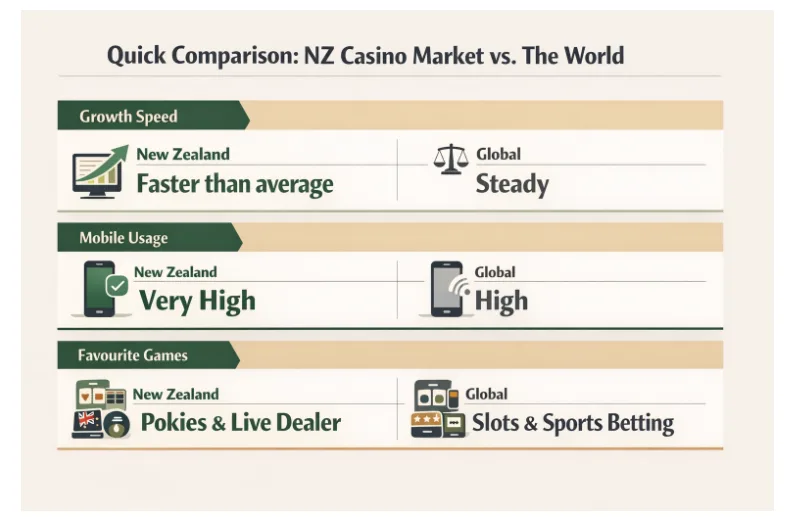
Statistics from the casino industry show that the local population’s preferences for pokies and live dealers differ from global preferences, in which slots and sports betting prevail. Such a difference, coupled with rapid growth and advanced digital infrastructure, increases the size of New Zealand’s online gambling market, positioning it as one of the leading markets in 2026.
| Feature | New Zealand Market (2026) | Global Average |
| Growth Speed | Faster than average | Steady |
| Mobile Usage | Very High | High |
| Favourite Games | Pokies & Live Dealer | Slots & Sports Betting |
Key Trends: What is New in the Online Casino Industry
Statistics in 2026 show a high rate of transformation in the online betting market. Multi-angle streaming live dealer formats now have augmented overlays and form broadcast-level sessions. Mobile-first architecture is the leading approach, with lightweight applications tuned to 5G networks, biometric access, and adaptive layouts. Industry experts highlight specific tech trends in iGaming for 2026, such as AI-driven personalization and sub-millisecond latency for fast withdrawals. Loyalty systems transform into gamified systems that include missions, badges, and dynamic rewards to sustain interest. The verticals of casino, sportsbook and e-sports merge in cross-platform wallets, which are backed by blockchain ledgers that enable transparent settlements. Such innovations put New Zealand among the largest gambling markets in the world, which strengthens its position in the global online gambling market.
Better Ads and Promotions
Industry statistics indicate that online casino advertising in 2026 will focus on accuracy, accountability, and innovation. Behavioural analytics splits audiences using artificial intelligence and substitutes general demographic targeting. Promotions become gamified, with missions, badges, and dynamic rewards that keep engagement high. Influencer partnerships increase coverage in mobile-first ecosystems, where activity is more than 80 per cent. AR advertisements preview live dealer experiences or loyalty programs, and provide portals of interaction. Blockchain-supported promotions ensure verifiable fairness, enhancing consumer trust. New approaches transform advertising in the online betting market, a competitive, consumer-centred sector of the global gambling industry.
New Ways to Bet
Online gambling industry statistics 2026 show that diversification by digital forms is a major highlight. Hybrid ecosystems combine casino, sportsbook, and e-sports, backed by blockchain wallets that enable transparent settlements. Skill-based modules extend beyond slot-based game systems to include competitive puzzle and interactive strategy games. Virtual reality simulates venues, while real-time data streams are delivered via augmented overlays. There is a preponderance of mobile-first platforms that are optimised to operate over 5G networks and to support biometric authentication. AI-driven personalisation uses behavioural analytics to deliver tailored incentives. Innovations hasten growth, making New Zealand one of the biggest gambling economies globally.
Competition and the Future of Gambling in NZ
The gambling industry in New Zealand has seen surging competition driven by offshore dominance, regulatory reform, and digital innovation. Revenue projections indicate that the figure will reach US$2.89 billion in 2025, with a 3.65 per cent CAGR (2025–2029). NZ operators have to update their infrastructure, implement mobile-first systems, and use blockchain-based security. Traditional venues will transform into entertainment centres, and the internet will drive up esports betting. Regulation will become stricter, focusing on new tax requirements for NZ iGaming and responsible gaming. The global casino market requires compliance, technological adaptation, and diversification of the ecosystem. Small firms could merge with international players, becoming more active market participants as the online gambling market share continues to shift toward digital platforms.
Greater Innovation for Players
The diversification of features is progressing very fast. Esports betting, interactive experiences, and AI-based personalisation are becoming a competitive point of difference, and conventional venues are transforming into multi-purpose entertainment centres. Regulatory reform will introduce responsible play standards and encourage technological advancements. An increased speed of payment and diversification of functions are now structural requirements that will guarantee competitiveness in the short and long term in a changing market.
The Market in 2027
The gambling industry in New Zealand will experience consistent growth through 2027 due to regulatory changes and increased competition. Market revenue is estimated at US$3.4 billion, with a 3.6 per cent CAGR (2025–2029). The average revenue per user is expected to exceed US$1,250 due to greater adoption of digital platforms and faster transaction systems. Consolidation among smaller companies will occur as international entrants exert pressure. Casino industry growth is surging, driven by compliance and technological innovation. The adoption of mobile integration and digital payments is increasing among younger demographics, while established audiences continue to use older formats. Analysts point to the growth of online gambling as an emerging trend shaping revenue sources, investment patterns, and policy discussions across New Zealand’s digital marketplace.