
Ontario Dynamics Bridges The Gap Between Concept Design And Production-Ready Innovation For Modern Engineering Projects
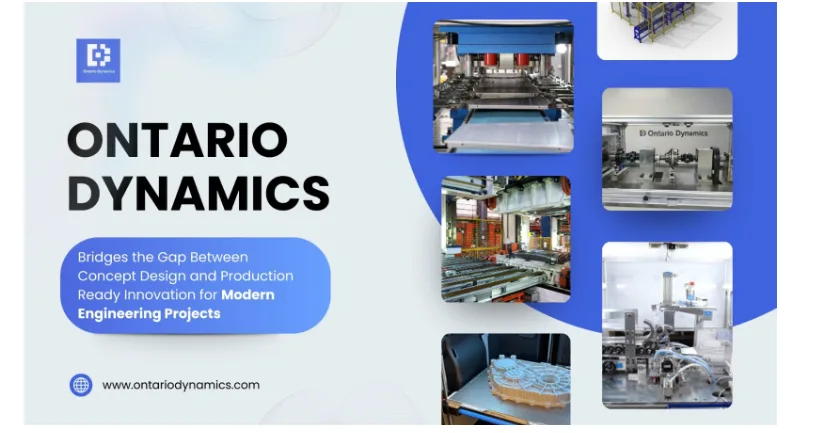
TORONTO, ONTARIO, March 8, 2026, Engineering teams today are under pressure to move faster without taking shortcuts. A good concept is not enough. A promising prototype is not enough. What matters is whether a design can be built, validated, maintained, and scaled on a real production floor.
Ontario Dynamics, a Toronto-based engineering services company, is positioning its work around that exact gap: helping manufacturers, OEMs, and product-focused startups move from early concept work to production-ready systems with the documentation, validation, and practical design decisions needed to reduce risk.
The company’s core capabilities span three connected areas: testing and validation equipment, product development and design, and special-purpose machines and automation, all built to support engineering teams that need designs that work in real conditions, not only on-screen.
The Real Problem: The Space Between “It Works” And “It’s Ready”
Most engineering delays do not happen because teams lack ideas. They happen because the transition from idea to execution is messy.
A design can look clean in CAD but fail during integration. A prototype can perform well in a controlled demo but break down under repeated cycles, vibration, or real-world use by operators. A machine can be built and still become a long-term headache if spare parts are hard to source, documentation is incomplete, or maintenance access was never considered.
Ontario Dynamics hears many of the same frustrations from clients: late deliveries, vague communication, difficult integration, and designs that do not scale. The company’s approach focuses on removing those bottlenecks by treating manufacturability, validation, and serviceability as first-class requirements, not afterthoughts.
A “Concept-To-Commissioned” Mindset, Not A Handoff
Ontario Dynamics supports work from early concept sketches and proof-of-concept builds through MVP development and production-ready documentation.
Instead of treating development as separate silos, the team leans on a phase-gated process that reduces the cost of late changes by pushing key decisions earlier, when they are cheaper to fix. Their product design support process explicitly moves through:
- Proof of Concept (PoC) to validate feasibility early
- Prototype design and build with iterative testing feedback
- Minimum Viable Product (MVP) built with manufacturing in mind
- Production-ready design with manufacturing specifications and documentation
This matters because the most expensive engineering changes are usually the ones discovered late. After tooling assumptions are locked in, supplier quotes are based on the wrong geometry, or a build reveals that a service access panel was never designed.
Ontario Dynamics also highlights the importance of carrying knowledge forward between phases through clear documentation of design decisions and lessons learned, so development does not rely on “tribal knowledge” inside one person’s head.
Engineering That Stays Grounded In Real Validation
A major reason concepts stall is uncertainty: teams are not sure what should be tested, how it should be tested, or what equipment is required to test it.
Ontario Dynamics positions itself not only as a builder of test equipment, but also as a partner that can help define testing needs from the ground up, drafting specifications and recommending the right approach when the path is unclear.
Its testing and validation work spans fatigue testing, durability lifecycle testing, performance testing, NVH systems, and integrated data acquisition.
On the testing side, Ontario Dynamics describes a wide range of custom rigs and benches, including examples across fatigue and endurance validation, such as seat frame fatigue testing, torsional fatigue testing for shafts, and multi-axis platforms that can apply combined loading for deeper life assessment.
The goal of this kind of equipment is not just “passing a test.” It is creating the proof needed to make a confident manufacturing decision, especially in industries like automotive and industrial equipment, where failures are expensive, and reputations are fragile.
Data Acquisition And Instrumentation Built Into The System
Modern validation is not only mechanical. It is also data.
Ontario Dynamics emphasizes integrated data acquisition and instrumentation as a core part of its custom test rigs, using platforms ranging from microcontroller-based loggers for cost-sensitive setups to professional DAQ hardware for high-sampling-rate systems and deeper analysis.
The company references working with established DAQ and instrumentation providers and integrating appropriate sensors, such as torque transducers, load cells, pressure sensors, LVDTs, microphones, and accelerometers, based on what the test is actually trying to prove.
In practice, this approach addresses a common need in engineering teams: the ability to measure what is happening in real time, diagnose failure modes early, and generate test results for decision-making, reporting, and future design improvement.
Special-Purpose Machines That Fit The Line, Not Fight It
On the automation side, Ontario Dynamics builds special-purpose machines (SPMs) and line integration solutions tailored to automotive, EV, and industrial manufacturing, designed to improve throughput, quality, and flexibility without creating maintenance nightmares.
The company’s SPM and automation approach is centered around:
- Inspection and quality assurance machines, including vision-based defect detection and presence/absence verification
- Custom assembly and line integration solutions, including conveyors, transfer cells, rotary indexing, and pick-and-place systems
- Press line automation and material handling, including destacker feeders, transfer systems, and post-press handling solutions
- Ergonomics, safety, and regulatory compliance, including the use of guarding, interlocks, and safety features aligned with standards
A key point is integration. Many production lines involve equipment from multiple suppliers. Ontario Dynamics describes solving handoff and flow problems by creating transfer cells, conveyors, and coordinated material handling, so the line runs as a system rather than isolated islands.
They also stress documentation and alignment early, using 3D models and assembly drawings for cross-team review so production, maintenance, and safety teams can give input before fabrication begins.
A Practical Example: Automated Bearing Noise Detection And Vibration Analysis
One recent project highlights how Ontario Dynamics connects engineering theory with production reality: an automated, high-throughput inspection machine built for mass production of automotive tensioner pulleys, designed to provide 100% inline inspection using vibration pattern recognition.
According to the project overview, the key challenge was isolating bearing noise signals from motor noise, avoiding false failures while still catching real defects. The solution included a contactless magnetic coupling to transmit torque while blocking high-frequency vibration interference, along with a layered control and DAQ architecture using NI DAQ, an industrial PC, and Siemens HMI/PLC elements.
This is a good example of the “gap” many teams face: it is not enough to detect vibration; the machine must detect it reliably in a noisy factory environment, under high-volume requirements, with automated load/unload sequences and repeatable results.
Documentation That Supports The Whole Lifecycle
A major marker of “production-ready” is whether the design can be manufactured, installed, supported, and maintained without guessing.
Ontario Dynamics repeatedly references delivering documentation packages that include 3D models, 2D drawings, bills of materials, and supporting documents so teams can install and maintain equipment with confidence.
For product development work, the company also lists documentation deliverables such as DVPR, DFMEA, and BOMs, materials that become critical when a product moves into controlled production environments and supplier-driven builds.
Designed For Manufacturing, Service, And Long-Term Support
Ontario Dynamics’ messaging leans heavily into a practical engineering philosophy: “simple is sustainable,” focusing on reducing component count, improving manufacturability, and making systems easier to service from the first iteration.
That philosophy also shows up in component choices and partner networks. For example, the company describes using proven industrial components and accommodating customer standards, so a delivered system fits into the customer’s plant ecosystem rather than forcing new tooling and training without reason.
About Ontario Dynamics
Ontario Dynamics is a Toronto-based engineering services company specializing in mechanical product development services, custom testing and validation equipment, and special-purpose machines and automation systems. The company supports manufacturers, OEMs, and startups with end-to-end engineering, helping teams move from concept and prototyping through MVP development and production-ready execution, backed by practical design for manufacturability, validation-focused thinking, and complete documentation.
Availability And Contact
Ontario Dynamics is based in Toronto, Ontario, Canada, and supports engineering projects involving product development, testing, and validation equipment, and special-purpose automation systems.
Media / Inquiries:
Ontario Dynamics
801 York Mills Rd, Unit 200, Toronto, ON, M3B 1X7, Canada
Phone: +1 647-615-6057
Email: [email protected]