Pakistan’s Internet Users Cross 117 Million, Reshaping How Businesses Reach Customers
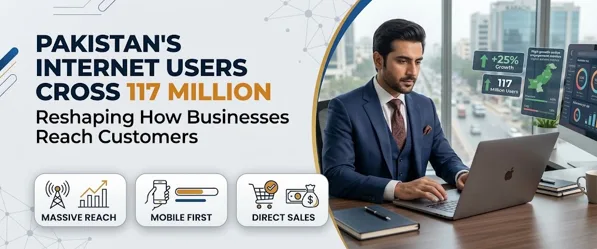
Pakistan has 117 million internet users, according to DataReportal’s Digital 2026 Pakistan report, which draws on data available in October 2025. That is 45.6% of a population of about 256 million, and it means a growing share of buying decisions start on a phone screen rather than in a market or over a phone call. For businesses, the figure raises a practical question: when those 117 million people search, who do they find?
What the numbers show
The Datar portal figures, based on the latest data available in October 2025, give a clear picture of who is online and how:
- 117 million internet users, or 45.6% of the population
- 9 million social media user identities, equal to 31.2% of the population
- 194 million active cellular mobile connections
- A median age of 20.6 years
The report puts the annual increase at 1.5 million users, or 1.3%, between October 2024 and October 2025. With more than half the population still outside that count, there is considerable room for the online audience to grow.
Official telecom data measures something different. Pakistan Telecommunication Authority (PTA) figures compiled by CEIC show 163.9 million broadband subscriptions in June 2026, of which 159.5 million are mobile broadband. This number is higher than the user count because it counts subscriptions rather than individual people, so one person can hold more than one connection.
A young audience
The median age in Pakistan is 20.6 years, according to the same report. A large part of the online audience grew up with smartphones and treats search, maps and messaging apps as the normal way to find a shop, a service or a price. That audience will make up a growing share of customers over the next decade, which gives businesses a long-term reason to be easy to find online, not just a short-term one.
Why mobile decides how customers find businesses
Almost all of this access runs on mobile networks. Fibre-to-the-home connections stand at around 2.9 million, a small fraction of total broadband subscriptions. For most internet users in Pakistan, being online means using a smartphone on a 4G connection.
That shapes how people look for businesses. Searches on a phone tend to be short, and many users type in Roman Urdu or a mix of Urdu and English. Customers can compare options, check a map listing and open a WhatsApp chat in a single session. A business whose site loads slowly or hides its prices and location gives that customer a reason to move to the next result.
5G is adding to this. Pakistan held its 5G spectrum auction in March 2026, and Jazz and Zong launched commercial services about a week later. Jazz began with around 180 sites across Islamabad, the four provincial capitals and cities including Rawalpindi, Multan and Faisalabad, while Zong went live in more than 16 cities. Coverage remains limited to major urban areas for now, but faster connections tend to bring more video, more voice search and more research before buying.
Social media reach is not the same as search visibility
With nearly 80 million social media identities in the country, many small businesses build their presence on Facebook, Instagram and WhatsApp. Those platforms work well for keeping existing customers engaged. They tend to be less effective at reaching someone who has never heard of the business and simply types a need into Google, such as a clinic near them or a supplier for a specific product.
The gaps that keep businesses out of search results are usually basic:
- No website, or a site that has not been updated in years
- Unclaimed or incomplete Google Business Profile listings with outdated timings or phone numbers
- Pages that leave out prices, delivery areas or other details customers search for
- Sites built for desktop that load slowly on mobile data
These are rarely expensive problems. They tend to persist because online presence is treated as a one-time setup rather than something that needs regular attention.
Search is changing at the same time
Google’s AI Overviews, which summarise answers at the top of the results page, expanded to more than 200 countries and territories in May 2025, with Urdu added among the supported languages. For businesses, visibility now depends on more than ranking. The information on a page also has to be clear and consistent enough for an AI summary to pick up and repeat accurately.
As a result, the work involved in SEO in Pakistan now goes beyond rankings. Businesses also need to think about map listings, AI-generated answers and voice queries. The basics still do most of the work: accurate business details, pages that answer specific questions directly, and a site that runs smoothly on a mid-range phone.
How businesses can respond
A business owner does not need a large budget to see where they stand. A few checks reveal most of the gaps:
- Search for the business name and main service on a phone using mobile data, and note what appears.
- Claim and complete the Google Business Profile, including category, timings, photos and a working phone number.
- Test whether the website loads quickly on 4G and reads properly on a small screen.
- Add plain answers to common customer questions, such as price ranges, delivery areas and working hours.
- Keep the business name, address and phone number identical across Google, social media, directories and the website.
A wider economic shift
The change is not limited to domestic customers. The Pakistan Economic Survey 2025-26 reported that ICT export remittances rose 19.7% to $3.38 billion during July to March of FY2026. The Federation of Pakistan Chambers of Commerce and Industry has named digital marketing, alongside software, fintech and business process outsourcing, among the sectors with export potential.
With 117 million people already online and 5G coverage expanding, more of the customer base will keep moving to screens. The businesses that benefit will be the ones people can find when they search.