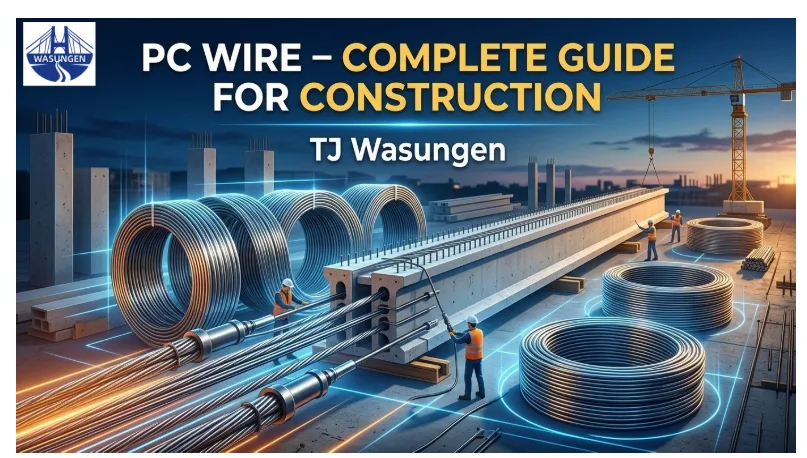
PC Wire – Complete Guide for Construction | TJ Wasungen
In the world of modern construction, PC wire (prestressed concrete wire) stands out as a powerhouse material for creating durable, high-strength structures. Whether you’re building bridges, high-rise buildings, or heavy-duty foundations, understanding PC wire is essential for engineers, contractors, and procurement specialists in the supply chain.
As a leading supplier at TJ Wasungen, we specialize in premium prestressing wire sourced from top manufacturers, ensuring your projects meet international standards.
This complete guide dives into everything you need to know about PC wire—from its definition and benefits to key comparisons, specifications, and why TJ Wasungen delivers the best PC wire for your needs. Let’s explore how this critical component drives efficiency and longevity in construction.
What is PC Wire?
PC wire, short for prestressed concrete wire, is a high-carbon steel wire designed specifically for prestressing concrete structures. Produced through a process of drawing high-strength steel rods into thin, tensile wires, PC wire is typically 4-12 mm in diameter and features a smooth or indented surface for optimal bonding with concrete.
Unlike regular steel rebar, PC wire is pre-tensioned before concrete pouring. This prestressing technique compresses the concrete, counteracting tensile stresses that occur under load. The result? Structures that resist cracking, deflection, and failure far better than conventional reinforced concrete.
PC wire applications span a wide range of projects:
- Bridges and flyovers, where high tensile strength handles dynamic loads.
- High-rise buildings and parking structures for floor slabs and beams.
- Railway sleepers, silos, and water tanks for corrosion-resistant durability.
- Nuclear power plants and dams, demanding ultra-high performance.
At TJ Wasungen, our prestressing wire undergoes rigorous cold-drawing and stress-relieving processes, achieving tensile strengths up to 1860 MPa. This makes it indispensable in seismic zones or heavy industrial settings, aligning perfectly with global standards like ASTM A421 and BS 5896.
In essence, PC wire transforms vulnerable concrete into a resilient powerhouse, enabling slimmer designs, longer spans, and reduced material costs—key advantages for cost-conscious B2B buyers in construction supply chains.
Benefits of PC Wire in Construction
Why opt for PC wire over traditional reinforcement? Its benefits are transformative, delivering measurable ROI in strength, efficiency, and sustainability.
First, superior tensile strength sets PC wire apart. With yield strengths ranging from 1470-1770 MPa, it boasts 5-10 times the capacity of mild steel, allowing thinner sections and lighter overall structures. This reduces deadweight by up to 30%, cutting foundation costs and transportation expenses—critical for large-scale infrastructure projects worldwide.
Second, PC wire applications excel in crack control. Prestressing induces initial compression, minimizing shrinkage cracks and improving water-tightness. In humid or coastal environments, this extends service life by 50+ years, slashing maintenance budgets.
Third, enhanced durability shines in harsh conditions. Galvanized or epoxy-coated variants resist corrosion, ideal for marine bridges or coastal structures. Studies from the American Concrete Institute show prestressed elements with PC wire endure 2-3 times longer under cyclic loading than non-prestressed ones.
Economically, PC wire optimizes material use. Projects save 20-40% on concrete and steel volume, speeding construction timelines. Environmentally, lower material needs mean reduced carbon footprints—a boon for sustainable B2B manufacturing.
Finally, versatility across PC wire applications includes precast elements, post-tensioned slabs, and rock anchors. For heavy machinery foundations or telecom antenna bases, PC wire ensures stability under vibration and wind loads.
In short, integrating prestressing wire boosts project performance, from safety to savings, making it a smart choice for forward-thinking constructors.
PC Wire vs PC Strand: Key Differences
A common question in procurement: PC wire vs PC strand—which is right for your project? Both are prestressing steels, but their structures and uses differ significantly.
PC wire is a single, solid wire (4-15 mm diameter), drawn from high-carbon steel billets. It’s flexible for single-wire stressing and excels in smaller sections like sleepers or poles. Smooth, spiral-ribbed, or indented finishes enhance grip.
PC strand, by contrast, comprises 7 twisted wires (one central with six outer), typically 9.5-15.2 mm overall. This multi-wire design offers higher flexibility for long tendons in post-tensioning, common in bridges and slabs. Strands achieve similar strengths (up to 1860 MPa) but with better fatigue resistance due to the helical twist.
Here’s a quick comparison:
| Feature | PC Wire | PC Strand |
| Composition | Single wire | 7 twisted wires |
| Diameter Range | 4-12 mm | 9.5-15.2 mm |
| Best For | Sleepers, poles, anchors | Beams, slabs, long spans |
| Flexibility | Moderate | High (for curving ducts) |
| Cost per Strength | Lower for short spans | Economical for large projects |
| Fatigue Performance | Good | Excellent |
Choose PC wire for compact, high-precision applications where individual tensioning matters, like precast factory production. Opt for strand in field-cast post-tensioning needing elongation over distance.
PC wire vs PC strand boils down to project scale: TJ Wasungen supplies both, recommending PC wire as the best PC wire for cost-effective, versatile prestressing in mid-sized infrastructure.
Specifications and Grades of PC Wire
Selecting the right PC wire hinges on specs and grades matching your project’s demands. Key parameters include:
- Tensile Strength: Graded as 1470 MPa (Grade 186), 1570 MPa (Grade 196), 1670 MPa (Grade 206), or 1770 MPa (Grade 216), per ISO 6934-2. Higher grades suit extreme loads.
- Diameter: 4.0-12.7 mm standard; custom sizes available.
- Surface: Plain (for unbonded), indented (bonded grip), or galvanized (corrosion protection).
- Relaxation: Low-relaxation types (<2.5% after 1000 hours at 70% load) for long-term stability.
- Standards: ASTM A421/A1060, EN 10138, AS/NZS 4672—ensuring compliance for exports.
TJ Wasungen’s prestressing wire meets these with certifications like ISO 9001. For example, our 7 mm Grade 186 PC wire offers 980 kN breaking load, perfect for railway sleepers.
Coatings like copper, wax, or PE sheathing prevent corrosion during storage. Elongation (min 4%) ensures ductility, while uniform diameter (±0.07 mm tolerance) guarantees precise stressing.
Technical Specifications & Standards
Our PC wire products meet common international prestressing requirements.
Typical specifications:
- Diameter: commonly 5mm
- Structure: single high-strength steel wire
- Surface: plain, indented, galvanized, or helical
- Tensile strength: as per application
- Coil form: export-grade coils
Supported standards:
- ASTM standards for prestressing wire
- EN standards for concrete reinforcement
- GB/T specifications
Mill test reports are available with each shipment.
Delivery Countries We Serve (Africa)
We export pc wire to a wide range of African countries with established logistics routes.
Africa:
Algeria, Angola, Benin, Botswana, Burkina Faso, Burundi, Cabo Verde, Cameroon, Central African Republic, Chad, Comoros, DR Congo, Republic of the Congo, Djibouti, Egypt, Equatorial Guinea, Eritrea, Eswatini, Ethiopia, Gabon, Gambia, Ghana, Guinea, Guinea-Bissau, Kenya, Lesotho, Liberia, Libya, Madagascar, Malawi, Mali, Mauritania, Mauritius, Morocco, Mozambique, Namibia, Niger, Nigeria, Rwanda, São Tomé and Príncipe, Senegal, Seychelles, Sierra Leone, Somalia, South Africa, South Sudan, Sudan, Tanzania, Togo, Tunisia, Uganda, Zambia, Zimbabwe, Western Sahara.
If your country isn’t listed, ask us. We handle custom routes.
Why Choose TJ Wasungen PC Wire
In a crowded market, TJ Wasungen stands as your trusted partner for the best PC wire. Sourcing from verified manufacturers, we deliver ASTM-compliant prestressing wire with full traceability—batch tests for tensile, torsion, and relaxation included.
Our competitive edge:
- Bulk pricing for B2B orders (500 tons/month capacity).
- Custom grades and coatings for telecom anchors or excavator base prestressing.
- Swift global logistics, with FOB/CIF terms.
- Proven track record: Supplied 10,000+ tons for bridges and 5G sites worldwide.
Clients rave about our quality—zero rejections in recent audits—and responsive support for SEO-optimized product specs. Why settle for generic when TJ Wasungen offers the best PC wire tailored to your supply chain?
Request a Quote
PC wire revolutionizes construction with unmatched strength, efficiency, and versatility across PC wire applications. From outperforming in PC wire vs PC strand debates to meeting rigorous specs, it’s the go-to for durable prestressed structures. Partner with TJ Wasungen for premium prestressing wire that powers your projects.
Ready to source the best PC Wire?
Request your PC strand quote today
FAQ
What is PC wire used for?
PC wire is used in prestressed concrete elements, poles, sleepers, pipes, and tension systems where precise load control and smaller diameters are required.
How is PC wire different from PC strand?
PC wire is a single steel wire, while strand is made of multiple wires twisted together. Wire allows tighter control and easier winding.
Do you supply indented PC wire?
Yes. Indented PC wire is available for applications requiring better bonding with concrete.
Is galvanized PC wire suitable for outdoor use?
Yes. Galvanized wire is commonly used for guying and external applications where corrosion resistance is needed.
Do you export PC wire to Africa?
Yes. We regularly supply PC wire to many African countries listed above.
Are test certificates provided?
Yes. Mill test reports and inspection documents are included with every shipment.