PCB Manufacturing Guide: Industrial Processes, Key Machines & Turnkey Solutions
Printed Circuit Board (PCB) manufacturing is the process that turns an electronic design into a physical board that connects and supports electronic components. It is the foundation of every electronic product — from simple consumer gadgets to complex medical and aerospace systems.
This article examines how modern PCB manufacturing operates, which machines and processes are involved, and why more companies are choosing industrial PCB manufacturing with turnkey assembly services for faster, more reliable results.
1. What Is PCB Manufacturing?
PCB manufacturing is the industrial process of fabricating circuit boards from digital design files such as Gerber or ODB++. It involves several precise steps — imaging, plating, drilling, lamination, surface finishing, and final testing — to produce a board that meets the design’s electrical and mechanical requirements.
While PCB manufacturing creates the bare board, PCB assembly (PCBA) mounts and sells components, completing the electronic product.
Fast Turn PCB handles both processes—from prototypes to mid-volume runs—helping engineers reduce costs, lead times, and steps.
2. The Need for Industrial PCB Manufacturing
Industrial PCB manufacturing is designed for customers who require high reliability, precise control, and certified quality. These boards are used in sectors such as medical electronics, industrial automation, automotive systems, aerospace, and communications.
Unlike consumer-grade PCBs, industrial PCBs meet strict durability, heat resistance, and performance standards. Fast Turn PCB operates under ISO 9001, ISO 13485, and UL certifications, ensuring consistency and traceability.
Capabilities typically include multilayer boards (up to 50 layers), HDI designs, flex and rigid-flex boards, high-frequency materials, and heavy-copper constructions for power or thermal management.
3. The End-to-End PCB Manufacturing Process
Modern PCB fabrication is a mix of chemistry, precision imaging, and automation. Below is a simplified overview of the main stages:
l Pre-Production & DFM Review – Engineering teams review your design for manufacturability (DFM) and confirm the layer stack-up, impedance control, and design rules.
l Inner Layer Imaging and Etching – The copper pattern of each inner layer is created using laser direct imaging (LDI) and chemical etching.
l Lamination – Multiple inner layers are aligned and pressed together with prepreg resin under high temperature and pressure to form a solid multilayer structure.
l Drilling & Plating – Holes are drilled (mechanical or laser) and plated to form electrical connections between layers (PTH, blind, or buried vias).
l Outer Layer Imaging and Etching – The outer copper circuits are patterned and etched just as the inner layers are.
l Solder Mask and Surface Finish – A green (or other colour) solder mask is applied, followed by a protective surface finish such as ENIG, HASL, or OSP.
l Profiling and Final Inspection – Boards are routed or V-scored to shape, then pass through AOI, electrical tests, and functional checks.
Fast Turn PCB maintains strict control at every stage, ensuring stable performance from prototype to mass production.
4. The Machines Behind PCB Manufacturing
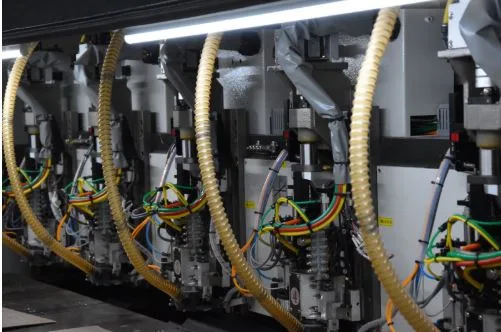
When you walk through a modern PCB factory, you will see a combination of precision machines and chemical lines working together. Typical PCB manufacturing machines include:
l · LDI (Laser Direct Imaging) for ultra-fine circuit patterns
l · DES lines for developing, etching, and stripping copper layers
l · High-speed drilling machines for micro and through holes
l · PTH plating lines for copper deposition
l · Lamination presses for multilayer bonding.
l · Solder mask spray or curtain coat machines
l · CNC routers or V-score cutters for final board shaping
l · AOI and Flying Probe testers for inspection and electrical validation
These machines influence yield, precision, and reliability. At Fast Turn, automation enables consistent results even with small geometries, such as 4-mil traces, 01005 passives, and fine-pitch BGAs—laying a strong foundation for assembly.
5. Why Many Companies Choose Turnkey PCB Manufacturing
Turnkey manufacturing means your supplier handles the entire process — PCB fabrication, component sourcing, SMT/THT assembly, testing, and shipping — under a single management system.
There are two common types:
l · Full Turnkey – The supplier purchases all components and manages the full process.
l · Partial Turnkey – The customer provides some or all materials, while the supplier completes the assembly.
The benefits of a turnkey PCB assembly service include:
l · One point of contact for the entire project
l · Shorter lead times and easier coordination
l · End-to-end quality control and material traceability
l · Lower overall cost compared to managing multiple vendors
Fast Turn PCB integrates in-house both PCB fabrication and assembly. Every project goes through engineering review, BOM validation, material sourcing from authorised distributors, and IPC Class 2/3 quality inspection using AOI, X-ray, and functional testing.
This one-stop approach eliminates vendor handoffs and ensures a smooth transition from prototype to production.
6. Lead Time, Capacity, and Ideal Applications
Speed is one of the key advantages of Fast Turn PCB. Depending on the project complexity and material availability:
l · Prototype fabrication can be completed in 24–72 hours.
l · Turnkey assembly (when components are in stock) can finish in as fast as 8–72 hours after board fabrication.
This fast-turn capability serves startups, engineers, and R&D teams needing small batches or engineering samples quickly, as well as OEMs preparing for mid-volume scaling.
7. Proven Quality and Customer Support
Industrial clients choose Fast Turn PCB not only for speed but also for consistency. Each project receives engineering support, visual inspection, and testing to ensure reliability in high-demand applications.
Customers appreciate the combination of rapid response, clear communication, and stable delivery — a key reason many prototype clients stay through to volume production.
Conclusion
If you’re looking for reliable industrial PCB manufacturing or a turnkey PCB assembly service, Fast Turn PCB offers flexible solutions for both prototypes and medium-volume builds. With in-house production, certified processes, and a responsive engineering team, your next PCB project can move from design to delivery — faster and smoother than ever.