Permits, Site Work, and Foundation: The 3 Biggest Quonset Cost Drivers in Real Projects
For the majority of people shopping for a Quonset building, the question is: how much is a kit? That’s understandable. The kit is the product. It’s what gets marketed, priced, and compared across manufacturers. In fact, most buyers begin by trying to compare Quonset building costs between different suppliers, assuming the kit price tells the whole story.
But once you’ve spent time on real Quonset projects, from home workshops a couple of guys put together for personal use to barn-like farm storage facilities, one thing stands out so much that it’s impossible not to notice. It’s the kit that rarely breaks a budget. Permits, site work, and the foundation usually do.
If you’re committed to building a realistic budget plan for your Quonset project, this is where that process starts.
Why the Price of the Kit Isn’t All That Matters
For a buyer comparing Quonset building prices between suppliers, they’re usually comparing steel panels, end wall options, and fastenings, with extraneous shipping costs not included. It’s worth doing that comparison because there are meaningful price and quality differences between manufacturers.
But the kit is just a fraction of what you’ll spend before your shelter is complete.
For most projects, the three cost variables discussed in this article, permits, site work, and foundation, will equal or exceed what you will pay for your steel package. When it comes to what makes up the cost of a Quonset building, that means seeing beyond the product page and looking down into the ground, and through the paperwork and permits, where your structure will actually live.
Cost Driver #1: Legislation and Local Permits
What Permitting Actually Involves
It’s easy to think of permitting as a formal process, basically a fee you pay and a form you fill out. In reality, it is commonly one of the most unstable and unpredictable components in the entire equation and overall cost of a Quonset building.
The cost of a permit varies significantly by where you live. In a few rural counties, the standards for agricultural buildings are low and fees are small. Other places require stamped engineering drawings by a licensed structural engineer, phased inspections, and possibly a zoning variance if your property’s classification doesn’t already permit the use you intend.
The stamped engineering drawings alone can run you $800 to $2,500 depending on your region and the complexity of the build. Add permit application fees, inspection fees, and the time value of navigating the process, and you could easily spend $1,500 to $5,000 before a panel goes up.
How to Get the Permits for Your Quonset Building and Compare Costs Once You Do
When you are inquiring for prices, be direct and ask whether they supply engineering documentation for local permit applications. Some do. Others come with only generic assembly instructions.
If your county requires stamped drawings, you’ll need to budget for that separately. One of the simplest ways to prevent budget surprises when planning a Quonset project is getting this information early.
Cost Driver #2: Site Work and Ground Preparation
When it comes to site work and ground preparation, you can expect to pay roughly around $0.50 per square foot of your paver structure.
Why Site Conditions Change Everything
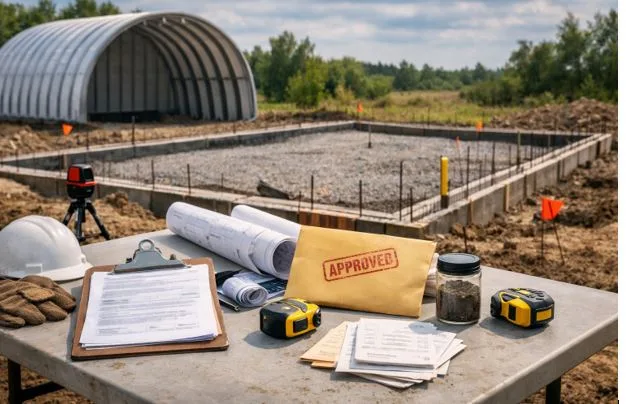
The land your Quonset sits on never looks as simple as it does on paper. Site work includes everything that needs to happen before the concrete foundation is poured, and the extent of that work can be huge depending on your piece of land.
Typical site preparation activities may include:
- Smoothing and leveling the immediate area
- Removing vegetation or tree roots
- Improving drainage around the installation
- Compacting the subgrade
- Adding fill dirt to raise the base above grade, if needed
If your site has bad drainage, a steep grade, or soft earth, each of those conditions adds cost and time.
For a midsize structure on flat, well-drained ground with a sturdy subgrade, site preparation may run $1,500 to $3,000. On difficult terrain, that number can rise to $8,000 or higher.
This is another cost consideration buyers tend to overlook, likely because it requires a site visit and assessment from a contractor rather than an online quote.
The Smart Approach to Site Selection
Before you finalize your Quonset building plans, take a site walk with your local excavation contractor. Ask them to evaluate drainage, slope, and soil conditions.
A small investment in an initial site consultation can save you from designing around a budget that doesn’t reflect real soil conditions.
Cost Driver #3: Type of Foundation and Construction Types
Understanding Your Foundation Options
The foundation is what ties your Quonset building to the ground, and cost differences between foundation types can be massive.
Of the many decisions involved in budgeting for a Quonset project, your foundation choice may be one of the most important.
Common options include:
- Gravel pad with anchor pins driven into compacted earth
This is cost-effective and typically suitable for lightweight, non-permanent structures. - Concrete perimeter footing with embedded anchor bolts
This is the baseline standard for many permanent agricultural and commercial Quonset applications. - Full concrete slab
If your building will have a floor and will support vehicles or heavy machines, a full slab is often required, and it increases both material and labor costs significantly.
A perimeter footing for a 40-foot by 60-foot Quonset could run between $8,000 and $14,000 depending on your region, concrete prices, and labor costs. A full slab on the same footprint might cost $15,000 to $25,000 or more. Those figures can swing based on location, season, and current material pricing.
Matching Foundation to Use Case
One of the most widespread and expensive mistakes is skimping on the foundation to cut initial costs. A structure designed and engineered for vehicular access and heavy loads that’s built on an undersized footing can create long-term problems such as cracking, settling, and in some cases damage that requires expensive repairs. Foundation specifications are one of the key factors affecting Quonset building cost, especially when the structure is intended for demanding use. When you consider the cost of building a Quonset hut, compare apples to apples for foundation requirements. Focus on the actual planned use, not just what code minimally requires.
Putting It All Together: A More Realistic Budget Framework
To create a workable budget, think of your Quonset project in three tranches:
- The kit and delivery
- The site and foundation
- The finishing work including permits, end walls, insulation, and doors
Get separate bids for each scope from experienced local contractors, not just the supplier of your kit.
A realistic installed price for a permanent Quonset building is somewhere between 2.0 to 3.5X the cost of your kit, depending on what else you need to do such as site work, foundation, and permits.
That’s not a flaw in the product. That’s the true cost of putting something permanent on real land, in the real world.
Final Takeaway
The metal is just the entrée. Nothing increases your Quonset hut budget faster than permits, site work, and a foundation, because those are the three things you truly need, aside from dirt floors. That is why planning a Quonset project budget from the very beginning is critical, not optional.
Early research and professional consultation deliver the clearest return in each of these areas. Whether you are researching Quonset building prices for a new build, or you have one and want to replace it, solid numbers help you make sound decisions before you start.
Frequently Asked Questions
Do I require a permit each time I construct a Quonset building?
Not always, but more than you think. Agricultural exemptions exist in many counties, but they depend on specific uses and property classifications.
If you plan to use your Quonset for anything other than basic farm storage, such as a workshop, retail use, or any building with electricity and or plumbing, a permit is likely required. Always check with your local building department before assuming an exemption applies.
Will my site work expense be less if I locate the home in a different place on my property?
Yes, significantly.
Placing your Quonset on the flattest and driest part of your property, with easy access, can save thousands in site preparation. If you have flexibility, spending a little time with a local excavator contractor before you choose the final location is money well spent.
Does my foundation selection influence the comparability of Quonset building prices?
It affects it considerably.
Comparing a “metal kit only” quote to a turnkey quote that includes a concrete slab and all permits is comparing apples to oranges. The key is to understand what each number includes, and what it does not, before drawing conclusions about Quonset prices between suppliers or builders.
What is the cheapest way to build your first Quonset?
If you are building a permanent structure for equipment storage, poured concrete perimeter footing with embedded anchor bolts often offers the best balance of economy, durability, and code adherence.
It’s cheaper than a full slab and offers stronger long-term performance than a gravel-only base in many permanent-use cases.