PhenQ Ingredients Explained: How the Formula Works for Weight Management
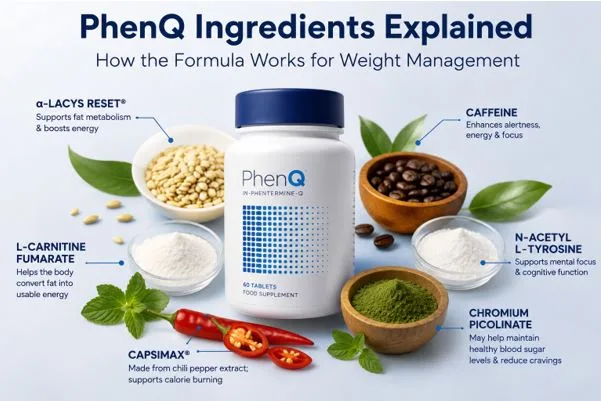
If you are looking at PhenQ, the most useful place to start is not with customer testimonials or before-and-after claims. It is with the formula itself. PhenQ is a multi-ingredient dietary supplement designed to complement a balanced diet and active lifestyle.
Its current formula combines vitamins and minerals with ingredients such as L-carnitine L-tartrate, caffeine, Capsimax®, α-Lacys Reset®, InnoSlim®, nopal cactus, and piperine. The manufacturer positions the formula around several areas of weight management, including appetite control, fat metabolism and energy support.
That does not mean every ingredient will produce noticeable weight loss on its own. The evidence behind individual ingredients varies, and the amounts used in PhenQ do not necessarily match the doses studied in clinical trials. Here is what is actually in PhenQ and what those ingredients can realistically contribute.
What Is PhenQ?
PhenQ is a daily weight-management supplement supplied in capsule form. The manufacturer recommends two capsules per day: one with breakfast and one with lunch. The product contains 60 servings per bottle when one serving is defined as one capsule.
The current formula contains several micronutrients alongside botanical extracts and other compounds commonly used in weight-management supplements.
Rather than relying on one supposed “fat-burning” ingredient, PhenQ takes a multi-ingredient approach. The manufacturer says the formula is intended to support appetite management, fat metabolism, energy, focus, and consistency.
PhenQ Ingredients at a Glance
According to the current Supplement Facts panel, each capsule contains:
| Ingredient | Amount per capsule |
| Vitamin B3 | 8 mg NE |
| Vitamin B6 | 0.7 mg |
| Vitamin B12 | 1.25 mcg |
| Iodine | 75 mcg |
| Copper | 1 mg |
| Chromium | 20 mcg |
| L-Carnitine L-Tartrate | 150 mg |
| InnoSlim® blend | 125 mg |
| Caffeine | 75 mg |
| Capsimax® | 50 mg |
| α-Lacys Reset® | 25 mg |
| Nopal Cactus | 20 mg |
| Piperine | 10 mg |
These amounts are listed per capsule, while the recommended daily intake is two capsules.
α-Lacys Reset®
α-Lacys Reset® is a combination of alpha-lipoic acid and L-cysteine. PhenQ includes 25 mg per capsule and uses the ingredient as part of its broader metabolic-support approach.
Alpha-lipoic acid has been investigated for weight management. A meta-analysis of randomized controlled trials found a small reduction in weight compared with placebo, although the researchers noted that further research was needed to establish longer-term effects.
The important distinction is that research on alpha-lipoic acid does not automatically establish the same effect from PhenQ’s specific 25 mg α-Lacys Reset® dose.
Capsimax®
Capsimax® is a capsicum extract standardized to 2% capsaicinoids. PhenQ provides 50 mg per capsule. The formula also contains piperine and caffeine separately.
Capsaicin and related capsaicinoids have been studied for their potential effects on body weight and energy expenditure. A systematic review and meta-analysis of 15 randomized trials involving 762 participants found modest reductions in body weight, BMI and waist circumference with capsaicin supplementation.
That evidence is encouraging but should be kept in perspective. The observed effects were modest, and the research was conducted on capsaicin supplementation rather than PhenQ as a complete product.
Chromium Picolinate
PhenQ contains 20 mcg of chromium per capsule. Chromium is an essential trace mineral, and chromium picolinate is a form commonly found in dietary supplements. It is often included in weight-management formulas because of its relationship with carbohydrate and glucose metabolism.
However, evidence for chromium as a meaningful weight-loss ingredient is much less convincing than supplement marketing can sometimes suggest. An earlier meta-analysis of randomized trials found that chromium picolinate produced only a very small effect on body weight, with the authors questioning whether the difference was clinically meaningful.
So chromium may have a role in the overall formula, but it should not be viewed as a standalone fat-burning solution.
Caffeine
Each PhenQ capsule provides 75 mg of caffeine, meaning the recommended two-capsule daily serving supplies 150 mg. Caffeine is one of the more familiar components of the formula. It can increase alertness and temporarily improve perceived energy, which may be useful for people trying to remain active while following a calorie-controlled routine.
The caffeine content also explains why timing matters. PhenQ’s official instructions recommend taking the capsules with breakfast and lunch and avoiding doses after 3 PM because caffeine may interfere with sleep. Anyone particularly sensitive to caffeine should take that into account before using the product.
Nopal Cactus
Nopal cactus, also known as Opuntia ficus-indica, is included at 20 mg per capsule. PhenQ associates it with appetite and fullness support. Nopal cactus contains dietary fiber, but the amount in a supplement capsule is not equivalent to getting a substantial amount of fiber from foods such as vegetables, legumes, fruits, or whole grains.
For that reason, it is better to consider nopal cactus one component of the formula rather than expect it to independently control hunger.
L-Carnitine L-Tartrate
PhenQ provides 150 mg of L-carnitine L-tartrate per capsule, or 300 mg across the recommended two-capsule daily serving. L-carnitine is involved in transporting fatty acids into mitochondria, which is why it frequently appears in sports and weight-management supplements.
Clinical evidence suggests that supplementation can have a modest effect on body weight. A systematic review of 37 randomized controlled trials found reductions in body weight, BMI, and fat mass, although the effects were relatively small and varied according to dose and population.
It is worth noting that the dose associated with the greatest effect in that particular meta-analysis was substantially higher than the amount supplied by PhenQ’s recommended daily serving.
InnoSlim®
InnoSlim® is a proprietary blend containing extracts of Panax notoginseng and Astragalus membranaceus. PhenQ lists 125 mg per capsule. Because it is a proprietary blend, the label provides the combined amount rather than revealing the individual quantity of each botanical extract.
That makes it difficult to compare the PhenQ dose directly with individual clinical studies. As with the other ingredients, evidence concerning an ingredient or botanical extract should not automatically be interpreted as proof that the finished PhenQ formula will produce the same result.
Piperine
PhenQ contains 10 mg of piperine from black pepper extract per capsule. Piperine is best known as a component of black pepper. It is often included in supplement formulas because it may influence the absorption or metabolism of certain compounds.
However, piperine should not be treated as a major weight-loss ingredient by itself. It is more appropriate to view it as a supporting component of the overall formulation.
B Vitamins, Iodine and Copper
PhenQ also provides vitamins B3, B6 and B12, along with iodine and copper. These nutrients are involved in normal physiological processes, including energy metabolism and nervous-system function.
However, providing adequate amounts of a nutrient does not necessarily mean taking more of it will accelerate fat loss. For most people, the role of these ingredients is better understood as nutritional support rather than direct fat burning.
How Does PhenQ Work?
PhenQ’s approach is based on combining several mechanisms rather than relying on a single ingredient.
Appetite and Food Intake
Some ingredients in the formula are positioned around appetite and craving management. The idea is straightforward: if a supplement makes it easier to stick to a planned eating pattern, maintaining a calorie deficit may become more manageable.
However, no supplement can replace the fundamentals of weight management. Total calorie intake, food quality, protein and fiber intake, physical activity, sleep and consistency remain important.
Energy and Alertness
The 75 mg of caffeine per capsule provides a more immediate mechanism. At two capsules per day, the recommended serving supplies 150 mg of caffeine. This may make some users feel more alert or energetic, although individual responses vary. It is also why taking PhenQ late in the day may be counterproductive for people who are sensitive to caffeine.
Fat Metabolism
Ingredients such as capsaicinoids, L-carnitine, and alpha-lipoic acid have been investigated in relation to energy metabolism and body composition.
The available research suggests that some of these ingredients can produce modest changes under certain circumstances. It does not establish that combining them in PhenQ will result in dramatic or guaranteed fat loss. That distinction matters when interpreting supplement claims.
What Does the Research Say About PhenQ’s Ingredients?
The evidence is best described as mixed but interesting. Some individual ingredients have human clinical research behind them. Meta-analyses have reported modest weight-related effects for alpha-lipoic acid, L-carnitine, and capsaicin.
At the same time, studies on individual ingredients cannot be used to prove that the complete PhenQ product will deliver the same outcomes. There is another issue: dose.
For example, the amount of L-carnitine supplied by PhenQ is 300 mg per day at the recommended serving, while some clinical research showing weight-related effects has examined substantially higher amounts.
The same principle applies to other ingredients. Evidence that a compound can influence a particular physiological pathway at a certain dose does not mean a smaller dose in a multi-ingredient supplement will produce a clinically significant effect.
So the most reasonable interpretation is that PhenQ is a supplement designed to support a weight-management routine, rather than a substitute for diet, exercise or medical treatment.
How to Take PhenQ
The manufacturer’s current instructions are straightforward:
- Take one capsule with breakfast.
- Take one capsule with lunch.
- Swallow each capsule with water.
- Do not exceed the recommended daily serving.
- Avoid taking PhenQ after 3 PM because it contains caffeine.
Consistency is also emphasized by the manufacturer. PhenQ is intended to complement a balanced diet and active lifestyle rather than replace either one.
Who Should Be Careful With PhenQ?
PhenQ is a dietary supplement, not a prescription weight-loss medication. Its suitability can vary depending on a person’s health, medications, and sensitivity to individual ingredients. The manufacturer advises people who are pregnant or nursing, taking medication, have a medical condition, or are under 18 to consult a healthcare professional before using it.
The caffeine content is particularly relevant for people who are sensitive to stimulants or who already consume substantial amounts of caffeine from coffee, energy drinks, tea or other supplements. It is also sensible to check the label against any other supplements being taken to avoid unnecessarily duplicating ingredients.
PhenQ Results: What Can You Realistically Expect?
PhenQ’s website includes customer testimonials describing substantial weight loss, but the company also states that individual results vary. Those testimonials should therefore be treated as individual experiences rather than typical or guaranteed outcomes.
A more realistic way to assess PhenQ is to ask whether it helps you maintain the habits that actually drive weight loss. If a supplement fits comfortably into a structured diet and exercise routine, it may be useful as part of that routine. If someone expects capsules to compensate for a consistently high-calorie diet or lack of physical activity, expectations are likely to be unrealistic.
Frequently Asked Questions About PhenQ
Does PhenQ contain caffeine?
Yes. Each capsule contains 75 mg of caffeine, and the recommended two-capsule daily serving provides 150 mg. The manufacturer recommends avoiding PhenQ after 3 PM because caffeine may affect sleep.
How many PhenQ capsules should you take per day?
The manufacturer’s current recommendation is two capsules per day: one with breakfast and one with lunch. Users should not exceed the recommended daily serving.
Does PhenQ replace a healthy diet?
No. PhenQ is intended to complement a balanced diet and active lifestyle. The manufacturer specifically advises that supplements should not be used as a substitute for a varied, balanced diet and healthy lifestyle.
How long does PhenQ take to work?
There is no reliable timeframe that guarantees when an individual will notice results. Weight change depends on factors including calorie intake, activity, starting weight, adherence and individual physiology. PhenQ itself states that results vary from person to person.
Is PhenQ a prescription weight-loss medication?
No. PhenQ is marketed as a dietary supplement and does not require a prescription.
Can PhenQ be taken at night?
The manufacturer recommends taking PhenQ with breakfast and lunch and avoiding late doses because of its caffeine content.
The Bottom Line on PhenQ
PhenQ stands out less because of one revolutionary ingredient and more because of its multi-ingredient formulation. The current formula combines caffeine, Capsimax®, L-carnitine, alpha-lipoic acid, and several other ingredients with vitamins and minerals.
Some components have human research suggesting modest effects on weight or body composition, while evidence for others is less conclusive. That makes PhenQ best viewed as a weight-management supplement intended to complement healthy habits, not as a guaranteed shortcut to substantial weight loss.
If you are considering it, the most important factors are the actual ingredient amounts, your caffeine tolerance, any medications or health conditions you have, and whether the product fits into a sustainable diet and activity plan.