Phuket’s Visitor Mix Is Broadening in 2026, and Property Owners Are the Quiet Winners
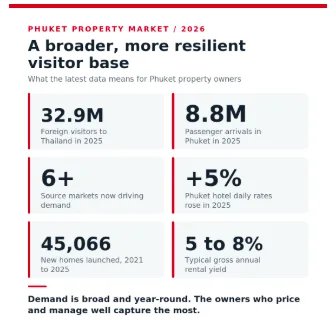
Phuket is heading into 2026 in a stronger position than the headline numbers suggest. Thailand welcomed around 33 million foreign visitors in 2025, and forecasts for 2026 range from roughly 30 million to 35.5 million, depending on flight capacity, energy prices, and global travel demand. The bigger story for property owners is not the national total. It is how Phuket’s visitor base has broadened and become more resilient, which is good news for anyone earning rental income on the island.
Phuket recorded 8.8 million passenger arrivals in 2025, according to C9 Hotelworks, even as Chinese arrivals fell sharply. The island absorbed that drop and still delivered strong numbers, because demand now comes from many directions, including Russia, India, South Korea, the Middle East, Europe, and Southeast Asia. For owners, a wider mix of guests means a steadier flow of bookings across the year.
“Strong tourism demand is no longer driven by European holidaymakers alone,” says Lofty Phuket, a property management company in Phuket that has watched the island’s visitor mix change over the past ten years. “Arrivals from the Middle East, India, South Korea, China, and across Southeast Asia now fill the calendar, which spreads bookings across a wider part of the year.” That shift quietly works in an owner’s favour.
A broader visitor mix is filling the quiet months
For most of Phuket’s history as a tourist destination, the income calendar followed a simple rhythm. The high season ran from roughly November to April, and the rest of the year was quieter. Owners planned around that gap and treated the slow months as part of the market.
That gap is now shrinking. Different source markets travel at different times of the year, so demand no longer arrives in one big wave. Travellers from India, the Gulf, South Korea, Australia, Russia, China, and Southeast Asia follow their own school holidays, public holidays, and booking windows. When several regions book at once, the low season stops being as empty as it used to be, and owners gain the chance to earn across more of the calendar.
Hotel data points the same way. C9 Hotelworks reported that Phuket’s average daily hotel rates rose about 5 per cent across 2025, even as occupancy dipped by around 6 per cent. Rates held up because guests are still willing to pay well for the right property. Well-run villas and condominiums can ride the same trend, earning more per booking even when the number of nights is slightly lower.
Investment keeps flowing in, which is a vote of confidence
The money following Phuket tells its own positive story. Colliers Thailand reported that Phuket recorded 45,066 newly launched residential units between 2021 and 2025, with a total investment value of THB 469.72 billion. In 2024 alone, the market reached 18,515 newly launched units and THB 190.11 billion in investment value.
For existing owners, this scale of development confirms they are holding an asset in a market that investors continue to back. It does raise the bar, since guests now have more choice. The owners who present and price their property well are the ones who stand out and keep winning bookings in a busier market.
Pricing is where owners capture the upside
The single biggest opportunity for most owners is pricing. A property whose rates move with demand earns far more during busy periods than one that sits at a flat rate all year. More bookings help, but the right rate on each booking is what lifts the yearly total.
Phuket gives owners plenty of moments to capture. A major event, a public holiday in a key source market, a jump in flight arrivals, or a surge in last-minute bookings can all support a higher nightly rate for a short window. Daily rate adjustments based on local events, seasonality, booking pace, and competitor pricing turn that demand into real income. Well-managed rentals on the island tend to deliver gross yields of 5 to 8 per cent per year, with the stronger performers at the higher end.
Guest experience keeps the bookings and reviews coming
Guest experience is the quieter advantage, and it compounds over time. Strong reviews boost a listing’s visibility on booking platforms, bringing in more bookings and, in turn, supporting better rates. A smooth stay is the engine behind all of that.
Round-the-clock guest communication, fast maintenance, clean handovers, and clear check-in instructions keep guests happy and reviews high. For an owner living in Bangkok, Europe, the United States, or elsewhere overseas, this daily work is hard to handle alone. A rental property looks passive from the outside, but the work behind a five-star stay is active and time-sensitive.
Where property management in Phuket helps owners win
This is where a good operator earns its place. Property management in Phuket is not only about handing over keys or arranging cleaning after check-out. The role covers marketing across several booking channels, daily pricing, check-ins and check-outs, cleaning and laundry, guest communication, routine maintenance, inspections, and clear financial reporting.
Lofty Phuket, a Phuket property management company, has operated on the island since 2015 and managed more than 10,000 guests from a range of countries. The company provides owners with real-time financial reporting, so they can see bookings and expenses as they occur.
The company says the difference often comes down to consistency. A property may look good online, but it still needs the right pricing, fast guest replies, reliable housekeeping, and quick maintenance to perform well across the year. A company managing several units in a single building also tends to have stronger relationships with legal offices and contractors, which helps when minor issues require quick fixes.
Honest expectations serve owners best
The way an operator talks about returns is worth paying attention to. Some companies win owners over by promising a specific annual income or a fixed occupancy rate, but those numbers tend to disappear the moment the market shifts.
Lofty Phuket takes a different approach. It does not offer guaranteed income or occupancy, and it operates under an open-ended contract with no lock-in. Rental performance depends on the property, location, season, pricing, reviews, and market conditions, and no operator can control all of those. What a good operator can control is the quality of daily management, and honest expectations backed by consistent work usually serve owners better over a full market cycle.
What this means for buyers eyeing Phuket
For buyers still weighing a purchase, the 2026 picture is encouraging. A broader visitor base and steady investment make Phuket an attractive place to own a rental property. The location, building rules, property condition, running costs, and management quality all shape the final return, so a buyer should factor in management from the start rather than after the keys change hands. A well-located property in capable hands can do very well in this market.
The takeaway: owners are well placed
Phuket’s broader, more resilient visitor base is good news for property owners there. The island welcomed 8.8 million passenger arrivals in 2025; investment continues to flow in, and demand now comes from many markets across more of the year.
The gains will not be shared evenly across all villas and condominiums. They will flow toward properties that are priced sharply, presented well, reviewed positively, and managed without gaps. Owners who get those basics right, whether they handle the property themselves or work with a professional team, are the quiet winners of Phuket’s 2026.