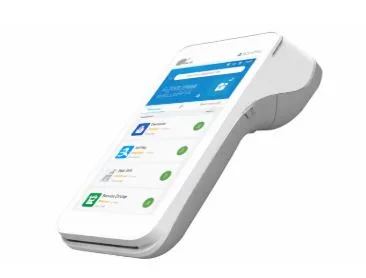
Portable terminals: flexible payments wherever your business operates
Consumer expectations around payments continue to evolve. Speed, convenience and security are no longer competitive advantages but basic requirements. For many businesses, especially in hospitality, services and field operations, the ability to accept card payments away from a fixed checkout has become essential. This is where portable terminals play a key role.
Mobility without compromising reliability
Portable terminals combine the full functionality of a traditional countertop device with the freedom of wireless operation. Thanks to Wi-Fi or mobile data connectivity, they allow merchants to process payments directly at the point of service – at the restaurant table, in a hotel lounge, on a market stall or during off-site events. This mobility reduces queues, shortens service time and improves overall customer satisfaction.
Despite their compact size, portable terminals are designed for everyday professional use. They offer stable performance, intuitive controls and robust construction suitable for frequent handling. From a business perspective, they provide the same transaction reliability and settlement accuracy as fixed terminals, without tying operations to a single location.
A better customer experience at the point of sale
Bringing the terminal directly to the customer changes the dynamics of payment. Guests no longer need to leave their table, and service staff can complete transactions seamlessly as part of the customer interaction. This approach is particularly valuable in restaurants, cafés and hotels, where smoother payments translate into faster table turnover and higher perceived service quality.
Portable terminals also support all common payment methods, including contactless cards and digital wallets. Customers can pay using the method they prefer, which reduces friction at checkout and lowers the risk of abandoned purchases.
Operational benefits for growing businesses
From an operational standpoint, portable terminals help businesses adapt to changing demand. They are well suited for seasonal operations, outdoor seating areas, pop-up concepts or events where fixed infrastructure is impractical. Adding or removing devices is straightforward, allowing companies to scale payment capacity up or down as needed.
In addition, transaction data from portable terminals can be consolidated with other payment channels, simplifying reconciliation and financial reporting. This consistency supports better cash-flow oversight and reduces administrative effort for accounting teams.
Security as a standard, not an option
Security remains a fundamental requirement in payment processing. Portable terminals meet the same stringent standards as stationary devices, using encrypted communication and modern authentication mechanisms. Customers benefit from familiar, trusted payment flows, while merchants gain confidence that transactions are processed in line with regulatory and industry requirements.
A practical step toward more flexible payments
For businesses seeking to modernise their in-person payment experience, portable terminals represent a balanced solution – combining flexibility, reliability and security. They support efficient service delivery today while remaining adaptable to future operational needs.
An overview of available options and use cases for portable terminals can help businesses assess how this type of solution fits into their payment strategy and daily operations.