Promotional Calendars: The Corporate Gift That Stays on the Wall, Not in the Drawer
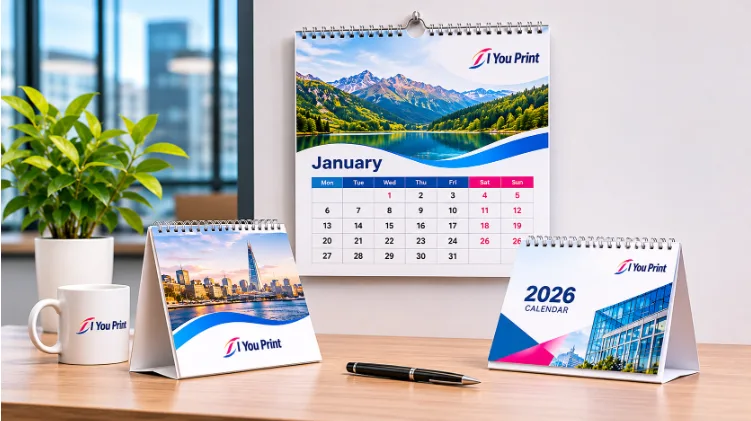
How branded calendars keep working long after the festive post has been opened, and how to specify one that earns its place for all twelve months.
Think back to the branded gifts that landed on your desk last December. The pen probably ended up in a pot with a dozen others. The stress ball went home in a coat pocket. The embossed notebook may still be in its cellophane, waiting for a spring clear-out to decide whether it stays.
None of those gifts were poor choices. They just ran out of reasons to be looked at.
Promotional calendars run on a different clock. Most corporate gifts are at their most interesting the moment they’re unwrapped, and they matter less from then on. A calendar works the other way round. It’s of little practical use on 18 December, then becomes something people genuinely need on 2 January, when the first appointments, delivery dates and school-run changes start getting written in. That reversal is the real commercial case for calendar marketing, and it’s worth understanding before a gifting budget goes anywhere else.
Why Promotional Calendars Outlast Most Corporate Promotional Gifts
The January Test
There’s a simple question worth asking of any corporate gift. It isn’t a formal standard, just a useful check: will this item be more useful in the second week of January than it was on the day it arrived?
Most promotional products struggle with that question. Novelty items are at their best when they’re unwrapped. Mugs last, but they spend much of their life in a cupboard or a dishwasher, and nobody reads a mug. A printed promotional calendar passes almost by design, because its job only really starts once the year turns over. The recipient doesn’t have to remember to use it. The date does that for them.
Visibility That Comes From Use, Not Logo Size
This is where calendar advertising differs from most branded merchandise. A logo on a pen gets seen when someone happens to glance at the pen. A logo on a calendar gets seen every time someone checks when the VAT return is due, how many weeks until the Easter holidays, or which Friday the boiler engineer is booked. The brand sits right next to information the reader went looking for.
Repeated exposure in a space the recipient controls tends to feel far less like advertising than a flyer or an email does. It can support recognition without asking the person to do anything at all.
The table below sets out the broad patterns behind that. These are general tendencies rather than measured outcomes, and every office is different.
| Corporate gift | When it tends to be most useful | Where it usually ends up | What keeps the brand in view | Common weakness |
| Branded pen | Day one, then now and again | Pen pot, bag, someone else’s desk | Being picked up by chance | Easily lost or passed on |
| Branded mug | Ongoing, but on and off | Kitchen cupboard, dishwasher | Being chosen from the cupboard | Little reason to read the branding |
| Notebook | When a new one is needed | Drawer or shelf | Being opened for notes | Often saved “for later” |
| Promotional wall calendar | Every month of the year | Office kitchen, workshop, reception | Daily date checking | Arrives late or is poorly laid out |
| Promotional desk calendar | Every working day | Beside the keyboard or phone | Constant sightline at the desk | Too small or cluttered to write on |
Notice that both of the calendar’s weaknesses in that table are within the buyer’s control. That’s encouraging, and most of what follows is about avoiding them.
Who Business Promotional Calendars Suit, and Who Should Choose Something Else
Business promotional calendars work best for businesses whose clients come back more than once a year. Think of accountants, garages, dental practices, letting agents, heating engineers, IT support firms and independent shops. Their clients will need them again in a few months, and until then a calendar keeps the phone number on the wall. Schools and charities get a lot out of them too, especially when the pages use photos from their own community. Supporters then have a reason to keep the calendar up beyond the dates themselves. Those same photos often show up on a roller banner at open days and fundraisers, so the calendar ends up looking like part of something people already recognise rather than a one-off gift.
They’re a weaker fit when the customer relationship is a one-off purchase with no likely repeat, or when the audience works from home with no fixed desk or wall. In those cases the budget may do more elsewhere.
For a few very important clients, a milestone anniversary sometimes calls for something weightier. A short hardback book telling the company’s story, or a well-produced set of booklets explaining your services, can carry a depth that a calendar isn’t built for. You don’t have to choose one or the other. Plenty of businesses send calendars to the wider client list and keep a more substantial printed piece for the few relationships that matter most.
Promotional Wall Calendars vs Promotional Desk Calendars
Start With Where It Will Actually Live
Choosing a format has less to do with taste than with where the recipient will put it. A wall calendar suits shared spaces like a staff kitchen, a workshop, a reception or the side of a family fridge. A desk calendar suits people who work at a fixed spot and want the dates within reach.
| Factor | Promotional wall calendar | Promotional desk calendar |
| Typical setting | Kitchens, workshops, receptions, homes | Office desks, counters, front desks |
| Who sees it | Several people, from a distance | Mainly one person, up close |
| Space for imagery | Generous, suits photography | Limited, suits simple artwork |
| Writing space | Usually larger date boxes | Smaller boxes for quick notes |
| Often suits | Trades, schools, charities, local services | Professional services, B2B accounts |
| Posting | Needs flat, rigid packaging | Compact, but the stand needs protecting |
There’s no single right answer. Some businesses order both, sending desk versions to key contacts and wall versions to everyone else.
Paper, Finish and Binding Decisions That Affect Daily Handling
This is where a calendar starts to feel either considered or cheap, and the reasons are practical. It will be handled, flipped and written on for a year, so the material has to cope with that.
Heavier paper generally feels more substantial and is less likely to curl when it’s hung. The finish matters more than many buyers expect. Gloss can make photography look vivid, but some pens may smudge or skip on a heavily coated surface, and people write on calendars. Silk and uncoated stocks tend to be kinder to biros and pencils. If your recipients are likely to fill in the date boxes, choose a finish they can write on over one that shines.
Binding changes how the calendar behaves on the wall. Wire binding lets the pages turn cleanly and lie flat, and a hanger keeps it level. Options vary from product to product, so judge the specification by how the calendar will be used, not by the product photo.
What Personalised Promotional Calendars Should Carry Beyond a Logo
The calendars that stay up are the ones that save the recipient a small job. A logo on its own doesn’t do that, but useful content does:
- Your phone number, website and a short line on what you do, placed on every page rather than only the cover
- Bank holidays for the right part of the UK, since England and Wales, Scotland and Northern Ireland don’t share an identical list
- Dates your clients care about, such as Self Assessment deadlines for an accountant’s clients, term dates for a school’s families, or a pre-winter boiler service reminder
- A QR code leading to a dedicated landing page, so responses can be traced back to the calendar
- Date boxes big enough to write in, because a calendar nobody can write on is really a poster
The most common branding mistake is turning every month into an advert. Twelve pages of sales messages tend to get a calendar taken down early. The better calendar branding ideas are restrained: a consistent header strip, your own photography or local scenes, and the occasional seasonal message where it’s actually relevant. A London firm using images of the city through the seasons will usually stay on the wall longer than one that repeats its service list twelve times.
Calendar Printing Mistakes That Send a Good Gift Into the Drawer
Late arrival is the easiest failure to miss. If a calendar turns up in mid-January, there’s a fair chance someone else’s calendar is already hanging in its spot.
The start month also catches people out. January to December is the default, but a school running on the academic year, or a client base that plans around the April-to-March tax year, may get more use from a calendar that starts when their year starts.
Then there’s proofing. Check every month’s grid against a reliable source, especially bank holidays and moving dates like Easter. One wrong date can make people doubt everything else on the page. Image resolution is the other trap. A photo that looks sharp on a phone can soften noticeably at wall-calendar size, so supply full-resolution files and set up artwork with bleed.
Quantity matters too. Running out halfway through a client list and reordering in a rush usually costs more than ordering a sensible number of spares at the start. Those spares come in handy for new clients who sign up in February.
Timing Promotional Calendar Printing Around UK Delivery
Work back from the date the calendars need to arrive, not forward from the day you place the order. Leave time for content, design, proofing, production and delivery, and remember that December post is busy across the UK. Check the current turnaround before you commit to a send date rather than assuming it.
How the calendar travels matters as well. A wall calendar posted in a soft envelope risks a creased first page, which is a poor first impression. Flat, rigid mailer boxes protect the print and make the delivery feel like a gift rather than routine post.
Autumn exhibitions are a natural place to hand calendars out, and they work harder when they clearly belong to the stand. If your SEG fabric display or stretch fabric display stand, the banner at the entrance and the posters around the space share the calendar’s look, visitors take home a piece of the stand rather than a random freebie.
How to Order Custom Promotional Calendars: A Practical Sequence
- Decide who’s receiving one and how many, adding spares for new contacts
- Choose wall, desk or both, based on where each group works
- Set the start month to match how your clients plan their year
- Gather the dates and content that will actually help them
- Prepare artwork at the correct size, with bleed and high-resolution images
- Proof every month, not just the cover and January
- Book production with a delivery date worked back from when they must arrive
When you order custom promotional calendars from I YOU PRINT, you choose your format and options online, send your artwork and have it printed for delivery across the UK, with support on hand if you’re unsure which specification suits your recipients.
Promotional Calendars Earn Their Place One Month at a Time
The strongest argument for promotional calendars isn’t novelty or price. It’s that people use them. Every page turn is a small, welcome reminder of who sent it, twelve times over, without a single follow-up email.
Choose the format to suit the space, use paper people can write on, include dates that matter to the recipient, and make sure it arrives before someone else’s calendar takes the spot. Get those right and the calendar stops being a seasonal gesture and stays in view all year, which is exactly what the team at I YOU PRINT sets every calendar order up to do.