Retail Window Displays in 2026: Turning Design Trends into Buildable Brand Experiences
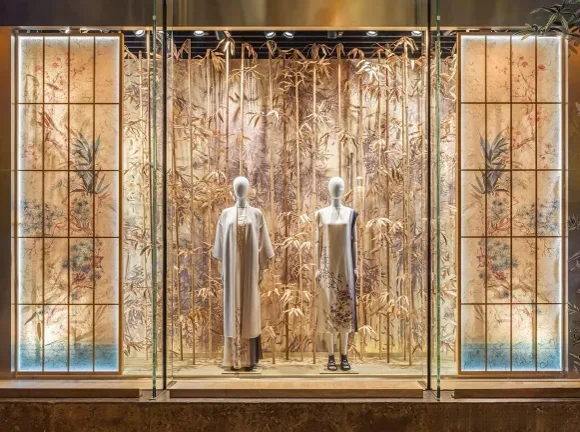
A store window has to do more than attract attention. It needs to communicate a brand’s identity, give products a clear role, and work within practical limits such as budget, installation time, and available space.
For visual merchandising teams, the challenge is not finding another striking concept. It is translating that concept into a display that looks right in person, survives transportation, and can be installed consistently across different stores.
Observations of 2026 retail windows point to several useful directions: more deliberate use of negative space, stronger material storytelling, reusable display components, and selective integration of digital elements. These are not universal rules for every brand. They are options that become valuable when connected to a clear creative brief and a realistic production plan.
Start with the Product, Not the Prop
A common mistake in window planning is choosing decorative elements before deciding what the display should communicate.
An oversized sculpture, elaborate backdrop, or animated screen can draw attention while leaving the product almost invisible. A more effective starting point is to define three things:
- The product or collection that deserves the most attention.
- The campaign idea a passerby should understand.
- The visual relationship between the product and its surroundings.
For example, a jewelry window may benefit from restrained forms and carefully controlled reflections. A sportswear display might use terrain-inspired textures to suggest movement and outdoor activity. A collectible toy retailer may need bold colors and recognizable character forms rather than a minimalist composition.
The objective is not to follow a single aesthetic. It is to make every element support the product and the brand.
Use Trends as a Design Framework
Trend reports are most useful when they help teams make decisions rather than encourage them to copy another storefront.
Gimsun’s overview of four retail window display trends for 2026 identifies relaxed minimalism, natural storytelling, sustainable materials, and light digital intervention. Together, these directions offer a framework for discussing how a window should look, feel, and function.
Relaxed minimalism means reducing visual competition. Fewer props can create a clearer focal point, but they also make proportion, joints, edges, and surface finishes more noticeable.
Natural storytelling uses textures and forms to suggest a setting or lifestyle. Wood, woven surfaces, stone-like finishes, and fabric can introduce depth without requiring a literal reconstruction of an outdoor scene.
Sustainable material choices should be evaluated through sourcing, durability, reuse, and end-of-life options. A material that looks natural is not automatically the lower-impact choice.
Light digital intervention can add movement or make campaign updates easier. Screens and projections should reinforce the physical display, not compete with it.
A brand may combine several of these approaches. A restrained window could use one textured plinth, a translucent backdrop, and a subtle moving light effect. The result depends on how well the elements work together, not how many trends are included.
Specify the Finish, Not Just the Material
Material names alone rarely provide enough information for a successful build.
“Wood,” “metal,” and “acrylic” describe broad categories. They do not define the appearance of the finished display. A brushed metal surface behaves differently under lighting from a polished one. Frosted acrylic produces a different effect from a clear panel. A printed stone texture can appear convincing from the pavement but less suitable at close viewing distance.
A useful material specification should address:
- Surface texture and gloss level.
- Color references and acceptable variation.
- Edge treatment and visible joints.
- Viewing distance and lighting conditions.
- Cleaning, handling, and maintenance.
- Weight, stability, and relevant safety requirements.
Physical samples are particularly valuable when several fabrication methods are combined. A printed backdrop, painted sculpture, and metal fixture may share the same intended color but appear different under the actual store lighting.
Approving samples together can help identify those differences before full production begins.
Choose Custom Props for Their Function
Custom display props should solve a visual or practical problem. Their value is not simply that they are unique.
A sculptural form may establish the campaign theme. A layered platform may improve product visibility. A modular frame may allow the same structure to support several seasonal campaigns.
Fabrication methods should follow those requirements. Depending on the project, a supplier might recommend woodworking, metal fabrication, acrylic processing, 3D printing, fiberglass molding, or a combination of techniques.
Each option involves trade-offs. Complex geometry may suit 3D printing, while a larger repeated form may require a different production approach. Lightweight components can simplify handling, but they still need adequate stability and protection during shipping.
Gimsun’s guide to custom window display props and supplier requirements discusses the relationship between design concepts, specialty materials, fabrication processes, and delivery. Its practical implication is important: evaluating a supplier requires more than comparing quotations against dimensions.
Bring the Fabricator into the Design Process Early
A concept drawing does not always reveal the difficulties of building and installing a display.
Early discussions with a fabricator can identify issues such as:
- A prop that cannot fit through the store entrance.
- A finish that needs more sampling time than the schedule allows.
- A suspended element without an approved fixing method.
- A display that requires too much on-site assembly.
- A component that is difficult to repair or replace.
These conversations do not have to limit creativity. They can help preserve the intended design by resolving constraints before they become expensive changes.
A well-prepared production brief should include drawings, window dimensions, reference images, material expectations, product placement, installation conditions, and the campaign deadline. For multi-store projects, it should also explain how window sizes and site requirements vary.
Supplier evaluation should then focus on relevant samples, comparable projects, quality-control procedures, packaging plans, and installation documentation—not price alone.
Design for the Second Campaign
Reusable displays work best when reuse is planned from the beginning.
A structure that is easy to dismantle, store, and update may support several campaigns. However, a theoretically reusable prop offers little value if it is too bulky to store or too fragile to handle again.
Practical options include:
- Retaining frames while replacing graphic panels.
- Using removable covers or interchangeable surfaces.
- Designing plinths in several compatible heights.
- Labeling components for straightforward reassembly.
- Using fixings that allow disassembly without damage.
Environmental claims also need care. Combining recyclable materials with permanent adhesives or coatings can make recovery more difficult. Teams should ask what can actually be reused or processed locally, rather than relying on a general “eco-friendly” label.
The better question is not simply, “Can this display be reused?” It is, “Who will dismantle it, where will it be stored, and how will it be used next?”
Treat Installation as Part of the Design
A window display is not complete when it leaves the factory.
Site access, delivery restrictions, electrical connections, fixing positions, and installation hours can all affect the final result. A detailed assembly guide, clearly labeled packaging, and a trial build can reduce uncertainty.
For larger rollouts, consistent execution also depends on communicating which details are essential and which can adapt to local conditions. The spacing between props may need to change across stores, while product hierarchy, color, and key finishes should remain recognizable.
This is why installation planning belongs in the initial brief rather than at the end of production.
Conclusion
The strongest retail window displays in 2026 are not necessarily the largest, most digital, or most expensive. They are the ones in which product presentation, material choices, fabrication, and installation support the same idea.
For brands and visual merchandising teams, the practical priorities are clear: establish the product focus, use trends selectively, approve finishes through samples, involve fabrication partners early, and plan for installation and reuse.
A compelling concept starts the process. Careful execution makes it work in the store.