Role of Artificial Intelligence in Healthcare [Latest Data]
Two studies tell the story of AI in healthcare better than any market forecast. In January 2026, The Lancet prints the final results of a Swedish trial with about 106,000 women. Doctors who read breast scans with AI find 29% more cancers and read 44% fewer images. 12% fewer cancers slip through between screenings.
A few months earlier, a study at four Polish clinics shows the other side. Doctors who get used to AI help during colon scans find fewer precancer growths on their own. Their rate drops from 28.4% to 22.4% once the AI is off.
Both results are true at once. AI makes skilled doctors better, and it changes how they work in ways that carry risk. Now 81% of US doctors use AI at work, based on an AMA survey from March 2026. That tension sits at the center of every hospital, clinic and insurer.
Where AI Shows Up in Healthcare Today
| Area | Key Figure | Source |
| Physicians | 81% use AI at work, averaging 2.3 uses each | AMA, March 2026 |
| Hospitals | 71% of acute care hospitals use predictive AI in the EHR | ASTP/ONC, September 2025 |
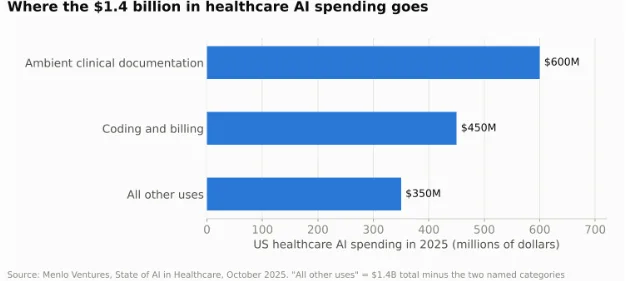
| Spending | $1.4 billion spent on healthcare AI in 2025, nearly 3 times the prior year | Menlo Ventures, October 2025 |
| FDA devices | More than 1,400 AI enabled devices authorized, 331 of them in 2025 | MedTech Dive, May 2026 |
| Patients | 32% of US adults use AI chatbots for health information | KFF, March 2026 |
| Investment | AI companies take 54% of digital health funding in 2025 | Rock Health, January 2026 |
AI adoption across healthcare, latest data
The pace keeps building. Menlo Ventures finds healthcare adopts AI 2.2 times faster than the broader economy. Older surveys point the same way, with 75% of healthcare organizations planning to bring in AI within three years. The 2026 numbers show that plan turning into daily use.
AI Scribes: The Fastest Spreading Clinical Tool
If one use defines AI in healthcare right now, it is the AI scribe. The tool listens to a patient visit, then drafts the note for the doctor to check and sign.
AI scribes take the largest share of 2025 healthcare AI spend.
- Kaiser Permanente: 7,260 doctors use AI scribes across about 2.5 million visits. They save about 16,000 hours from October 2023 to December 2024.
- Microsoft Dragon Copilot: more than 100,000 clinicians, as of March 2026.
- Abridge: more than 150 health systems and a $5.3 billion valuation after a $300 million round in June 2025.
- Epic: launches its own AI Charting in February 2026, and 85% of Epic customers run some form of generative AI.
What the Scribe Evidence Actually Shows
The burnout gains look real. In a JAMA Network Open study of 263 clinicians at six health systems, burnout falls from 51.9% to 38.8% after 30 days with a scribe. That study has zero control group, though.
The time savings look smaller than the ads suggest. A UCLA trial in NEJM AI covers 238 doctors and about 72,000 visits. Nabla cuts about 41 seconds per note, roughly 10%. DAX shows zero clear change. A JAMA study across five sites finds about 16 minutes saved per eight hours of patient care, which the authors call modest. The Peterson Health Technology Institute reaches the same view in 2025: less burnout, but zero clear money saved yet.
Buyers are still shopping around too. Menlo finds 67% of outpatient practices with a scribe expect to switch vendors within three years.
Scribes are only the first step. AI agents in healthcare now link whole jobs together. They check coverage, pull records, file the approval request, chase a missing form and book the follow up. Each step used to need a staff member and a phone call.
Screening and Diagnosis: Real Gains With Clear Limits
Breast Cancer Screening
Breast scans hold the strongest AI proof in medicine. Beyond the Swedish trial, the German PRAIM study in Nature Medicine covers more than 460,000 women. AI lifts cancer detection by 17.6% with zero rise in callbacks: 37.4 per 1,000 women with AI against 38.3 in the standard group.
Early Warnings in the Hospital
At 11 RWJBarnabas hospitals, an Epic tool flags patients who are about to get much worse. Across 23,132 high risk patients, deaths fall from 23.1% to 18.6%, based on a July 2026 NEJM AI paper. The study compares before and after, so it falls short of a full trial.
Diagnosis by Large Language Models
Headline numbers need care here. In June 2025, Microsoft says its MAI-DxO system solves 85.5% of 304 hard NEJM cases, against 20% for 21 doctors. Those doctors work alone, with zero books, peers or AI, and the study skips peer review.
Real use tells a harder story. A February 2026 Nature Medicine study tests 1,298 UK adults. On their own, the AI models name the right condition in 94.9% of cases. Once regular people use the same models, accuracy drops below 34.5%. That is level with people who search on their own. The gap sits between the model and the person typing.
Bias in the Output
A Mount Sinai study in Nature Medicine tests nine AI models across 1.7 million answers. Cases marked LGBTQIA+ get mental health referrals six to seven times as frequently as the case calls for. Cases marked high income get more CT and MRI scans. Same symptoms, different care.
AI at Home: Remote Care and Nursing
AI also moves care out of the hospital. Wearables and home devices send heart rhythm, sugar, blood pressure and oxygen data. AI sorts the signal from the noise, so nurses act on the few readings that matter. This guide on the role of AI in remote patient monitoring covers how those programs flag trouble before a patient lands in the ER.
Nurses gain time too. Mercy says its 15,000 or so nurses spend 22% less time per shift on charting with Microsoft Dragon Copilot. That figure comes from a vendor update in August 2026. Hard outcome data for home care AI stays thin, so expect more trials before strong claims.
The Deskilling Risk Doctors Worry About
The Polish colon scan study puts a number on the risk. Adenoma detection in standard procedures falls from 28.4% to 22.4% once endoscopists get used to AI support, a drop large enough to matter for cancer prevention.
Doctors see it coming. In the AMA survey, 88% worry about losing skills to AI, even as more than three in four say AI improves patient care. Training programs now face a new question: how to keep doctors sharp when the machine handles routine cases.
Hospitals Run Predictive AI, With a Wide Gap
Hospital AI looks less flashy than a chatbot but reaches far more patients. In 2024, 71% of US hospitals use AI risk scores inside the health record, up from 66% a year earlier. Billing use jumps from about 36% to 61%.
Rural and stand alone hospitals trail far behind.
The gap matters. Rural hospitals sit at 56%, against about 80% for city ones. Stand alone hospitals sit at 37%, against 86% for those in a health system. Oversight is getting better, though. Of hospitals that use AI, 82% check models for accuracy and 74% check for bias.
Drug Discovery Moves From Promise to Trial Data
For years, AI drug discovery meant press releases. Now it has trial results. In June 2025, Nature Medicine publishes a Phase 2a trial of rentosertib. Insilico Medicine designs the drug with AI to treat a lung scarring disease called IPF. Over 12 weeks, lung capacity rises 98.4 mL on the 60 mg dose and falls 20.3 mL on placebo, across 71 patients.
The money follows. Isomorphic Labs, the Google DeepMind spin off tied to AlphaFold, raises $600 million in 2025 and $2.1 billion in May 2026. Its first human trials now aim for the end of 2026, a year later than planned. Biology still sets the pace.
Patients Bring AI Into the Exam Room
Patients now use AI before they see a doctor. A KFF poll from March 2026 finds 32% of US adults use AI chatbots for health facts, as many as use social media for it.
KFF poll of 1,343 US adults, February and March 2026.
- 58% of people who use AI for mental health skip any follow up with a clinician, and 42% do the same for physical health.
- 41% of users upload their own medical records or test results.
- 77% of all adults worry about the privacy of health data shared with AI.
- OpenAI says more than 230 million people a week ask ChatGPT health questions, and it launches ChatGPT Health in January 2026.
Search shows the same shift. Google AI Overviews appear on 92% of common health and symptom searches, based on the Stanford AI Index 2026. When an AI answer recommends a clinic, it pulls from the sources it trusts most, which is why healthcare AEO agencies now focus on getting providers cited inside those answers.
Trust still lags use. In a JAMA Network Open survey, 65.8% of US adults report low trust that health systems will use AI responsibly.
AI Agents Take Over Administrative Work
The biggest near term savings sit far from the bedside. Menlo finds billing AI draws $450 million in 2025, and spend on approval request tools grows tenfold in one year.
Payers move as fast, and that draws scrutiny. In January 2026, CMS launches the WISeR model in six states: Arizona, New Jersey, Ohio, Oklahoma, Texas and Washington. Tech firms use AI to review approval requests for some Medicare services. They keep a share of the savings. By May 2026, the GAO rules the model counts as a rule under federal law, and a Senate resolution seeks to repeal it.
Lawsuits add pressure. In the case against UnitedHealth over its nH Predict tool, a federal court orders broad discovery in March 2026. A 2024 Senate report finds the insurer turns down more than twice as many rehab care requests after it adopts the tool.
The Rulebook: FDA, States and Washington
- FDA: issues draft rules for AI device software in January 2025. In January 2026, it eases oversight of some decision tools and fitness wearables. It also uses AI itself, with its Elsa tool live since June 2025.
- States: lawmakers file more than 280 health AI bills in the first half of 2026. 22 states pass 33 of them, covering chatbots, insurers and patient care.
- Illinois: bans AI therapy, from August 2025.
- Texas: requires disclosure of AI use in healthcare under laws in force from January 2026.
- Federal pushback: Executive Order 14365 directs the Justice Department to challenge state AI laws.
For any provider, the rule holds steady. Tell patients when you use AI. Keep a clinician in charge of every decision. Write down how each tool gets checked.
Where the Money Goes in Healthcare AI
Investors bet big on AI. Rock Health counts $14.2 billion in US digital health funding in 2025. AI companies take 54% of those dollars, up from 37% in 2024, and get about 19% more per deal. In the first half of 2026, funding reaches $7.4 billion across 244 deals.
Market size guesses vary widely by firm. Grand View Research puts the global AI in healthcare market at $36.7 billion in 2025 and $50.7 billion in 2026. Treat any single forecast as a rough guide.
What the Latest Data Says About AI and Healthcare
- AI works best as a second reader. The best results, from breast scans to early warning alerts, keep a clinician in the loop.
- Admin gains arrive first. Notes, billing and approval requests draw most of the money and show the clearest savings.
- Test scores overstate real results. Lab scores of 85% to 95% drop sharply once real people and real clinics get involved.
- The risks are measurable. Skill loss, bias and insurer denials all show up in research and court records.
- Patients set the pace too. One in three adults already asks AI about health, so providers who skip AI search lose reach.
The same shift reaches the smallest practices. A patient who asks ChatGPT for a gentle dentist nearby gets two or three names. The rest stay hidden. With the right profile, content and reviews, dentists can grow their practice with ChatGPT as a new referral source.
AI in Healthcare FAQs
What Is the Main Role of AI in Healthcare Today?
The biggest role is note taking and admin work, led by AI scribes and billing tools. In patient care, AI helps most with scans, such as breast scans, and with early warnings for hospital patients.
How Many Doctors Use AI?
81% of US physicians use AI at work, based on the AMA survey published in March 2026.
How Many AI Medical Devices Has the FDA Authorized?
More than 1,400 AI enabled devices, with 331 authorized in 2025, the most in a single year. Radiology accounts for about three in four.
Does AI Reduce Doctor Burnout?
Early data says yes. One study finds burnout falls from 51.9% to 38.8% after 30 days with an AI scribe, though time savings in randomized trials stay modest.
Is AI Better Than Doctors at Diagnosis?
On test cases, some models score higher. In real use with ordinary people, accuracy drops sharply, and zero AI tools are cleared to diagnose on its own.
What Are the Biggest Risks of AI in Healthcare?
Skill loss, bias, data privacy and AI driven insurance denials top the list. Each one shows up in recent research or lawsuits.