Rolex GMT-Master II Super Clone Guide
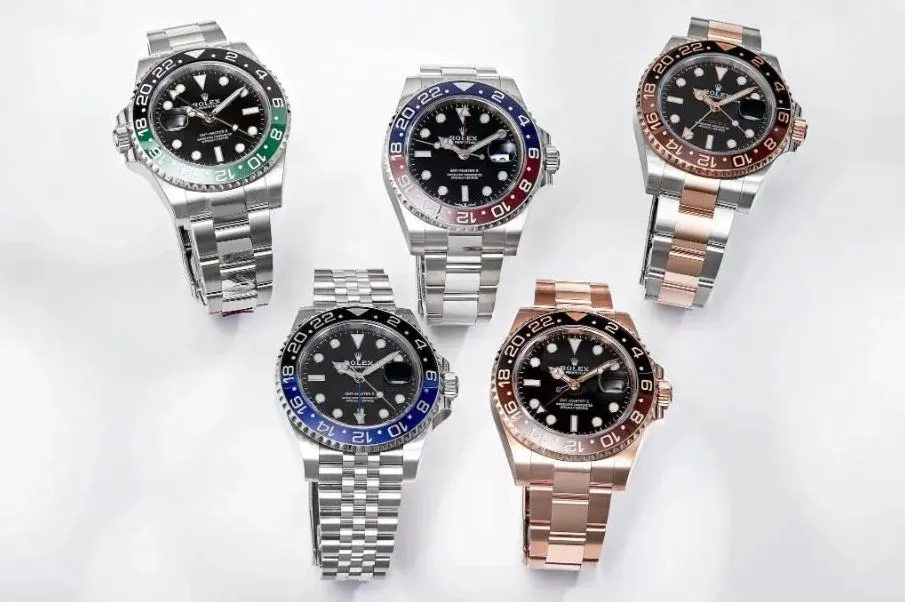
The Rolex GMT-Master II is the second-most-discussed watch in the super clone space, right behind the Submariner. That’s not an accident. The genuine article is hard to get from an authorized dealer, trades way above retail on the secondary market, and comes in a handful of colorways that people have strong opinions about. Pepsi. Batman. Root Beer. Sprite. Each one has its own fan base, and each one presents a different set of challenges for the factories trying to copy it.
A GMT-Master II super clone isn’t a Submariner with a different bezel. The movement is more complex. The bezel insert is bidirectional and has two colors that need to match the genuine article under different lighting. The bracelet options—Jubilee vs. Oyster—change the whole feel of the watch. And the tells are different from what you’d look for on a dive watch.
This guide walks through what makes the GMT-Master II a distinct build challenge, what to look for on the bezel variants, how the clone movements compare, and what still separates a super clone from the real thing.
Why the GMT-Master II Is a Different Build Challenge
The Submariner is a simpler watch to clone. Fixed bezel, no GMT hand, one color on the insert. The GMT-Master II has a bidirectional rotating bezel, a fourth hand for a second time zone, and a date complication that interacts with the jumping hour hand. That adds mechanical complexity.
On the genuine Caliber 3285, the hour hand jumps independently in one-hour increments when you pull the crown to the first position. The date changes backward and forward with the hour hand. That’s a feature called a “jumping hour” or “traveler’s” GMT. Most cheap replicas use a different hand stack (GMT hand on the bottom, hour hand on top) or a “caller” GMT where the GMT hand adjusts independently. A proper super clone rolexes gets the hand stack right and the jumping hour function correct.
The other challenge is the case. The GMT-Master II has a slightly different profile than the Submariner—thinner lugs, a different crown guard shape, and a rehaut (the inner bezel ring) that needs to have the “ROLEXROLEXROLEX” engraving at the right depth and alignment. Factories have gotten better at this, but it’s still a place where corners get cut.
Bezel Insert Color-Matching (Pepsi, Batman, Root Beer)
The bezel is the first thing anyone notices on a GMT-Master II. It’s also the hardest part to get right.
Pepsi (red and blue): This is the one that trips up most factories. The genuine Cerachrom insert has a specific red that’s slightly muted and a blue that’s on the lighter side. Many super clones get the red too bright or the blue too dark. Under sunlight, the differences show up. Under indoor lighting, they’re harder to spot. Clean Factory has historically been the reference for Pepsi bezel color, with VSF not far behind. But neither is perfect. The blue on most reps is darker than the genuine article, and the red is usually a shade off.
Batman (black and blue): This one is easier than Pepsi. The black half is straightforward. The blue half needs to match the genuine’s deep, inky blue without looking purple. Most top-tier factories get this close enough that you need a side-by-side comparison to spot the difference.
Root Beer (brown and black): The brown on a Root Beer bezel is tricky. Too warm and it looks orange. Too cool and it looks gray. The genuine two-tone Root Beer (steel and Everose gold) has a specific warmth to the brown that’s hard to replicate. The all-steel version (reference 126711CHNR) is slightly different again.
Sprite (green and black): The left-handed GMT. The green needs to be the right shade—not too bright, not too olive. Clean and VSF both make this now, but the color match varies batch to batch.
The best advice: if the bezel color looks off to you in the QC photos, it’s probably off. Good lighting can hide a lot. Natural light tells the truth.
The Jubilee vs. Oyster Bracelet Question
Genuine GMT-Master II references come on either Jubilee (five-piece links) or Oyster (three-piece links). The bracelet choice changes the look and feel of the watch.
Jubilee is dressier. It catches light differently, wraps around the wrist more comfortably, and hides scratches better. Oyster is sportier, heavier, and more traditional for a tool watch.
On super clones, the bracelet quality varies. The key things to check:
- SEL (Solid End Link) fit: The end links should sit flush against the lugs with no gaps. If there’s a gap or the SEL is recessed, it’s a tell.
- Clasp feel: The genuine Oysterlock clasp has a crisp snap and a smooth glide-lock extension. Super clones often feel gritty or don’t lock cleanly.
- Bracelet weight: 904L steel is denser than 316L. A proper super clone uses 904L, but some lower-tier watches use cheaper steel and feel lighter.
Jubilee bracelets are harder to clone well because there are more individual links and the finishing needs to be consistent across all of them. A sloppy Jubilee is a dead giveaway.
Movement Notes (3285-Generation Clones)
The genuine GMT-Master II has used the Caliber 3285 since 2018. It has a 70-hour power reserve, a Chronergy escapement, and a blue Parachrom hairspring.
Super clone movements have caught up. The Dandong 3285 (sometimes called DD3285) is the current standard. It’s based on the VS3235 architecture, which means it shares the same base as the Submariner clone movement but with a GMT module added. Power reserve is around 70 hours on a full wind. The beat rate is 28,800bph, so the second hand sweeps smoothly like the genuine article.
The hand stack is correct on the Dandong 3285—GMT hand on the bottom, hour hand on top, minutes hand on top of that. That’s a big improvement over older ETA-based clones where the hand stack was reversed.
What the clone movement doesn’t have: the same level of finishing. Under a display case back (which Rolex doesn’t use on steel GMTs anyway), the rotor decoration, perlage, and anglage are inferior. The balance wheel isn’t a free-sprung Parachrom hairspring. The winding feel is close but not identical.
One practical note: clone movements are serviceable, but parts are hard to come by. If a super clone movement breaks, you’re usually better off replacing the whole movement than trying to fix it.
What Still Gives a GMT Clone Away
Even the best super clones have tells. Here are the ones that still separate a replica rolexes from a genuine GMT-Master II:
Rehaut engraving: The “ROLEXROLEXROLEX” text around the inner bezel should be sharp, evenly spaced, and aligned with the minute markers. On many super clones, the engraving is too shallow, the letters are uneven, or the alignment is off. Under magnification, the difference is obvious.
Cyclops magnification: The genuine date magnifier is 2.5x. Most super clones are closer to 2x or 3x. It’s subtle, but if you compare them side by side, the genuine cyclops is crisper and the date appears larger.
Lume: The genuine Chromalight lume is blue and lasts all night. Super clone lume is often greenish (like Super-LumiNova) and doesn’t last as long. The color temperature under UV light is different.
Water resistance: Rolex pressure-tests every watch to 100 meters (or 300 meters on some models) with a rigorous gasket testing protocol. Super clones might have gaskets, but they’re not tested to the same standard. Take a super clone swimming at your own risk.
The crown: The engraved Rolex crown on the winding crown itself. Super clones get the shape close, but the depth of the engraving and the finish inside the crown are usually off.
Hand stack and GMT function: A proper super clone gets the hand stack right. But the GMT hand adjustment—the way it jumps in one-hour increments when the hour hand is moved—sometimes feels different. The genuine has a crisp, precise jump. Clones can feel slightly mushy.
Weight: The genuine GMT-Master II on an Oyster bracelet weighs about 150 grams (fully linked). The super clone is usually within a few grams because it uses 904L steel. But if it feels noticeably light, it’s not 904L.
No papers, no warranty: A genuine Rolex comes with a warranty card, a serial number that matches the movement and case, and a service history if it’s been maintained. A super clone has none of that. No resale market, no Rolex service center will touch it.
Where to Actually Start Looking
If you’re considering a GMT-Master II super clone, the first step isn’t finding a seller. It’s understanding what you’re looking for.
The top-tier factories for GMT-Master II are Clean Factory and VSF. Clean has historically been stronger on bezel colors—particularly the Pepsi—and crystal clarity. VSF is known for better case proportions and overall assembly quality. Clean Factory was raided in July 2025 and has not returned to production, which means remaining stock is all that’s left unless another factory picks up the tooling. VSF is currently the most consistent producer of GMT-Master II super clones, with a strong reputation for movement accuracy and finishing.
If you’re looking at a specific reference, the key questions are: Who made it? What movement is in it? What version is it? Factories iterate. A V3 is usually better than a V1. The community tracks these updates.
The reliable way to source a super clone is through a dealer who works directly with the factories—someone who sends QC photos before shipping and is transparent about what you’re getting. Dealers who don’t send QC photos or who can’t tell you the factory and movement are a red flag.]
Price is a separate conversation, but a general rule: if it’s significantly cheaper than the going rate for a top-tier super clone, something is off. The materials (904L steel, sapphire crystal with AR coating, ceramic bezel) cost money.
The GMT-Master II super clone market is mature at this point. The watches are good—good enough that you need to know what you’re looking at to tell them apart from a genuine article. But they’re not perfect. The bezel colors are close, not identical. The movements are functional, not finished to Swiss standards. The bracelets are solid, but the clasp action isn’t quite there.
If you go into it with your eyes open, knowing what the compromises are, a GMT-Master II super clone can be an impressive piece of work. But it’s still a replica. It doesn’t have the resale value, the warranty, or the heritage. And anyone who knows watches will be able to spot the difference if they look closely enough.
For those looking to dive deeper into the current landscape, a dedicated ROLEX super clone resource can provide more detailed model-by-model breakdowns and community-vetted insights.
This article is for educational and informational purposes only. The author does not endorse the purchase or sale of counterfeit goods. Trademarks belong to their respective owners.