Running Out of Space? How ASRS Helps Warehouses Overcome Capacity Limits
The combination of more SKUs, larger inventories, and quicker order processing has caused warehouses to reach their maximum capacity sooner than predicted. The old storage arrangements were not designed for the modern intricate supply chain in the USA, where requiring a high standard of efficiency, safety, and service. The lack of space impacts daily activities, thus making the management of capacity a challenge that is crucial for the business rather than just an operational concern.
It is becoming expensive and impossible to expand warehouses due to high land prices, construction delays, and disruption of operations. Therefore, businesses are reconsidering the use of their existing spaces. A lot of companies have stopped outward expansion and have resorted to better vertical and internal utilisation. This change has turned space optimisation into a core strategy, with the automatic storage and retrieval system showing up as an effective solution for increasing existing facility capacity.
Why Warehouse Space Constraints Are Increasing
The storage demands have been greatly increased due to SKU expansion and more complex inventory profiles. Besides, e-commerce and omnichannel fulfillment in the USA have facilitated the need for wider product assortments, quicker picking, and greater stock availability, all within the same physical space.
Conventional layouts usually struggle to accommodate such changes. Inefficient ways of storing impose additional pressure on the current infrastructure, particularly in sites dealing with high-volume warehouse logistics operations.
Key Reasons Warehouses Run Out of Space
Underutilisation of Vertical Space
A lot of warehouses continue to depend on labor-intensive picking methods that put a limit on the safe height of storage racks. Hence, a good amount of vertical space is left unused, even in structures with high ceilings.
This imposes an unrealistic limit on the capacity, which makes it necessary for the facilities to go outward rather than upward, thus incurring costs and causing more complexity in the operations.
Low Storage Density
Aisles that are wide enough for both forklifts and manual movement lead to a decrease in the number of storage locations available per square metre. Too many travel paths occupied are also wasting useful floor space that could be used for inventory. The reduction in density has a direct effect on the maximum stock that a warehouse can handle without increasing the area.
SKU Proliferation and Inventory Growth
A wider assortment of products results in an increase in pick faces, safety stock, and storage areas. A separate space is needed for each new SKU, which is additional pressure on the already packed layouts. Sooner or later, this will cause congestion and inflexibility during the busy times.
Operational Congestion
A crowded space means that workers and machines have to share the same routes, thus giving rise to a situation where picking is slower, error rates are higher, and safety risks are more pronounced in areas with heavy traffic. In addition, crowded layouts are responsible for poor visibility and less efficient flow of goods.
Lack of Scalable Storage Design
A lot of warehouses were constructed without considering future growth or automation. One of the main downsides of fixed racking systems is that they are hard to change; thus, it is not easy to change the layout of a warehouse to meet the evolving needs of businesses. Design that is not scalable implies that the process of capacity expansion will be a major disruption and very expensive.
How ASRS Helps Warehouses Overcome Capacity Limits
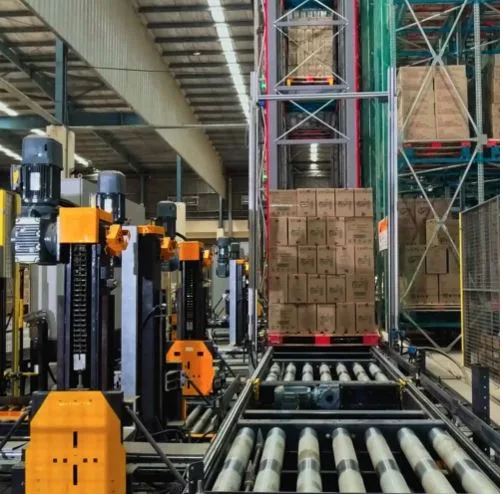
Automated storage systems, by completely taking advantage of the height of the warehouse, allow the storage of more inventory in the same ground area. The vertical space that was formerly unused is now able to accommodate multi-level storage with exact access. High-density designs cut down on aisle width and limit floor space that is not used. Hence, it is possible for the buildings to grow in terms of capacity without increasing their size.
Automation also assists in congestion removal through controlling material movement along predetermined routes. This leads to better picking flow and fewer safety hazards.
With better inventory control and accuracy, warehouses gain clearer visibility into stock levels and locations. This makes space planning more efficient and reduces the need for excess buffer stock. The automatic storage and retrieval system enables capacity expansion without structural changes, supporting long-term scalability in fast-growing operations.
By improving inventory management and precision, warehouses are able to have clearer insights into the numbers and places of their stocks. This results in improved space planning and less requirement for buffer stock. The installation of an ASRS allows for expansion of the capacity without the need for structural changes, thus accommodating the long-term scalability of a fast-growing operation.
Common Types of ASRS Used for Space Optimisation
Pallet ASRS solutions are made for high-bay storage, enabling the stacking of bulk items vertically with automated access. They are suitable for large, uniform loads.
Shuttle-based systems are ideal for high-density storage in mixed SKU situations, whereas mini-load ASRS takes care of small cartons in an efficient way. Vertical Lift Modules use compact vertical towers for storage, thus maximising the use of space in low-footprint areas.
Addverb: Enabling Space-Efficient Warehousing Through ASRS & Automation
Addverb has deployed automatic storage and retrieval system solutions that are aimed at maximising both vertical and horizontal spaces in the warehouses. The company’s offerings consist of carton storage, crane-based shuttle solutions, pallet handling robots, and modular multi-level storage designs that are catered to the specific layouts of the warehouses. These systems support key functionalities, including high-density storage, automated pallet movement, precise retrieval, scalable expansion, and seamless integration with warehouse control software, all tailored to specific warehouse layouts.
By integrating intelligent software with automation hardware, Addverb supports precise storage, faster retrieval, and improved inventory control. These solutions help businesses optimise capacity in both greenfield and brownfield warehouses while maintaining reliable logistics performance.
The combination of Addverb’s smart software and automation hardware enables exact storage, faster retrieval, and better inventory control. Moreover, these solutions allow companies to maximise the capacity of their warehouses, whether they are greenfield or brownfield facilities, without losing warehouse logistics performance.
Conclusion
The limitation of warehouse space is turning into a serious problem, whereas the complexity of inventory and the demands of fulfillment are increasing constantly for businesses across the USA. In the case of a lot of businesses, just increasing the size of their premises is not a very feasible option anymore.
Smarter storage methods can be implemented, thus enabling the warehouses to increase their capacity, efficiency, and scalability without necessarily enlarging their current footprint. Automation is considered to be the main contributor to the development of space-efficient and future-ready warehouse operations, with companies such as Addverb being actively involved in the making of sophisticated ASRS solutions.