SEO in 2025: Latest Trends and Key Benefits
Search Engine Optimisation (SEO) remains a cornerstone of online marketing, but it is constantly evolving. Today’s search landscape is constantly evolving – now driven as much by AI and voice assistants as by traditional keyword matching. As one expert notes, “SEO has always been one of the most powerful ways to attract high-intent traffic”, and its value is growing even further in our AI-powered era. In this changing environment, businesses that stay on top of the latest SEO updates can capture more visibility, while reaping the many benefits of SEO (from higher traffic to better ROI). This article breaks down current SEO trends, explains why SEO pays off, and even addresses common questions like “How much does SEO cost?”
Recent SEO Trends and Search Updates
New technologies and user habits are shaping SEO in 2025. Here are some of the biggest developments today:
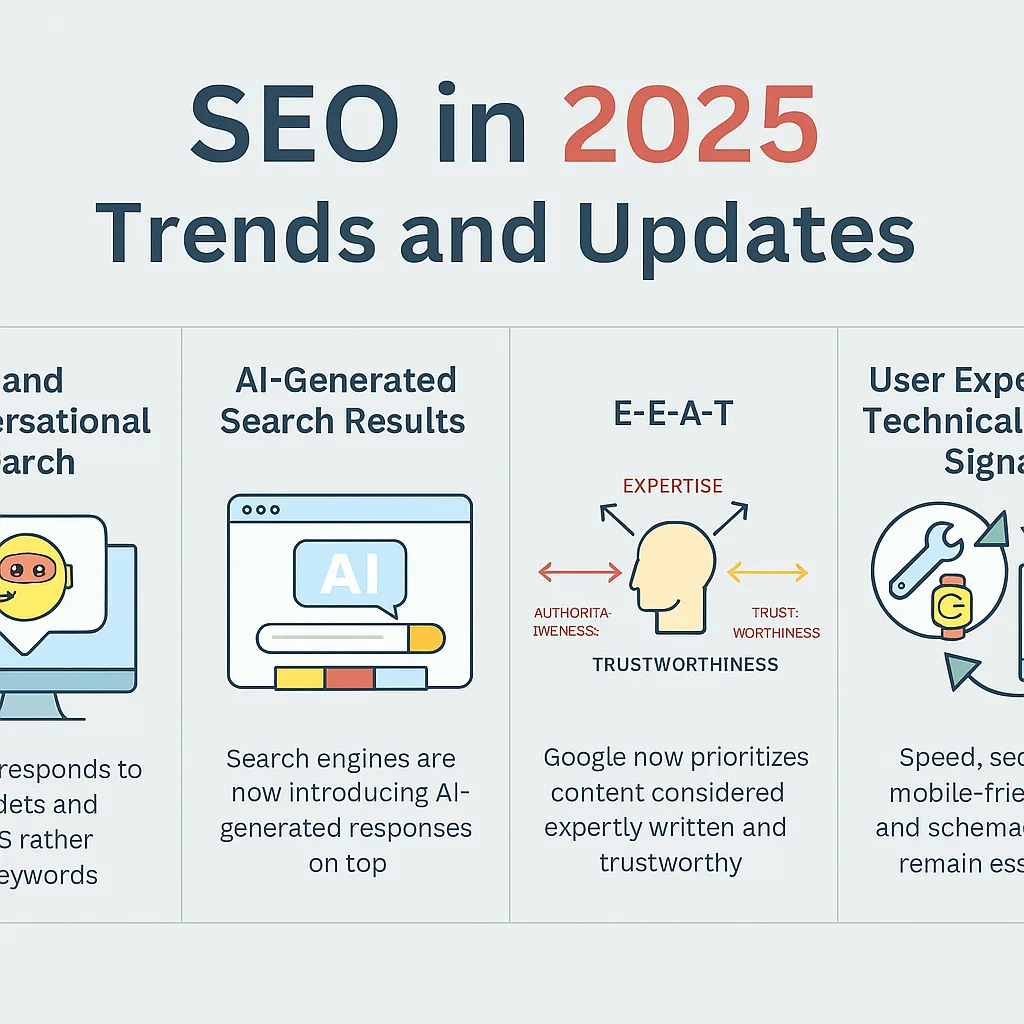
- AI and Conversational Search: AI and search engines are now expected to read minds, not keywords, and help users. Numerous searches are initiated by chatbots or voice assistants, and many of the results are presented immediately without user clicks. The result has been the Answer Engine Optimization (AEO), in which the content is optimized to give the immediate answer that appears on AI tools and voice systems.
- AI-generated search results: Google and Bing are now showing AI summaries and answer boxes at the top of their search results. Websites need to optimise not only rankings but also trust and authority to remain visible. The voice and visual search are also increasing, and cursory data and explicit conditions are critical to AI-inspired exploration.
- E-E-A-T: Google is becoming more and more inclined to reward quality and credible content. The recent changes focus on expertise, authority, and reliability, with well-researched content, author, and credible sources being of utmost importance in ranking highly, both in the standard and AI search engines.
- User Experience and Technical Signals: Technical SEO is still crucial. The speed of loading is fast, mobile-friendly, consistent page structure, and formidable security of the site have a direct influence on the rankings. Optimized images, video,s and the correct markup of the schema are also preferred by search engines, and therefore, clean and easy to navigate websites are a fundamental requirement in terms of search engine optimization.
Top Benefits of SEO
Investing in SEO yields many rewards. Here are some key benefits that make SEO worth the effort:
-
Marathon, Sustainable Traffic Development:
SEO develops a sustainable base of traffic. SEO keeps generating traffic 24 hours a day, as compared to paid advertisements that cease delivering traffic once the expenditure is exhausted. The more pages and backlinks you have, the more the number of related queries your optimized page can be ranked in. This produces a snowball effect of visibility that remains long after the initial work has been completed, thereby reducing the cost of acquisition in the long run.
-
Audience, High-Intent, and Conversion-Ready:
SEO targets users who are already in search of solutions. The immediate intent in search terms such as best coffee maker under 100 where there is a query of how to fix a leaky faucet implies that they have a high chance of converting, hence they tend to convert better than cold audiences. As a matter of fact, research findings indicate organic leads achieve conversion rates of approximately 14.6% in comparison with approximately 1.7% on outbound channels. Since SEO caters to the needs of the customers at their point of need, it provides better quality traffic (and conversions) per visitor.
-
More Brand Trust and Authority:
A high ranking in a search indicates credibility to users (as well as artificial intelligence systems). Brands that keep appearing in major queries create familiarity and trust. Practically, individuals overwhelmingly choose organic results, 40% of which are typically received by the first result in Google, compared to the 2% of the first ad, which indicates credibility in high-ranking sites. This familiarity builds your brand as a resource to go in your niche over time, which solidifies authority.
-
Full-Funnel Visibility:
SEO targets buyers on all levels of the funnel. By producing content to respond to general informational searches (e.g. how does SEO work) and to make the particular product/service search (SEO services for small business), you attract the potential customer at the awareness, consideration, and decision stages. That is, SEO will allow you to get users involved in the early stages (through blog posts and guides) and get users involved in the conversion (through comparison pages and landing pages) in a smooth process. Such a wide reach will give you a chance to capture demand in every stage of the customer journey.
-
Multi-Platform Reach:
Strong SEO makes your content discoverable across channels beyond Google. Tactics like clear site structure, proper schema markup, and authoritative backlinks help search engines and AI tools find and use your content. For example, Yoast notes that structured data “helps AI assistants, voice search tools, and new web platforms” interpret your content and prepares it “to be found, used, and displayed in many places where people search”. In short, SEO fundamentals increase the chances your content surfaces in AI overviews, voice assistants, social platforms, and marketplaces – not just in traditional search results.
-
Cost-Effectiveness and ROI:
SEO tends to be more cost-effective than paid channels over time. Once your site is well-optimized, it continues generating free organic traffic without ongoing ad spend. Research shows SEO delivers very high ROI – on average 200–275% (about $2–$2.75 return per $1 spent). By comparison, paid ads require continuous funding. In practice, businesses that invest steadily in SEO see traffic and sales rise steadily, even with modest monthly spend, effectively multiplying their investment over time.
Budgeting for SEO: Cost and ROI
Naturally, many people who run businesses are asking themselves how much SEO costs. The truth is, it varies. SEO prices are based on such factors as the competitiveness of your industry, the size and age of your site, and the hiring of professionals. Industry standards can be used to answer the question: How much does SEO cost? For example, a popular SEO guide notes a rule of thumb: a medium-sized business might spend about CAD $1,500 per month to build a solid SEO foundation. Of course, this assumes you already have a functional site and some backlinks. More aggressive goals or highly competitive niches would require higher investment.
Ultimately, the cost of SEO should be seen in light of value. Given the benefits above – sustainable traffic, higher conversions, brand growth – many companies find SEO to be highly worthwhile. The initial expense of SEO in comparison to paid channels is frequently rewarded by continuous profits. And keep in mind, certain SEO activities (such as basic keyword research or content revision) can be outsourced internally, which would help to optimize your budget even more. An SEO budget, when properly planned and measured, can bring in a large amount of profit in the long run.
Conclusion
Staying visible nowadays means staying up to date in the digital realm. Search strategies and user habits continue to change – Google undergoes product-level updates regularly, and AI chatbots are becoming a common practice – and so must SEO. With the emphasis on the quality of content, technical perfection, and the upcoming formats (such as voice and generative AI), the companies can avoid being the victims of the changes but follow them. The advantages of SEO are evident because organic traffic is maintained, more screened leads are offered, brand presence is improved, and ROI is higher than in other distribution channels.
To the business owners, message creators, and even marketers, the message is the same: SEO is a must. Although the strategies can grow ( Answer Engine Optimization, E-E-A-T, Core Web Vitals, etc.), the principle remains the same to reach people when they are searching and gain their trust. In an era of AI-driven search and information overload, a well-executed SEO strategy helps you be the answer your audience is looking for.