SEO Marketing Is Shifting From Traffic Growth to Search Intent
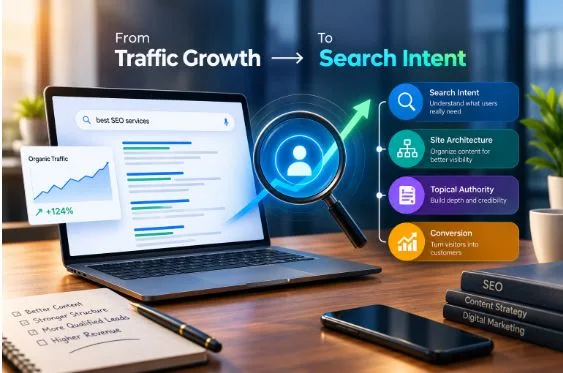
Search engine optimization has traditionally been associated with rankings.
A company chooses a keyword, creates content, earns links, improves technical performance, and attempts to move closer to the top of a search results page.
That process remains important, but the objective of SEO is changing.
For many businesses, the question is no longer simply, “How much organic traffic can we generate?”
A more useful question is, “Which searches can bring people who are likely to take the next step?”
This distinction is pushing SEO marketing toward a more sophisticated model built around search intent, site structure, topical authority, and conversion.
More Organic Traffic Does Not Automatically Mean More Business
Organic traffic is an attractive metric because it is visible.
When traffic rises, SEO appears to be working. When traffic falls, teams become concerned.
But traffic does not have equal value.
A website can receive tens of thousands of visits from broad informational searches while producing almost no meaningful inquiries.
Another website can receive far fewer visits but attract users searching for highly specific services, prices, comparisons, locations, or solutions.
The second website may generate considerably more revenue.
This is why traffic should be treated as one layer of SEO performance rather than the final objective.
Search Queries Reveal Different Stages of Decision-Making
Search behavior can often be divided into stages.
At the beginning, users look for definitions and general information.
Later, they begin comparing alternatives.
They then evaluate companies, prices, risks, reviews, and specific conditions.
Finally, some searches indicate immediate commercial intent.
Consider the difference between these queries:
- “what is SEO”
- “SEO agency comparison”
- “technical SEO audit company”
- “SEO services for law firms”
All relate to the same general topic, but the user behind each query is at a different stage.
A mature SEO strategy assigns different content to each stage instead of treating every keyword as an independent traffic opportunity.
SEO Works Better as a Site Architecture
One reason many SEO projects struggle is that they begin with individual articles rather than a larger information structure.
A company publishes blog posts based on keyword ideas, but the relationship between those pages is unclear.
Over time, multiple pages may compete for similar queries. Important service pages may receive few internal links. Search engines may struggle to identify the site’s main areas of expertise.
A more scalable approach starts with architecture.
Core topics become hubs.
Specific questions become supporting pages.
Service pages target commercial intent.
Comparison pages serve users who are evaluating alternatives.
Informational articles answer earlier-stage questions and guide readers toward deeper resources.
Internal links connect these layers.
This creates a system in which each page has a defined role.
One Keyword Should Usually Have One Clear Destination
Keyword cannibalization is often misunderstood as simply having the same word on multiple pages.
The real issue is ambiguity.
If several pages appear to answer the same search intent, a search engine may have difficulty identifying which page deserves to rank.
Good SEO architecture reduces this ambiguity.
A company should know which page is intended to rank for its main service term, which page targets pricing, which page answers comparison questions, and which pages support those topics.
The clearer this mapping becomes, the easier it is to expand the website without creating internal competition.
Modern SEO Extends Beyond Google Rankings
Search discovery is also becoming more fragmented.
Users may encounter a brand through traditional search results, AI-generated summaries, conversational search, recommendation systems, social platforms, videos, or third-party publications.
This means SEO increasingly overlaps with AEO, or Answer Engine Optimization, and GEO, commonly used to describe optimization for generative search environments.
The terminology may evolve, but the practical change is already visible.
Content needs to be understandable not only as a web page, but also as a reliable source that systems can interpret, summarize, reference, and connect to a recognized entity.
Clear headings, consistent brand information, strong topical organization, structured data, and authoritative references can all contribute to this broader search presence.
Search Intent Should Influence Content Investment
Companies often allocate content budgets according to search volume.
High-volume keywords receive the largest articles and the most promotion.
This can be inefficient.
A lower-volume query with strong commercial intent may deserve considerably more attention.
For example, a user searching for “website design” may still be exploring the topic. A user searching for “WordPress website development company with SEO structure” expresses a much more specific need.
The smaller keyword may create a better business opportunity.
Effective SEO 마케팅 SEO marketing therefore requires businesses to evaluate keywords by intent and economic value, not just by monthly volume.
Technical SEO Still Matters
The focus on content and intent does not make technical SEO less important.
Search engines still need to crawl, render, understand, and index pages correctly.
Technical problems can prevent strong content from performing.
Important areas include:
- crawlability
- indexation
- canonical URLs
- mobile usability
- site speed
- internal linking
- redirects
- structured data
- sitemap management
- duplicate content
The technical layer is particularly important as websites grow.
A five-page company website may function with minimal planning. A site containing hundreds or thousands of pages requires clear rules governing URLs, categories, templates, internal links, and indexing.
Data Should Feed Back Into SEO Strategy
SEO should not end when a page ranks.
Search Console data, rankings, click-through rates, conversion behavior, and lead quality can reveal whether the original strategy was correct.
Suppose a page begins ranking for an unexpected group of queries.
That data may reveal a new content opportunity.
If another page receives strong traffic but users rarely continue deeper into the site, the search intent and page purpose may be misaligned.
If a low-traffic page repeatedly generates inquiries, similar queries may deserve expansion.
SEO becomes more effective when teams treat performance data as feedback for the next round of site architecture and content planning.
SEO Is Becoming a Business System
The most important change in SEO may be conceptual.
SEO is no longer simply a tactic for ranking blog articles.
For companies that depend on search-driven demand, it can become part of the business infrastructure.
Keyword research influences page creation.
Page architecture influences how services are presented.
Search intent influences content.
Content influences inquiries.
Conversion data then influences the next SEO decisions.
When these pieces are connected, SEO begins to operate as a continuous acquisition system rather than a collection of optimization tasks.
The companies that benefit most from organic search will therefore not necessarily be those that publish the most content.
They will be those that build the clearest relationship between what people search, what information they need, and what decision they are trying to make next.