Siding Repair or Replacement? 7 Signs, Costs, and How to Decide
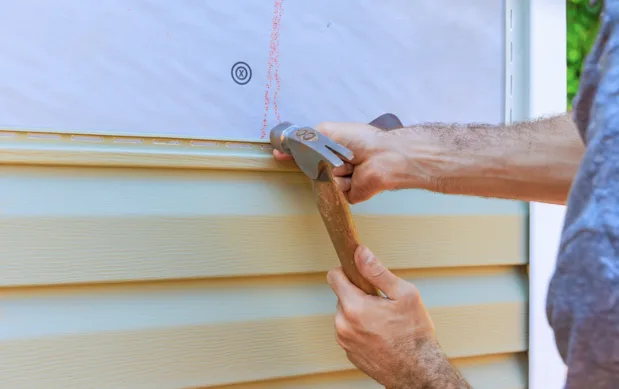
Your siding took a beating. Maybe it was hail. Maybe a board is soft near the downspout. Maybe a panel just cracked.
Now you’re stuck on one question: patch it, or replace the whole thing?
Guess wrong in one direction, and you spend $20,000 you didn’t need to. Guess wrong in the other, and you pay for repairs that hide rot until it spreads into your walls.
In this guide, I’ll show you:
- The 7 signs that tell you which way to go
- What siding repair costs, material by material
- How hail and insurance change the math
- What to ask a contractor before anyone touches your wall
Let’s dive in.
First, the Numbers
Here’s what siding repair costs nationally, according to 2026 data from Inch Calculator:
| Siding Material | Repair Cost per Sq Ft |
| Vinyl | $2 to $4 |
| Fiber cement | $3 to $11 |
| Wood | $4 to $13 |
| Metal | $5 to $7 |
| Average repair job | About $850 (typical range $350 to $1,500) |
Compare that with a full replacement, which averages about $14,500 nationally, with most homeowners paying between $8,500 and $20,000, according to Fixr.
That’s a big gap. Which is exactly why the decision matters.
The 7 Signs
Sign #1: Damage Is Limited to a Few Boards → Repair
A handful of cracked, dented or holed boards? That’s a repair.
A skilled crew can remove damaged pieces and install new ones in an afternoon.
Sign #2: The Wall Behind It Is Soft → Investigate Before Anything
Push gently on the siding near windows, doors and the bottom row.
Soft or spongy? Water may have reached the sheathing underneath.
Pro Tip: Never let anyone patch over soft spots. Rot needs to be cut out and the moisture source fixed first, or the new board will fail too.
Sign #3: You Can’t Match the Color or Profile → Consider Replacing a Full Wall
Siding fades. Products get discontinued.
A brand-new board on a 12-year-old wall can stick out badly. Many homeowners solve this by replacing the full side of the house that’s damaged, rather than the whole home.
Sign #4: Damage Is Spread Across Several Walls → Lean Toward Replacement
If every side of your house has cracks, dents or loose panels, piecemeal repairs add up fast.
At some point, you’re paying replacement money for a patchwork result.
Sign #5: Paint Won’t Stay On → Check the Material
Peeling paint on wood or fiber cement every couple of years can point to moisture problems or worn-out material.
Sometimes it’s a prep issue. Sometimes it’s a sign the siding is near the end of its life.
Sign #6: Energy Bills Keep Climbing → Look Behind the Siding
Loose, cracked or gapped siding lets air and water in. If your heating costs keep rising and the siding looks tired, have the house wrap and insulation checked when the boards come off.
Sign #7: Hail Just Hit → Get an Inspection Before You Decide
This is the big one in hail country.
Colorado ranks No. 2 in the nation for hail insurance claims, according to the Rocky Mountain Insurance Information Association. State Farm alone paid $521 million in Colorado hail claims in 2024.
Here’s the thing: hail damage isn’t always obvious from the ground. Small cracks and dents in fiber cement or vinyl can let water in for years before you see a stain.
Bottom line: After a significant storm, get a professional inspection and document everything before you choose repair or replacement.
Quick Decision Chart
| What You See | Best Move |
| 1 to 5 damaged boards, dry wall behind | Repair |
| Soft sheathing or rot | Repair the rot first, then decide |
| New boards won’t match | Replace the affected wall |
| Damage on 3 or more sides | Get a replacement quote |
| Widespread hail damage with a claim | Inspection plus insurance documentation |
| Siding near the end of its lifespan | Replace |
How Insurance Fits In
If a storm caused the siding damage, your homeowner’s policy can cover repairs or replacement, minus your deductible.
A few tips:
- Photograph every wall with dates, as soon as it’s safe.
- Don’t wait. Many policies set deadlines for filing hail claims.
- Ask about matching. Some policies and adjusters account for the fact that new siding won’t match old siding. Ask directly.
- Get your own inspection. A contractor who documents damage for adjusters can help you avoid missed items.
5 Questions to Ask a Siding Contractor
- Which siding materials do you repair and install?
- Will you check behind the damaged boards for rot or moisture?
- Can you source matching material for my siding?
- Do you help with insurance documentation?
- Are you insured, and can I see proof?
Finding Home Siding Repair in Broomfield
In hail-prone Broomfield, one more factor narrows the field: homes across the area are clad in fiber cement, engineered wood, vinyl, wood and stucco. A repair crew that works on only one material may not be able to match your home, which pushes you toward a bigger job than you need.
That’s where questions 1, 3 and 4 above do the most work. Before hiring anyone, identify the existing siding material, determine how far the damage extends, and ask whether individual boards or sections can be repaired without replacing an entire wall. This is particularly important after hail because visible dents, cracks or chips may be concentrated on the sides of the house that took the strongest impact.
Material experience also affects how well the repair blends in. Fiber cement, engineered wood, vinyl, traditional wood and stucco require different repair methods. The contractor needs to identify the existing product, determine whether a compatible replacement is available, and account for differences in profile, texture, thickness and exposure. A structurally sound patch can still be a poor repair if it leaves an obvious mismatch.
This provides a practical reason to look at the range of materials handled when comparing Home Siding Repair Broomfield CO. ATS Exteriors is one local example because its published repair scope includes James Hardie fiber cement, LP SmartSide engineered wood, vinyl, wood and stucco. That range is relevant to the checklist because the first question should be whether the existing siding can be repaired correctly, not whether the contractor can sell a full replacement.
The same principle applies to the size of the job. Hail damage to several boards, localized moisture damage or an isolated section of deteriorated siding does not automatically establish that the entire exterior needs replacement. The damaged area should first be inspected for underlying problems such as water intrusion, loose panels, failed flashing, rot or damage extending behind the siding.
Storm-related repairs add another documentation step. Photograph the damage before work begins, record which elevations are affected, and get the proposed repair area in writing. If an insurance claim is involved, keep the contractor’s estimate separate from the insurer’s coverage decision. The contractor can document physical damage and proposed work, while the insurer determines what the policy covers.
For Broomfield homeowners, the comparison therefore comes down to three practical questions: Can the contractor work with the siding already on the house? Can the damaged area be repaired without unnecessary replacement? And can the contractor clearly document why the proposed scope is necessary?
Those answers are more useful than choosing a siding company based on a low estimate or a long list of services.
The Bottom Line
Most siding problems start small.
Repair when damage is limited and the wall behind it is dry. Replace a full wall when you can’t match the old siding. Replace the house when damage is everywhere or the siding is worn out.
And after hail, inspect before you decide. It’s the cheapest step in the whole process.