Skin Clinics in Seoul for Foreigners: A 2027 Guide to Korean Skin Treatments
Plenty of travelers now plan a trip to Seoul around a clinic appointment. Lifting devices and injectable skin boosters are part of an ordinary clinic menu here, many clinics stay open into the evening and on weekends, and the ones used to foreign patients run consultations in English. If you’re booking a first appointment at a skin clinic in Seoul in 2027, the treatment names on the menu are the first thing to sort out.
The Korean skin treatments visitors book most
Non-surgical lifting is where Seoul clinics put most of their equipment. Ultherapy (the newer platform is called Ultherapy Prime) uses focused ultrasound aimed at the SMAS, the deeper layer a surgeon tightens in a facelift. Thermage FLX heats the skin with radiofrequency. Sofwave is a newer ultrasound device whose seven transducers work at about 1.5 mm, inside the dermis, and it’s often used for lines around the eyes, mouth and neck. ONDA lifting sends microwaves into the fat under the skin, so it comes up when sagging along the jaw comes with extra fullness. Clinics often combine two devices in one visit, and they price them by the number of shots.
Skin boosters are injected into the skin itself instead of adding volume underneath it. Rejuran is made from polynucleotides (PN) taken from salmon DNA and is often booked for texture and fine lines; Rejuran i is the version for the under-eye area. Juvelook mixes PDLLA, a collagen stimulator, with hyaluronic acid, and Juvelook Volume is used where a little more volume is needed. Exosome and PRP-type treatments usually sit under the same booster heading on clinic menus.
Lasers cover pigmentation, redness, pores and acne scars. Potenza, a radiofrequency microneedling device, is a common choice for pores and scarring.
Gangnam skin clinics
Gangnam has more skin clinics than any other part of Seoul, most of them within a few blocks of Gangnam, Sinnonhyeon and Yeoksam stations. That makes it the obvious base if you want several consultations in one afternoon.
UH CELL, Gangnam Station
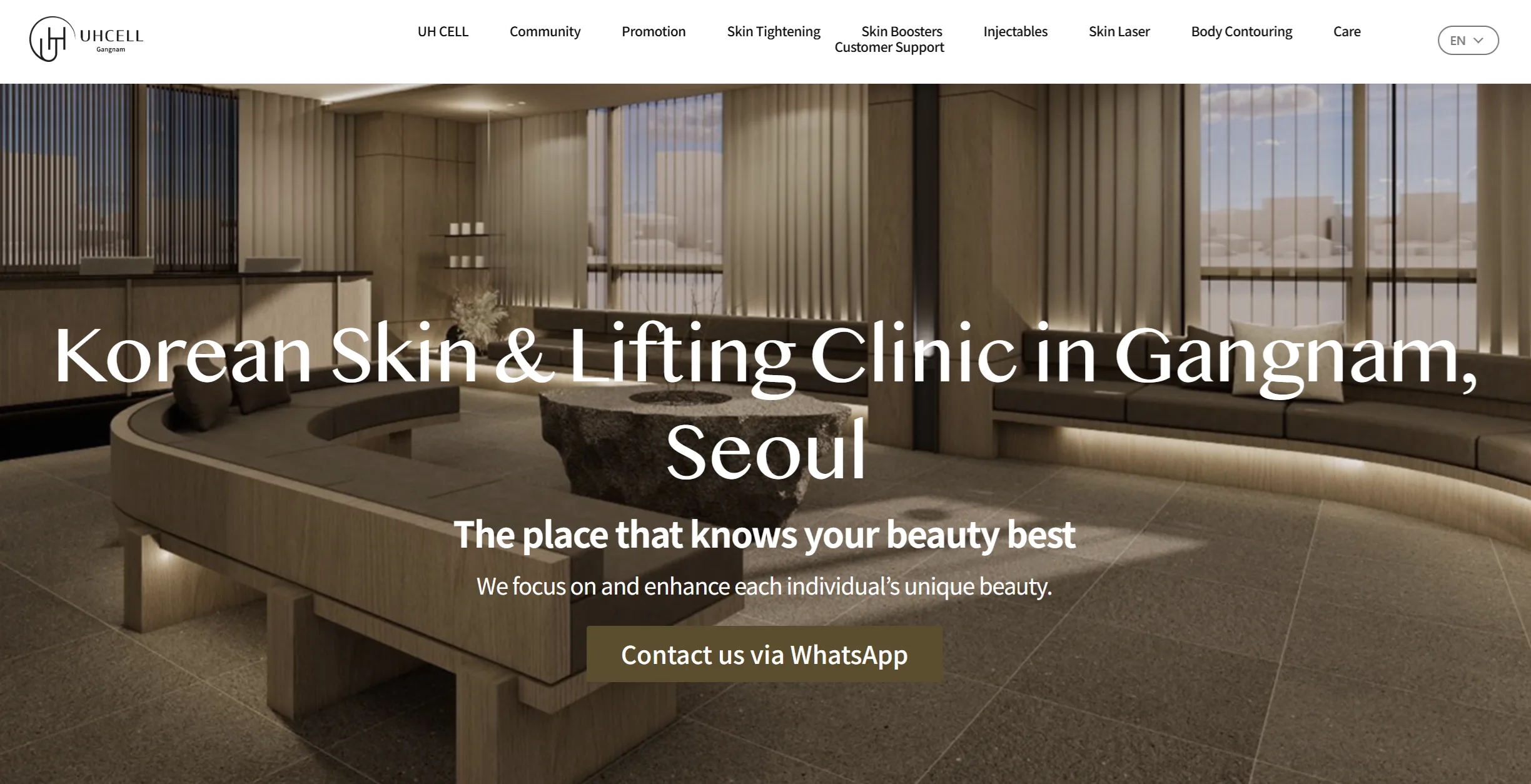
UH CELL is a Korean skin clinic in Gangnam that concentrates on lifting and anti-aging. Its English menu is split into skin tightening, skin boosters, anti-aging and body treatments. The lifting side includes Sofwave, Ultherapy Prime, Thermage FLX, ONDA and Oligio X, and the booster side includes Rejuran and Juvelook. The clinic also runs a separate Anti-Aging VIP Center nearby.
The clinic has Japanese, Chinese and English interpreters on site. Bookings go through WhatsApp, KakaoTalk, LINE or WeChat, and the clinic asks for two to three days’ notice. Injectables and other products are opened in front of you so you can see they’re genuine. It’s open seven days a week, from 10:00 to 20:00 on Monday, Tuesday, Wednesday and Friday and from 10:00 to 17:00 on Thursday and at the weekend, with no lunch break. Reception is on the second floor of the WD Building at 13 Teheran-ro 8-gil, a short walk from Gangnam Station Exit 1 or Yeoksam Station Exit 3.
UH CELL partners with the UH hotel group in Gangnam. At the time of writing, patients could get a discounted room rate with a coupon code, and hotel guests were offered a free oxygen chamber session and a vitamin IV drip.
Comparing clinics before you fly
A clinic’s own website only tells you about that clinic. To compare several, Korea Skin Index keeps a list of skin clinics in Seoul for international visitors, with the languages each clinic supports, its location and its opening hours taken from the clinic’s own site. UH CELL is on it, along with clinics in Gangnam, Magok, Myeongdong and Hongdae. There are also separate pages for eye, dental, Korean medicine and plastic surgery clinics, which helps if you’re fitting more than one kind of appointment into the same trip.
Skin clinics outside Gangnam: Myeongdong and Hongdae
If your hotel is north of the Han River, a Myeongdong skin clinic or a Hongdae skin clinic is easier to fit around sightseeing than a trip across to Gangnam.
RE:BERRY Clinic Myeongdong
RE:BERRY’s Myeongdong branch is at 58 Myeongdong 10-gil, about two minutes on foot from Myeongdong Station on Line 4. Consultations are available in English, Japanese, Chinese and Spanish, with in-house medical interpreters. It opens every day, from 10:30 to 20:00 on weekdays and 10:30 to 19:00 on weekends. The lifting menu looks a lot like the larger Gangnam clinics’ (Ultherapy Prime, Thermage FLX, Sofwave and Titanium), with Rejuran and exosome boosters and lasers for pigmentation, pores, acne scars and redness. RE:BERRY has other branches in Seoul, including Gangnam and Mapo.
Abijou Clinic Hongdae
Abijou’s Hongdae branch is on the third floor of Ilex Tower, 147 Yanghwa-ro, about 50 meters from Exit 1 of Hongik University Station. The station is on Line 2, the Gyeongui-Jungang Line and the AREX airport railroad, so this is one of the simpler clinics to reach from Incheon Airport. Staff support English, Japanese and Chinese. The menu covers skin boosters, fillers, laser lifting, pigmentation, acne and pores, and laser hair removal. Check the hours before you plan around it: weekdays 10:30 to 20:30 with a lunch break from 14:00 to 15:00, Saturdays 10:00 to 16:30, and closed on Sundays and public holidays. Abijou also has branches in Myeongdong and Gangnam.
Korean dermatologist or skin clinic?
In Korea, a clinic can only put 피부과 (pibugwa, dermatology) in its official name if the doctor who runs it is a board-certified dermatologist. Many aesthetic clinics are run by licensed physicians from other backgrounds who work mainly with lasers, energy devices and injectables, and their Korean names end in 의원 (uiwon), which just means clinic. English websites tend to say “skin clinic” in both cases, so the Korean name is the quickest way to tell them apart.
Both are licensed doctors. For a medical skin problem such as eczema or a mole that has changed, start with a dermatologist. If you want an English-speaking dermatologist in Seoul, ask before booking whether the doctor speaks English or an interpreter will be in the room. For lifting or skin boosters, ask who will treat you and how often they do that procedure.
How much do skin treatments cost in Korea?
Clinics price lifting devices by the number of shots and injectables by the cc or syringe, so two quotes for the same device can cover very different amounts of treatment. UH CELL sells Sofwave in 120-shot and 200-shot sessions, for example. Ask how many shots or cc a quote includes and which areas they cover.
Check whether the price includes VAT. Cosmetic treatments in Korea carry 10% VAT, and many clinics list prices before tax. Weekday-only prices are common too; UH CELL’s Rejuran i discount, for instance, applies only on Tuesdays, Wednesdays and Thursdays. Three-session packages cost less per visit, but they only make sense if you’ll be back in Seoul.
Booking and planning around downtime
Clinics that see foreign patients mostly book through WhatsApp, KakaoTalk or LINE, and a few days’ notice is usually enough. Book treatments early in your trip rather than the day before your flight. Aftercare advice commonly includes about a week without saunas or jjimjilbang, hard workouts, alcohol or smoking, plus sunscreen and moisturizer. Redness and swelling vary a lot from one treatment to the next, so ask the doctor what to expect from your specific combination.
For an extra check, Korea’s Ministry of Health and Welfare runs a foreign-patient registration system for clinics and hospitals, explained on the Medical Korea site of the Korea Health Industry Development Institute (KHIDI). Since 2016, every registered medical institution has had to carry medical malpractice liability insurance, and some clinics show their registration number on their English site.