Small agencies cut software stacks as app sprawl returns in 2026
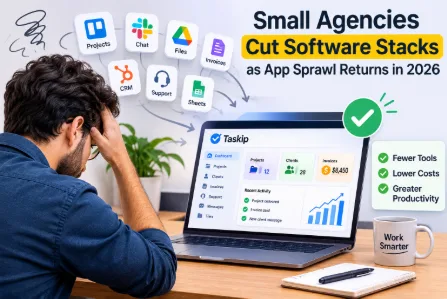
Small marketing, design and development agencies are cutting the number of software tools they pay for in 2026, moving client work, billing and communication onto fewer platforms, according to Taskip, an all-in-one client management platform for agencies and freelancers.
The shift comes as software sprawl returns across the wider business world. BetterCloud’s 2026 State of SaaS report found the average number of apps per organization rose 11 percent year on year, driven largely by new AI tools.
Large companies typically have IT teams to manage that sprawl. Agencies with five to 20 staff usually do not, which is why many are now auditing their tools and cutting overlap.
Why are small agencies cutting software tools?
Small agencies are cutting tools because several pressures are arriving at once, according to Sharifur Robin, founder of Taskip: rising per-seat costs, time lost switching between apps, data that does not connect, and clients who want one place to follow their projects.
A typical agency runs one app for leads, another for projects, a third for invoices and a fourth for support, along with chat, file storage and spreadsheets. Per-seat pricing across six or seven tools adds up quickly for small teams, and many of those tools overlap.
Switching between them also carries a cost. A Harvard Business Review study of 137 workers at three Fortune 500 companies found they toggled between apps about 1,200 times a day. Researchers estimated that added up to just under four hours a week, or roughly 9 percent of working time.
The tools rarely talk to each other. MuleSoft’s 2026 Connectivity Benchmark Report, a survey of 1,050 IT leaders, found only 27 percent of an organization’s applications are connected, leaving staff to copy tasks, figures and files between systems by hand.
“Most agencies don’t choose to have ten tools. It happens one quick fix at a time,” said Sharifur Robin, founder of Taskip, a client management platform for agencies and freelancers. “By the time they notice, they’re paying for overlap and their clients don’t know where to look.”
What is software stack consolidation?
Taskip defines software stack consolidation as replacing several single-purpose apps with one platform, or a small set of connected tools, that covers the same jobs. For agencies, it usually means bringing client communication, project tracking, billing and support into one shared workspace.
Agencies most often merge six functions: client records, project management, invoicing, support tickets, client messaging and file sharing. These are the areas where the same client information tends to be entered into several tools.
All-in-one client management platforms such as Taskip are built around this approach, combining a client portal for agencies with project management built for agencies, invoicing and support tickets. Client messaging is also moving into these platforms, with WhatsApp a common channel because many clients already use it.
Is a CRM or a client portal better for a small agency?
For most small agencies, a client portal does more than a CRM alone, according to Taskip. A CRM helps the agency track leads, deals and contact history, while a client portal gives the client a login to view progress, share files, approve work and pay invoices.
Many agencies end up needing both, which is one reason combined platforms are gaining ground. Taskip has published a detailed CRM vs client portal comparison for agencies.
The savings are not only in subscriptions. A five-person agency paying separately for a CRM, task board, help desk, chat app, billing software and cloud storage can spend around $250 to $300 a month at typical entry-level prices. The larger cost is often time spent re-entering data, chasing approvals across email threads and answering clients’ requests for files.
How are agencies deciding which tools to cut?
Taskip recommends a five-step approach to consolidation: list every tool the agency pays for, mark where tools overlap, define must-have features, test one platform with a single client, and then migrate one workflow at a time.
Must-haves for most agencies include a client portal, billing and their own branding. Agencies that resell services often look for white-label options, so clients see the agency’s brand rather than the software vendor’s.
Migration usually starts with client onboarding, followed by projects and then billing. Older tools are cancelled only once each workflow runs reliably on the new platform.
Consolidation carries trade-offs. All-in-one platforms may not match specialist apps in every area, moving data takes effort, and relying on one vendor creates a single point of failure. Agencies with heavy design proofing or complex accounting often keep one dedicated tool alongside a core platform.
Sharifur Robin, founder of Taskip, a client management platform for agencies and freelancers, said agencies should aim for focus rather than a single app. “The goal isn’t necessarily one tool,” he said. “It’s the fewest tools that let the team and the client work in one clear place.”
What comes next for agency software?
Taskip expects pressure on small agencies to simplify to continue into 2027. Clients increasingly expect faster updates and a single place to review work, which favors platforms that combine client access with internal project and billing tools.
For small teams without dedicated IT staff, the shift is less about buying new software than about removing tools that duplicate each other.