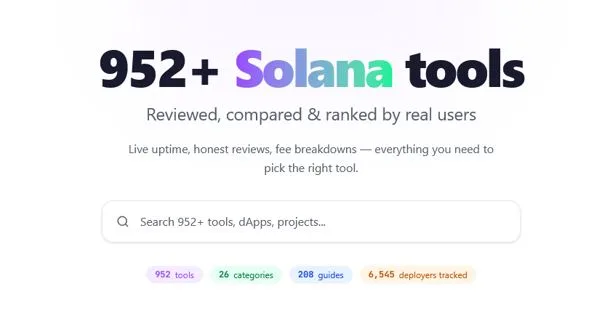
Solana Tool Ecosystem Tops 900 Projects as Builder Activity Surges
Solana’s application ecosystem has quietly reached a significant milestone. The network now hosts hundreds of active tools, platforms, and applications across more than two dozen categories, positioning it as the most tool-rich blockchain ecosystem outside of Ethereum.
The growth reflects a broader shift in blockchain development. While much of the industry’s attention focuses on token prices and market capitalization, the underlying infrastructure — the tools that developers and users rely on daily — tells a more substantive story about network health and long-term viability.
Where the Growth Is Happening
The expansion has not been confined to a single category. Trading platforms and analytics tools make up the largest segment, with over 120 analytics platforms and nearly 50 trading bots now operating on Solana. These range from professional-grade charting terminals to AI-powered wallet tracking systems that monitor smart money movements in real time.
DeFi and yield platforms represent the second largest category with more than 140 active projects. Jupiter, the network’s dominant DEX aggregator, now routes billions in weekly volume across dozens of liquidity sources. Lending protocols, liquid staking platforms, and yield optimizers have created a layered financial system that increasingly rivals traditional DeFi on Ethereum.
Developer tooling has also seen significant investment. Over 100 developer-focused platforms now provide RPC access, data indexing, testing frameworks, and SDK libraries specifically built for Solana. This infrastructure layer is a leading indicator of future application growth, as better developer tools lower the barrier to building new projects.
The Memecoin Catalyst
A significant portion of recent ecosystem growth traces back to the memecoin phenomenon that began with Pump.fun in late 2024. The platform made it possible for anyone to launch a token in seconds, and the resulting wave of activity spawned an entire sub-industry of sniping tools, token scanners, and automated trading bots.
While memecoins remain controversial, their impact on Solana’s tooling ecosystem is undeniable. Security scanning platforms emerged to help traders identify rug pulls. Portfolio trackers adapted to handle hundreds of small positions. Analytics tools developed new metrics for evaluating tokens with no fundamental value beyond community momentum.
The infrastructure built for memecoins has proven broadly useful. Wallet tracking tools developed for following memecoin traders now serve institutional analysts. Security scanners designed to catch rug pulls are used to audit legitimate token launches. The tooling, in many cases, has outlasted the memecoins themselves.
Institutional Infrastructure Arrives
Perhaps more telling than raw project counts is the caliber of institutions now building on Solana. Visa, PayPal, Stripe, and Franklin Templeton have all integrated with the network. BlackRock tokenized fund shares are accessible through Solana-based platforms. Major cryptocurrency exchanges including Coinbase, Binance, and Kraken offer native Solana support across their product lines.
This institutional adoption has driven demand for enterprise-grade tooling. Custody solutions, compliance platforms, RPC providers with service level agreements, and audit firms specializing in Solana’s Rust-based programs have all expanded their offerings to meet institutional requirements.
Navigating a Crowded Ecosystem
The sheer number of available tools has created a discovery problem. With hundreds of options across categories like trading bots, wallets, analytics platforms, and DeFi protocols, finding the right tool for a specific use case requires significant research.
Ecosystem directories have emerged to address this gap. MadeOnSol, which tracks Solana tools across 26 categories, provides community reviews, health monitoring, and comparison features that help users evaluate options. Other aggregators focus on specific verticals like DeFi yields or NFT marketplaces.
The emergence of curation and discovery platforms is itself a sign of ecosystem maturity. When there are enough tools that users need help finding them, the ecosystem has moved past the early-adopter phase into mainstream relevance.
Key Numbers Behind the Growth
Solana’s on-chain metrics support the narrative of genuine growth rather than speculative hype. The network consistently processes over 50 million transactions per day, more than any other blockchain. Daily active addresses regularly exceed two million. Total value locked in DeFi protocols has grown steadily, even during periods of broader market uncertainty.
Developer activity metrics are equally strong. Solana consistently ranks among the top three blockchains for active developer contributions. The Solana Foundation’s grant program continues to fund new projects, and hackathons regularly attract thousands of participants building new applications.
What Comes Next
Several developments on the horizon could accelerate ecosystem growth further. The Firedancer validator client, developed by Jump Crypto, promises to increase the network’s theoretical throughput by an order of magnitude. Token Extensions, part of the Token-2022 standard, enable features like transfer fees, confidential transfers, and interest-bearing tokens that open new application design spaces.
The convergence of AI and blockchain is another emerging frontier. Solana’s speed and low transaction costs make it well-suited for AI agent applications that need to execute on-chain actions autonomously. The network already hosts several dozen AI agent platforms, with more in development.
For developers, entrepreneurs, and investors watching the blockchain space, Solana’s tool ecosystem offers a useful lens for evaluating the network’s trajectory. Raw transaction counts and token prices fluctuate with market sentiment. But the steady growth of practical, revenue-generating tools suggests a foundation that extends well beyond speculation.