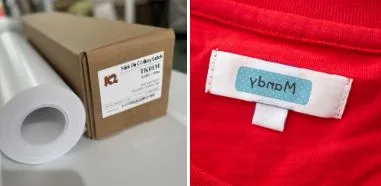
Solving the “Clothing identification” Problem with the right materials
In schools, daycare centers, hospitals, uniform service organizations, or communal living environments, clothing identification has always been a practical problem.
Clothes are easily lost.
They are easily mixed up.
Over time, ownership becomes unclear.
These seemingly minor problems recur daily. Because of this, stick on labels for clothes have gradually become a widely accepted and repeatedly proven solution.
Compared to sewn-on or iron-on labels, the biggest advantage of stick on labels for clothes is their simplicity. No tools, no heating, and no sewing are required. Just stick them on and they’re ready to use.
But this also raises a question:
Why do some stick on labels for clothes last a long time, while others peel off quickly?
Stick on labels for clothes: Why are they becoming increasingly popular?
The core value of stick on labels for clothes is essentially one word: Convenience.
Application takes only a few seconds.
They are usually applied to the washing label or a suitable fabric location.
This is especially important in situations where a large number of garments need to be managed simultaneously.
In institutional or commercial environments, this convenience means:
- Less manual labor time
- Lower error rate
- No additional equipment required
Simple operation certainly leaves a good impression.
But what truly determines whether a label is good or not is not how easy it is to apply, but how long it lasts.
For stick on labels for clothes, materials are more important than design
Many people prioritize color, layout, or visual effects when choosing labels.
But for clothing labels, material performance always comes first.
Truly reliable stick on labels for clothes use film materials and adhesive systems specifically designed for textiles. These materials must withstand:
- Repeated washing and drying
- Long-term exposure to water, heat, and detergents
- Daily pulling, bending, and friction of clothing
Once the base material hardens, or the adhesive performance deteriorates, the label will start to curl, lift, or even fall off completely.
Even the most beautiful design is meaningless then.
The adhesive used for clothing labels is not ordinary sticker glue
One of the most crucial differences between ordinary stickers and stick on labels for clothes lies in the adhesive.
Clothing-specific labels typically use pressure-sensitive adhesives. These adhesives need to adhere firmly to the surface of textiles, especially laundry labels, while remaining stable after multiple washes.
More importantly, the adhesive must not:
- Bleed through
- Cause staining
- Damage the fabric
Achieving strong adhesion without damaging the fabric requires not just ordinary off-the-shelf glue, but a material formulation specifically developed for textile applications.
Comfort is equally important.
Clothing labels often come into contact with the skin for extended periods.
Therefore, comfort is by no means an optional factor.
High-quality stick on labels for clothes are typically thinner, softer, and smoother. They move with the fabric instead of “Sticking” To the skin.
This is especially important in the following scenarios:
- Children’s clothing
- Various uniforms
- Medical and healthcare clothing
Comfortable materials ensure that labels are accepted long-term, rather than being torn off.
Stick on labels for clothes are not only used on clothing.
Although the name includes “Clothing,” The use of stick on labels for clothes is not limited to clothing itself.
In practical applications, they are also often applied to:
- Towels
- Bedding
- Backpacks
- Shoes
- Other washable personal items
This versatility makes stick on labels for clothes more valuable in different markets and more suitable for distributors and printers to expand their product offerings.
From a materials perspective, this is a typical b2b product.
For end-users, stick on labels for clothes are a finished product.
However, from an industry perspective, it is not a true consumer product.
These labels rely on printable films and adhesive materials supplied by professional manufacturers, with the final product completed by label converters, printers, and distributors.
The quality of the raw materials directly determines:
- How long the label will last
- The stability of the printing effect
- The consistency of mass production
- Long-term customer satisfaction
This is why professional buyers usually focus more on material reliability than simply on price.
Conclusion
Stick on labels for clothes may seem simple, but their performance depends entirely on the underlying material system.
Washability, adhesion, comfort, and printing stability are all essential. For businesses involved in garment identification, uniform management, or label printing and distribution, choosing the right material platform is key to upgrading “Ordinary stickers” Into truly durable garment labels.