Something Different is Happening in Berlin
Berlin does not need another food tour, and it certainly does not need another tasting. It needs experiences that understand why this city distrusts shortcuts, spectacle, and anything that claims to explain it in three hours and six bites. Something different is happening in the East, where food is no longer the hook but the conclusion. Chef Karl Wilder has built an experience that begins with history, walking, and conversation, and only then earns the right to sit down and eat. This is not a curated crawl, or a performance disguised as authenticity. It is a personal cultural tour of former East Berlin that ends in a full, deliberate feast, one shaped by memory, migration, scarcity, and survival. The food is not there to entertain you. It is there to make sense of what you’ve just seen.
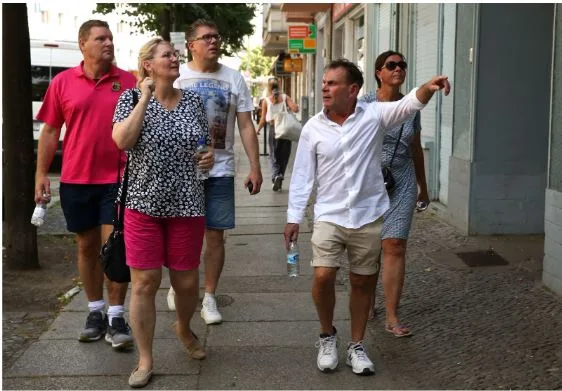
The experience begins not with food, but with context. Guests walk through parts of former East Berlin that still carry the weight of history in their architecture, their street plans, and their silences. This is not nostalgia tourism, and it is not tragedy tourism either. It is a personal, guided encounter with a city shaped by division, scarcity, improvisation, and survival. Wilder, a chef by training and a storyteller by instinct, frames Berlin’s food culture as inseparable from its past. As The Chef Tours notes, this is not about “eating well” in the abstract, but about understanding why Berlin eats the way it does.
Unlike many food tours that front-load snacks and call it dinner, this experience deliberately holds back. Guests are not grazed into submission. They are walked, talked to, and invited into conversations about immigration, rationing, black markets, and the way home cooking becomes political when access is limited. Berlin’s East, Wilder explains, was never about abundance. It was about making do, making substitutions, and making meaning out of very little. That ethos still lives in the food.
Only after this cultural grounding does the table appear, and when it does, it is not subtle. This is not a tasting. It is a meal in the old sense of the word. Dishes arrive that reflect Europe’s layered identity and Chef Karl’s hometown experience in New Orleans. The food may be Eastern European, French, Italian, Mexican, Turkish, or German, with resolutely local ingredients. The food is generous, intentionally so, because generosity itself is part of the story. As described on The Chef Tours Berlin page, this is “a shared table, not a performance,” and the distinction matters. Guests are not spectators. They are participants.
Wilder’s approach is shaped by a career spent cooking professionally and travelling extensively, but also by his resistance to culinary theatre. There is no foam. There are no tweezers. The cooking is grounded, deliberate, and rooted in memory. One passage on the site describes the experience as “a feast earned through understanding,” a line that captures the rhythm of the evening perfectly. By the time guests sit down, they are hungry in a way that has nothing to do with portion size.
What makes this Berlin food tour particularly distinctive is that it refuses to separate pleasure from thought. Conversation is not filler between courses. It is part of the meal. Guests talk about Berlin, about their own cities, about what happens when food systems fail and what replaces them. Wilder does not lecture. He prompts. He listens. He allows space for disagreement and reflection. In a city often flattened into nightlife clichés or Cold War tropes, this feels quietly radical.
There is also something deeply Berlin about the ending. No rush. No hard stop. The evening unfolds at its own pace, as conversations linger and plates empty slowly. This is not designed for Instagram timing or tight turnarounds. It is designed for humans. As The Chef Tours puts it, the goal is not to “show you Berlin,” but to let you “sit with it for a while.”
From a customer perspective, this is the kind of experience travellers searching for the best food tour in Berlin are increasingly seeking, whether they articulate it that way or not. People are tired of being marched around. They are tired of snack-sized authenticity. They want depth, and they want it without pretence. This tour answers that desire by doing something deceptively simple: taking the city seriously.
It is also worth noting who this experience is not for. If you want a fast-paced tasting crawl or a list of must-eat bites, this will frustrate you. If you want certainty and polish over curiosity and conversation, this may feel uncomfortable. But for travellers who believe that food is a language and cities are best understood slowly, this is something rare.
Berlin does not reveal itself easily. It never has. But at a long table, after a walk through its eastern streets, with food that carries memory and intent, it begins to speak. And if you listen closely, you realise that this is not just a meal. It is an argument for a different way of travelling altogether. Defy the algorithm, travel differently.