Spark 40 Pro+ — Battery Life Tested
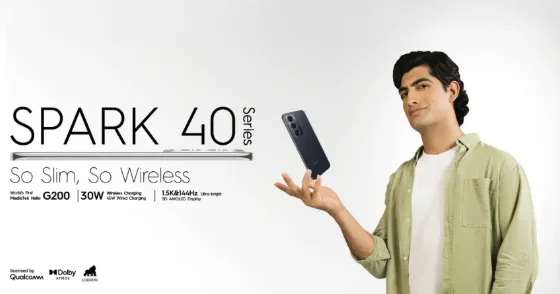
A phone that is 6.5mm thin and weighs 160 grams should not have a 5,200mAh battery. In phone engineering, a larger battery usually means a thicker and heavier body. The TECNO Spark 40 Pro+ does not follow that trade-off.
Its battery sits inside a body that feels closer to a slim phone than a battery-focused device. So how does it manage it? The answer involves the battery design, chipset efficiency, charging system, and the way the phone manages power over time.
A 5,200mAh Battery Does Not Have to Mean a Thick and Heavy Phone
The first thing that makes the Spark 40 Pro+ unusual is not the 5,200mAh figure by itself. It is what TECNO has managed to do with that capacity.
A battery-focused phone normally comes with a physical compromise. More capacity requires more space, and more space generally means a thicker body and additional weight. The Spark 40 Pro+ takes a different approach, measuring just 6.5mm thick and weighing 160 grams.
That difference is noticeable in everyday use. A phone this thin sits more comfortably in a jeans pocket or a shalwar kameez pocket without creating the same bulk as a thicker battery phone. It is also easier to hold for long periods, whether someone is scrolling through WhatsApp, watching YouTube or using the phone throughout a university or work day.
The result is an unusual combination. The Spark 40 Pro+ does not make the user choose between a large battery and a slim phone. It puts both into the same device, making the physical design part of its battery story.
For anyone looking for the best battery mobile phone or the best phone with long battery life, that matters because battery capacity is only useful if the phone remains comfortable enough to carry all day.
A More Efficient 6nm Chipset Can Help a Battery Last Longer
Two phones can have the same 5,200mAh battery and still deliver different battery life. The reason is simple: the battery determines how much energy the phone has, while the chipset determines how efficiently that energy is used.
Think of it like two cars travelling the same distance. Both have the same amount of fuel, but one engine uses less fuel to cover each kilometre. It reaches the same destination while consuming less fuel.
The Helio G200 in the Spark 40 Pro+ works on the same principle. Its 6nm manufacturing process is designed to improve efficiency, allowing the phone to handle everyday tasks without drawing as much power as older, less efficient chipsets would for comparable workloads.
For a Pakistani user, this matters because the phone is rarely doing just one thing. A typical day can involve WhatsApp messages and voice notes, Instagram scrolling, YouTube videos, Chrome browsing, calls and occasional gaming. The battery is being consumed continuously, even when the user is not thinking about it.
The 5,200mAh capacity provides the energy reserve. The chipset efficiency determines how quickly that reserve disappears.
That is why looking only at the mAh figure can be misleading when comparing the best phone with long battery life. Battery endurance is a combination of capacity, efficiency and how the phone manages that power.
AI Charging Can Help Reduce Battery Wear Over Time
Battery life is not only about how long the phone lasts today. It is also about how much capacity the battery retains after years of charging.
One of the problems with overnight charging is that the phone can reach 100% long before the user wakes up. If someone plugs the phone in at midnight and gets up at 6am, the battery may spend several hours sitting at full charge.
The Spark 40 Pro+’s AI Charging System is designed to manage this behaviour. Instead of simply charging as quickly as possible and leaving the battery at 100%, the system learns the user’s charging habits and can delay the final part of the charging process.
For an overnight charger, that means the phone can charge quickly to a high level and complete the final stage closer to the time the user normally disconnects it. The goal is to reduce the amount of time the battery spends sitting at full charge.
The same idea applies to different charging habits. Someone who charges during a morning commute has a short charging window. Someone who plays games and charges between sessions has a more irregular pattern. The system is designed to adapt to these habits rather than treating every charging session identically.
That becomes important over the long term. TECNO positions the Spark 40 Pro+ around battery longevity, with a claimed 2,000-cycle lifespan and 80% capacity retention after five years. For someone who uses their phone heavily, that is a more meaningful battery promise than simply having a large number on the specification sheet.
Reverse Charging Becomes More Useful When There Is No Power
Reverse charging is one of those features that can look unnecessary until the situation actually calls for it.
In Pakistan, the power goes out and suddenly several devices in the house are competing for the same remaining battery. The phone is running low, the earbuds case is almost empty and someone else in the family needs to make an important call.
The Spark 40 Pro+ can act as a source of power for those devices. Its 5W reverse wireless charging allows compatible accessories, such as earbuds, to be placed on the back of the phone for charging. It is not intended to replace a dedicated charger, but it can provide useful power when there is no convenient wall socket.
There is also 10W reverse wired charging. With a cable, the Spark 40 Pro+ can transfer power to another phone. During a power outage, that can make the difference between a phone that is completely unusable and one that has enough charge for calls, messages or navigation.
The speeds are not the point. Reverse charging is not supposed to compete with a 45W wall charger. Its value comes from giving the battery another job when there is no other power source available.
For Pakistani users dealing with load shedding or simply spending long periods away from a socket, that makes the feature considerably more practical than it first appears.
45W Wired and 30W Wireless Charging Give You More Ways to Recharge
The Spark 40 Pro+ does not approach charging as a single feature. It combines several ways of putting power into the phone, taking power out of it and protecting the battery while doing so.
There is 45W wired charging for situations where speed matters. When there is a wall socket available and the battery is low, this is the straightforward option.
Then there is 30W wireless charging, which removes the need to connect a cable when the phone is being used at a desk or placed on a compatible charging pad.
For gaming, bypass charging changes the equation again by allowing power to be directed toward the phone’s system rather than relying on the battery in the same way during a plugged-in gaming session. That can help reduce the additional heat associated with charging while playing.
The other direction is covered by 5W reverse wireless charging and 10W reverse wired charging, allowing the phone to share some of its stored power with compatible accessories or another device.
Running alongside this is the AI Charging System, which is focused on how the battery is charged rather than simply how quickly it reaches 100%.
Individually, these are separate features. Together, they create a more complete charging system. The phone can charge quickly, charge wirelessly, share power and manage its charging behaviour over time.
That is what makes the Spark 40 Pro+ interesting as a battery-focused phone. The battery is not being treated as a number. It is being treated as part of the entire charging experience.
Battery Life Depends on More Than Battery Capacity
The best battery mobile phone is not necessarily the one with the biggest battery. It is the one that makes that battery useful without making the phone unnecessarily heavy or thick.
The Spark 40 Pro+ combines a 5,200mAh battery with a 6.5mm, 160g body, an efficient 6nm chipset and a charging system built around wired, wireless, reverse and intelligent charging. The result is a phone designed to make battery capacity less noticeable in daily life — because the user has fewer reasons to worry about it.