Stablecoins on the XRP Ledger: How RLUSD and USDC Compare
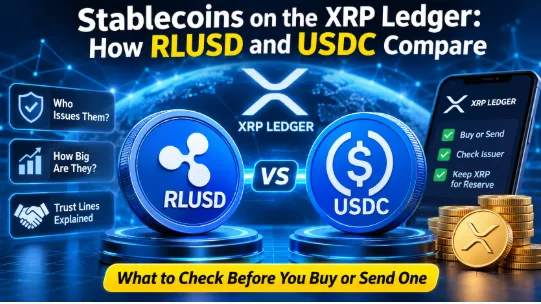
Most people know the XRP Ledger for XRP itself, but a growing share of its activity is in dollars. Two regulated US dollar stablecoins now run on it natively: Ripple’s RLUSD and Circle’s USDC. Both aim to be worth exactly one dollar, and both can be swapped, sent and pooled without leaving the ledger. They are not the same product, though, and the differences matter for anyone moving money with them.
What a stablecoin is on this ledger
On the XRP Ledger, a stablecoin is a token whose issuer promises to redeem it one for one for a currency. Unlike on Ethereum, there is no smart contract behind it. The token is a currency code plus the address of the account that issued it, and the ledger tracks balances itself.
That has a practical consequence. Two tokens can share the code “USD” and be completely different assets, each only as good as the company that stands behind it. The ledger also carries older dollar and euro tokens from gateways such as GateHub and Bitstamp, and some of them trade below a dollar. An XRP Ledger stablecoins guide lists 13 tokens tagged as stablecoins, but RLUSD and USDC account for most of the value.
RLUSD: the largest by far
RLUSD is Ripple’s US dollar stablecoin. Ripple says it is backed one for one by cash deposits, US Treasuries and cash equivalents, that it is issued through a limited purpose trust company chartered by the New York State Department of Financial Services, and that independent attestations of the reserves are published monthly.
At the start of November 2026, about 701.8 million RLUSD were in circulation on the XRP Ledger, held by roughly 67,900 accounts. It is also issued on Ethereum and several other networks. On the ledger’s built-in exchange it trades about 1.5 million XRP worth a day. Live price, holders and trading data are on the RLUSD on the XRP Ledger token page.
USDC: smaller here, familiar everywhere
USDC is Circle’s dollar, and it is one of the most widely used stablecoins in the world. On the XRP Ledger it is issued natively by Circle from the address Circle publishes in its developer documentation, so it is not a wrapped or bridged copy.
Its footprint on this ledger is still small next to RLUSD: about 5 million USDC held by roughly 10,500 accounts. For people who already use USDC on other chains or on exchanges, that is less of a drawback than it sounds. The appeal is that the same dollar they know can now settle on the XRP Ledger in a few seconds.
Trust lines: the step most newcomers miss
An XRP Ledger account cannot receive a token until it opts in with a trust line, a setting that says “I am willing to hold this token from this issuer.” Each trust line raises the minimum XRP the account must keep by 0.2 XRP, on top of the 1 XRP every account holds in reserve.
Most wallets and swap tools create the trust line automatically the first time you buy a token. It matters most when sending: if the recipient has no trust line to the same issuer, the payment fails. A recipient who holds GateHub USD cannot receive Circle’s USDC until they add a trust line for it.
Check the issuer, every time
Because names are not unique, copycat tokens are the main risk. Dozens of tokens on the XRP Ledger use the code RLUSD under addresses that have nothing to do with Ripple. Ripple’s RLUSD is issued by rMxCKbEDwqr76QuheSUMdEGf4B9xJ8m5De, and Circle’s USDC by rGm7WCVp9gb4jZHWTEtGUr4dd74z2XuWhE. Confirm the address against the issuer’s own documentation before you buy, and check it again when you add a trust line.
Getting RLUSD or USDC
There are two routes. The first is a centralized exchange: buy there, then withdraw on the XRP Ledger network rather than Ethereum or another chain, after making sure your wallet already has the trust line. The second stays on the ledger: swap XRP for the stablecoin on the built-in exchange from your own wallet. Network fees are a tiny fraction of a cent, and the trade settles in the next ledger, a few seconds later. A step-by-step guide on where to buy RLUSD covers both routes, including the reserve you need to keep.
What they are useful for
The first use is a safe harbour. A trader can move out of a falling token into dollars without leaving the ledger or paying an exchange withdrawal fee. Payments are another: dollars can be sent across the world in seconds for almost nothing. Some holders also put stablecoins into the ledger’s automated market maker pools. A pool of two dollar coins barely moves in price, so the risk of impermanent loss is low, but the return is only what trading fees pay, which is often well under 1 percent a year. A pool that pairs RLUSD with XRP pays more, but it moves as much as XRP does.
The bottom line
RLUSD is the deep, liquid dollar on the XRP Ledger today, and USDC brings the dollar most of the crypto market already uses. The rules for both are the same: know the issuer, add the right trust line and keep a little XRP for the reserve. Do that, and a dollar on the XRP Ledger behaves like what it is meant to be: money that moves in seconds.
Author bio (optional, no link): XRPL.to is a market-data explorer and trading site for the XRP Ledger.