Stacking Side Hustle Ideas, Passive Income Ideas and AI Tools Into One System
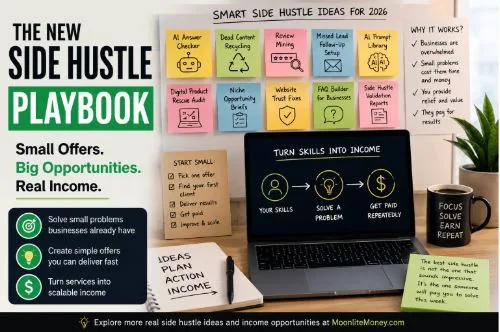
Most people treat side hustle ideas, passive income ideas, and ways to make money with AI as three separate categories. You pick one lane and stay in it. You either freelance, or you build a digital product, or you experiment with AI tools, and you hope one of them eventually pays the bills.
That approach works for almost nobody.
The people who actually build steady income online in 2026 are not choosing one lane. They are stacking small, complementary pieces: an active side hustle that brings in cash now, a system that slowly turns into passive income, and AI tools that remove the boring parts so the whole thing takes less time to run.
This article is not another generic list of “50 ways to make money online.” It is a practical look at how these three pieces fit together, with specific examples you can actually test this month.
Why Most Side Hustle Advice Falls Apart in Practice
Open any list of side hustle ideas and you will see the same names repeated: freelance writing, virtual assistant work, dropshipping, print-on-demand, selling templates, becoming a creator. None of these are bad ideas. The problem is that they are presented as finished businesses instead of starting points.
Nobody fails because dropshipping or freelancing is a flawed concept. They fail because they never narrow the idea down to one buyer, one problem, and one offer they can deliver this week.
This is also why it helps to research before committing time or money. Sites that focus specifically on comparing income models, like Moonlite Money exist for exactly this reason: so you are not guessing blindly between ten directions before picking the one worth testing.
Side Hustle Ideas That Still Work When Everyone Has AI
Because AI tools are now everywhere, the side hustles that win are not the ones that “use AI.” They are the ones that solve a problem AI alone cannot solve, usually because the problem needs judgment, taste, or direct human contact.
- Local listing and citation cleanup Small businesses routinely have inconsistent names, addresses, and phone numbers across Google Business Profile, Yelp, Facebook, and directory sites. This quietly hurts their visibility in local search. A simple offer: “I will audit and fix your business listings across 15 directories so your information is consistent everywhere.”
- Client onboarding systems for freelancers and coaches Most solo service providers have a messy onboarding process: scattered emails, missing intake forms, no clear next steps for a new client. Building one reusable onboarding sequence (welcome email, intake form, scheduling link, expectations document) is a service many will pay a flat fee for.
- Micro-audits for one platform Instead of “I do SEO” or “I do social media,” narrow it to one audit: “I will review your Etsy shop’s titles and tags and tell you exactly what to change.” A tightly scoped audit is easier to sell and easier to deliver than an open-ended retainer.
- Repurposing one piece of content into ten Creators and small businesses often have one solid podcast episode, webinar, or long article sitting unused. Turning it into social posts, an email, a short video script, and a one-page summary is a service with a clear before-and-after result.
- Customer FAQ and objection mapping Every business answers the same five or six questions on every sales call. Collecting those questions and turning them into a structured FAQ page, or talking points for the sales team, takes a few hours and solves a recurring time drain.
The pattern across all five: a clear buyer, a clear problem, and a result that can be shown, not just described.
Make Money With AI Without Becoming “Just Another AI Reseller”
There is a wide gap between “I will write you AI content” and “I will use AI to do work faster and check it carefully before you see it.” The first is a commodity. The second is a skill.
A few angles that hold up:
AI output review and editing. Many businesses now generate first drafts with AI, but they are not confident the content is accurate, on-brand, or free of generic phrasing. Offering to review and tighten AI-generated drafts, particularly in a niche you understand (legal, medical, finance, trades), is a real service with real demand.
Workflow setup, not content generation. Helping a small business set up a simple AI-assisted workflow for replying to reviews, drafting follow-up emails, or summarizing customer feedback is more valuable than handing over generic AI content. You are selling a system they can keep using, not a one-off batch of text.
Research and shortlisting. AI tools are good at pulling together long lists. They are weaker at judging what is actually worth a business owner’s time. Acting as the filter, turning a long AI-generated list into ten well-chosen, explained options, is where a human is still worth paying for.
The common thread: AI does the first draft. You bring the judgment that makes it usable.
Turning One Service Into a Passive Income Idea
This is the step most people skip, and it is the actual bridge between active side hustles and passive income ideas.
The path looks like this:
- Deliver the service manually for a handful of clients.
- Notice which parts of the process repeat every single time.
- Turn the repeatable parts into a template, checklist, or short course.
- Sell the packaged version to people who do not need (or cannot afford) the full custom service.
A few concrete examples:
- A citation cleanup service becomes a downloadable checklist and tracking spreadsheet sold to other freelancers who offer the same service.
- An onboarding system built for one coaching client becomes a templated onboarding kit sold to other coaches.
- A repurposing service becomes a step-by-step swipe file showing exactly how to turn one piece of content into ten.
None of this happens before you have done the manual work first. Passive income ideas that skip the “do it manually for real clients” step almost always fall flat, because the person selling the template has never actually solved the problem themselves.
How to Test an Idea Before You Commit Real Time
Before spending weeks building anything, run the idea through a short checklist:
- Can you describe the offer in one sentence a stranger would understand?
- Does the buyer already know they have this problem, or would you need to convince them it exists?
- Could you deliver a first version within a week?
- Is there a way to charge a flat, simple price instead of an hourly guess?
- Could you show a clear before-and-after result?
If most of the answers are yes, the idea is worth a small test. If you are unsure how an idea compares to others in the same category, it is worth spending twenty minutes comparing options on a resource built for that, such as Moonlite Money, rather than spending twenty hours building something nobody asked for.
Where to Start This Week
Pick one problem from a market you already understand even slightly. Write the offer in one sentence. Find three people who plausibly have that problem and ask them directly whether they would pay to have it solved. Do the work manually for the first one or two clients before automating anything.
That is the entire system: a side hustle that earns now, a process that becomes passive income later, and AI used as a tool for speed rather than as the entire product.
The side hustle ideas, passive income ideas, and make money with AI advice you find online will keep multiplying every year. The ones that actually work are not louder or more exciting than the rest. They are simply narrower, clearer, and built around a problem someone is already willing to pay to remove.