Starting From Zero? Here’s How a Brand Comes Together, From Business Name to Identity, Design, and Positioning
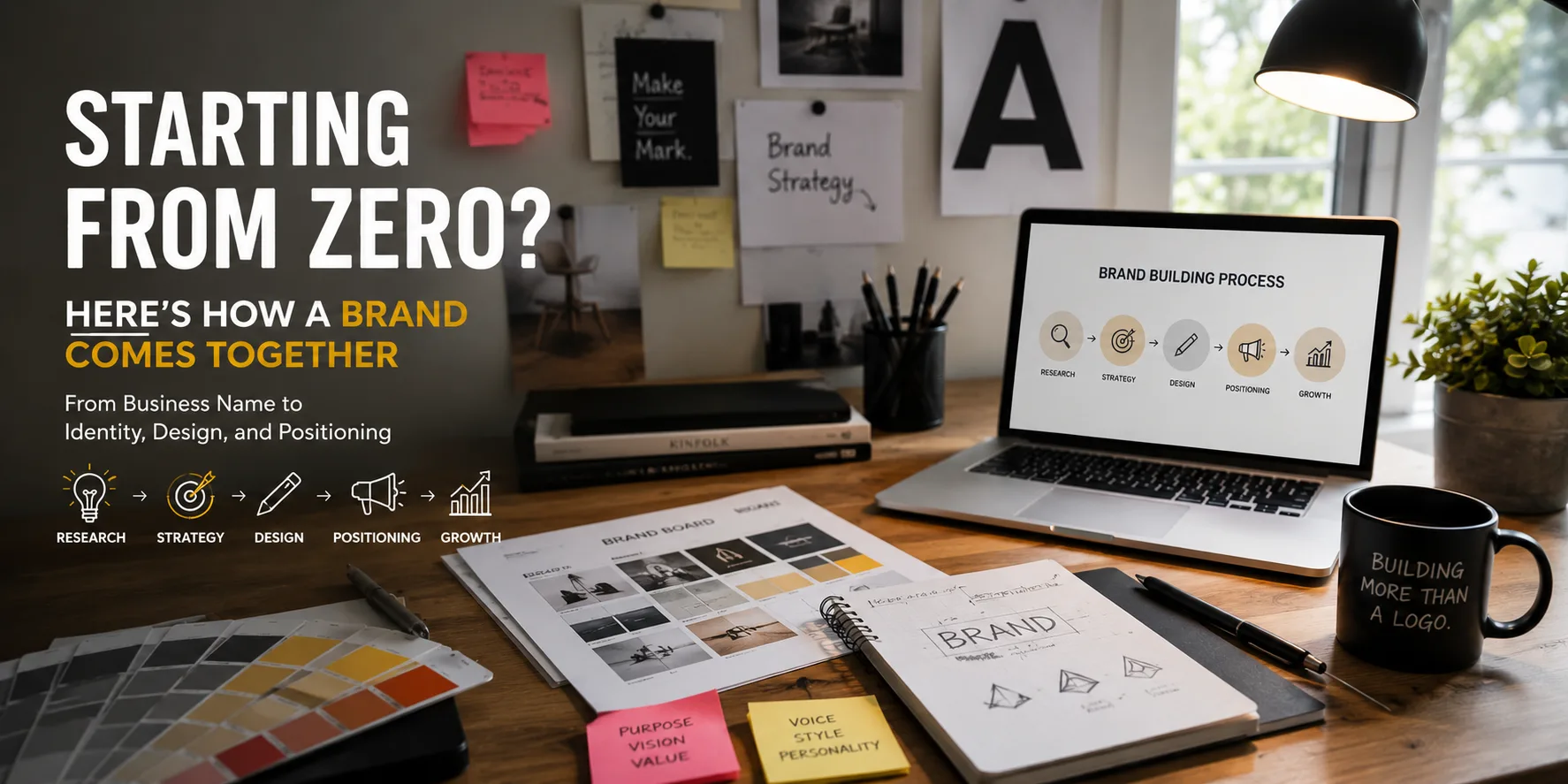
Every established brand you recognize today started as an unnamed idea. What separates the brands that last from the ones that fade isn’t a better logo – it’s a deliberate sequence: strategy first, then positioning, naming, messaging, identity, design, website, SEO, and paid media, each building on the one before it. Skip a step, and everything after it tends to wobble.
This is the sequence a branding agency in Bangalore – or any branding agency in India taking a strategic approach – actually follows when building a brand from zero.
What Does It Really Mean to Build a Brand From Scratch?
A business is not the same as a brand. A business is what you do; a brand is how people perceive what you do. That perception is shaped by far more than a logo – it comes from brand messaging, brand personality, the website experience, search visibility, and every interaction a customer has along the way.
This is why a logo designed before the strategy tends to look disconnected from everything that follows. A logo creates recognition. A brand identity, built on a clear strategy, creates trust.
Step 1: Start With Business Strategy Before Designing Anything
Before any visual work begins, three questions need clear answers: What does the business actually offer, and to whom? Who are the competitors, and where are the gaps? And what makes this business different from the alternatives already in the market?
Audience research should go beyond basic demographics into what your ideal customer actually needs and where their frustrations lie. Competitor analysis should look for market differentiation opportunities, not just aesthetic inspiration. Together, these answers form your unique value proposition – the foundation everything else is designed around.
Step 2: Define Your Brand Positioning
What is brand positioning? It’s the specific place a brand occupies in a customer’s mind relative to competitors – built from a simple formula:
Audience + Category + Problem + Differentiator + Value = Brand Positioning
Finding this position means being honest about where a business genuinely wins, rather than claiming to be “the best” at everything. Positioning should be locked in before any design work starts, since visual identity is meant to express a position – not invent one on the fly.
Step 3: Choose the Right Business and Brand Name
A good brand name is memorable, simple, distinctive, easy to pronounce and spell, relevant to the business, and able to scale as the company grows into new offerings.
Names generally fall into a few categories: descriptive (names that state what the business does), suggestive (names that hint at a benefit), abstract or invented names, founder-based names, acronyms, and compound names. Each carries different trade-offs between clarity and memorability.
Before finalizing any name, check trademark availability, domain availability, and whether matching social media handles are free – skipping this step is one of the more expensive mistakes in early brand building, since a name may need to be abandoned later after design and marketing spend has already gone into it.
Step 4: Build Your Brand Messaging and Voice
Brand personality – whether that’s professional, premium, friendly, innovative, bold, or approachable – should be defined before writing a single line of marketing copy. It becomes the anchor for the brand story, the brand promise, a tagline, an elevator pitch, and a set of core messaging pillars the business can return to consistently.
Tone of voice then carries that personality into every piece of communication – website copy, social captions, ad copy, and customer support – so the brand sounds like the same entity everywhere it shows up.
Step 5: Create Your Visual Brand Identity
This is where branding design begins in earnest, and it should start from the strategy and messaging already defined, not from a blank canvas.
Logo design typically needs a primary logo, a secondary or simplified variant, a standalone logo mark, a responsive version for small spaces, and monochrome variations for different backgrounds. Brand colours should draw on colour psychology to reinforce the intended perception, not just personal preference. Typography should be legible across digital and print, with a clear hierarchy between headings and body text. Supporting elements – icons, patterns, illustration style, and photography direction – round out a visual system that can be applied consistently across every touchpoint.
Step 6: Create Brand Guidelines for Consistency
Brand guidelines document logo usage, the colour palette, typography, imagery style, iconography, layout principles, brand voice, and core messaging in one reference, so that anyone producing brand materials – internally or externally – stays consistent.
This matters because brand recognition is built through repetition. A brand that looks and sounds slightly different across its website, social media, and printed materials takes longer to become memorable than one that stays visually and verbally consistent everywhere it appears.
Step 7: Turn Your Brand Identity Into a Website
A website is usually the first place a fully-formed brand identity gets tested at scale, and it should communicate the brand – not just display the logo and colours on a template.
This is where brand identity and UI/UX design need to work as one system: typography, colour, and imagery carried through consistently, alongside navigation, mobile responsiveness, page speed, and clear conversion paths. A professional web design company in Bangalore – or any website design company taking this seriously – should be considering UX, accessibility, and SEO architecture from the first wireframe, not bolting them on after launch. An SEO-friendly website, with clean architecture and strong Core Web Vitals, is far easier and cheaper to build right from day one than to retrofit later.
Step 8: Make Your Brand Discoverable With SEO
Branding creates recognition. SEO creates discoverability – and a new brand with no search visibility is, for most of its potential audience, invisible.
This means building visibility for both branded searches (people searching for the business by name) and non-branded searches (people searching for the problem the business solves). Content strategy plays a central role here, building topical authority around the areas a brand wants to be known for.
Long-term brand authority through SEO comes from genuinely helpful content, clear E-E-A-T signals, digital PR, backlinks, brand mentions, and reviews – the kind of groundwork a serious SEO agency in Bangalore builds over months, not the kind that shows up in a single audit.
Step 9: Optimise Your Brand for GEO and AEO
GEO (Generative Engine Optimization) structures content so AI-powered search tools can understand and potentially reference a brand in generative results. AEO (Answer Engine Optimization) focuses on answering specific user questions directly and clearly.
For a new brand, this means clear, consistent business information across the web, strong entity signals, structured content, FAQ sections, schema markup, visible author information, and credible citations – making it easy for both traditional search engines and AI systems to understand exactly what the brand is and what it does.
Step 10: Launch Across Every Customer Touchpoint
A brand identity needs to show up consistently everywhere it’s encountered – digitally through the website, Google Business Profile, social media, email, search results, and advertising, and offline through business cards, brochures, packaging, signage, office branding, and presentations.
Consistency across these touchpoints is what turns a one-time impression into recognition. A prospect who sees the same visual language and tone across a website, an Instagram ad, and a printed brochure builds trust faster than one encountering a brand that looks different in each place.
Step 11: Use Meta Ads to Accelerate Brand Awareness
For a new brand with no existing audience, Meta Ads services can compress the time it takes to become visible, using repeated exposure to reinforce brand visuals, messaging, and offers among a targeted audience.
SEO and paid social play different roles: SEO captures demand from people already searching, while Meta Ads can create and amplify awareness among people who haven’t started searching yet. A capable Meta Ads agency should bring audience research, creative strategy, careful campaign setup, ad testing, retargeting, and conversion tracking – not just ad spend and a handful of creatives.
How Branding, Web Design, SEO, and Meta Ads Work Together
The full sequence looks like this: brand strategy → visual identity → website design → SEO and content → GEO and AEO → Meta Ads → conversions → brand loyalty.
Each pairing reinforces the next – brand strategy shapes visual identity, visual identity shapes the website, website architecture shapes SEO performance, and brand consistency carried into Meta Ads makes paid reach compound rather than start from zero each time. Handling these as one integrated system, rather than as separate vendors working from different briefs, is usually what produces a brand that grows faster and appears more coherent to the people encountering it.
Choosing the Right Partner to Build It
A modern branding agency in Bangalore – or a branding company evaluated more broadly across India – should be able to offer brand strategy, naming support, visual identity, corporate branding, web design, SEO, content, and performance marketing under one roof. When evaluating options, it’s worth looking past the logo portfolio to their web design capabilities, SEO expertise, performance marketing track record, and whether they understand GEO and AEO at all – since that last piece is quickly becoming table stakes rather than a nice-to-have.
Corporate branding deserves a specific mention for growing companies: it builds the identity of the organization itself – for employees, partners, and investors – through a corporate identity system, brand guidelines, presentation design, website branding, marketing collateral, and social media identity, distinct from branding built around a single product.
Common Branding Mistakes to Avoid
The most common ones worth naming: designing the logo before the strategy is set, choosing a name without checking trademark or domain availability, copying competitors instead of differentiating, trying to appeal to everyone at once, letting messaging drift across channels, designing a website without SEO in mind, running ads without a strong brand foundation behind them, and ignoring AI search and AEO entirely.
How to Measure Brand Growth
Brand metrics: branded searches, direct traffic, brand mentions, social engagement, reviews, share of voice. SEO metrics: organic traffic, rankings, impressions, CTR, non-branded clicks, organic conversions. Meta Ads metrics: reach, frequency, CTR, CPC, CPM, leads, CPA, ROAS.
Frequently Asked Questions
How do I build a brand from scratch?
Start with business strategy – audience, competitors, and a clear value proposition – before positioning, naming, messaging, and visual identity. Only after these are defined should a website, SEO, and paid media come into play, since each stage is meant to express the strategy set before it.
What should I do first when creating a brand?
Define the business strategy first: who the brand serves, what problem it solves, and what makes it different. Brand positioning and messaging follow from this, and visual identity should only be designed once the strategy is clear.
How do I choose a business name?
Look for a name that’s memorable, simple, easy to pronounce and spell, and relevant to the business. Before finalizing it, check trademark availability, domain availability, and whether matching social handles are free.
What is the difference between a logo and a brand?
A logo is a visual identifier – one part of a brand. A brand is the complete perception people have of a business, shaped by its identity, website, messaging, search presence, and every customer interaction, not just its visual mark.
What does a brand identity include?
Brand identity typically includes a logo system, colour palette, typography, imagery style, and supporting visual elements like icons and patterns – all documented in brand guidelines so they’re applied consistently across every touchpoint.
Why is brand positioning important?
Positioning defines the specific place a brand occupies in a customer’s mind relative to competitors. Without it, messaging and design tend to feel generic, since there’s no clear differentiator guiding the decisions behind them.
How does web design affect branding?
A website is often where a brand identity gets its first real test. Typography, colour, layout, navigation, and page speed all shape how a visitor perceives the brand, meaning UI/UX design directly reinforces – or undermines – brand identity.
Why is SEO important for a new brand?
A new brand has no existing search visibility, meaning most potential customers can’t discover it through search until SEO work begins. Beyond rankings, SEO builds long-term visibility for both branded and non-branded searches.
What is GEO in SEO?
GEO, or Generative Engine Optimization, is the practice of structuring content so AI-powered search tools can understand and potentially reference a brand in generative search results, alongside traditional organic rankings.
How do I choose the best branding agency in Bangalore?
Look past the logo portfolio to check web design capabilities, SEO expertise, performance marketing experience, case studies, and whether the agency understands GEO and AEO – since brands increasingly need all of these working together, not just visual design.
How Honeycomb Creative Helps You Build Your Brand From Scratch
This is exactly the sequence Honeycomb Creative works through with founders and businesses starting from zero – strategy and positioning first, then naming support, messaging, visual identity, and brand guidelines, followed by a website built on that identity, and SEO, GEO/AEO, and Meta Ads layered on to make the brand discoverable and visible from day one. Rather than handing off a logo and moving on, the same team stays involved through design, development, search, and paid media, so the brand stays consistent as it grows instead of drifting across vendors. For a Bangalore-based business building a brand from the ground up, that continuity – one team carrying the strategy through every touchpoint – is usually what separates a brand that gains traction quickly from one that spends its first year catching up to inconsistencies it didn’t need to create.
Final Takeaway: A Brand Is Built, Not Just Designed
A brand comes together through a sequence, not a single deliverable: business idea → strategy → positioning → naming → messaging → identity → design → website → SEO → GEO/AEO → Meta Ads → customer experience → brand equity. Skipping ahead to design before the earlier steps are settled is the most common reason new brands struggle to gain traction – no matter how good the logo looks.