Stashpatrick Shop Security: What Users Should Know Before Visiting
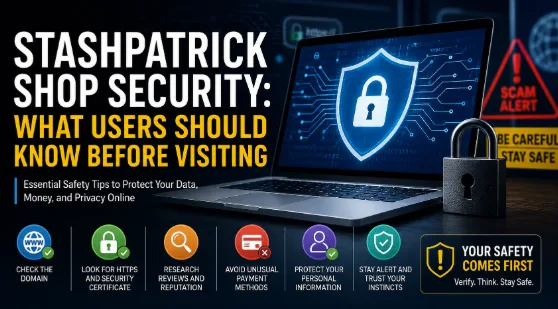
Online security has become an essential concern for anyone visiting unfamiliar websites, especially platforms that use changing domains, limited public information, or names associated with high-risk digital marketplaces. Searches for terms such as Stashpatrick Shop Security, Stashpatrick CC Review, Patrickstash New Domain, Stash patrick Market, and Patrick Stash Market indicate that users are trying to understand what these names represent and whether visiting related websites is safe.
The challenge is that a recognizable name or professional-looking website does not automatically establish legitimacy. Domains can change ownership, imitation websites can appear quickly, and search results may contain outdated or misleading information. Before entering personal information, creating an account, downloading files, or making any type of payment, users should examine the security signals surrounding a website.
This guide explains the practical checks that can help readers assess unfamiliar domains while avoiding unnecessary exposure to fraud, malware, phishing, and data theft.
Why Stashpatrick Shop Security Deserves Attention
Stashpatrick Shop Security should be approached as a website-safety question rather than simply a question of whether a particular page loads successfully. A functioning website can still present privacy, financial, or cybersecurity risks.
Users should evaluate several factors together. These include the domain’s history, connection security, reputation, transparency, payment practices, and the type of information requested from visitors.
This becomes particularly important when people encounter multiple names or addresses that appear to represent the same platform. A domain change can happen for legitimate technical reasons, but frequent changes can also make verification more difficult.
A cautious visitor should therefore avoid assuming that a site is trustworthy simply because its branding resembles a previously known website.
Understanding Searches for a Stashpatrick CC Review
Someone searching for a Stashpatrick CC Review may be looking for independent information about reputation, reliability, security, or user experiences. Reviews can provide useful clues, but they should never serve as the only basis for deciding whether a website is safe.
Online reviews can be manipulated. Positive comments may be promotional, while negative comments may be inaccurate, outdated, or related to imitation websites. The best approach is to compare information from several independent sources.
When reading reviews, pay attention to recurring concerns involving:
- Unexpected requests for sensitive information
- Unusual or irreversible payment methods
- Reports of phishing or impersonation
- Malware warnings from browsers or security software
- Complaints about inaccessible accounts or funds
- Sudden changes in domain names
- Lack of identifiable support or ownership information
Repeated patterns are generally more informative than one enthusiastic recommendation or one isolated complaint.
Why Domain Changes Require Additional Verification
The phrase Patrickstash New Domain suggests that some users may be searching for a current web address associated with a familiar name. This situation requires special caution because domain changes create opportunities for impersonation.
Scammers frequently register domains resembling existing brands. They may change a letter, add a hyphen, use another domain extension, or reproduce the appearance of another website.
A user who remembers only the general name may accidentally visit an imitation.
Before trusting any claimed Patrickstash New Domain, visitors should independently investigate its history and reputation. Avoid relying solely on links posted in random comments, unsolicited messages, forums, or advertisements.
If a website claims that an older domain has moved, look for consistent and independently verifiable evidence supporting that claim.
Evaluating the Stash Patrick Market Name
Searches for Stash patrick Market may lead users through a mixture of search results, discussions, copied pages, reviews, and potentially unrelated domains. Similar names can make it difficult to determine whether two websites actually belong to the same operator.
This is where careful verification becomes valuable.
Check whether the website provides meaningful information about its operator, privacy practices, terms of service, and support procedures. A legitimate-looking design alone should not be treated as proof.
Users should also examine the language used by the website. Excessive urgency, promises that sound unrealistic, or pressure to act immediately can be warning signs.
Security decisions should be based on evidence rather than familiarity with a name.
Patrick Stash Market and the Importance of Independent Checks
The same principle applies when researching Patrick Stash Market. Search engines can help users discover information, but ranking highly in search results does not guarantee that a website is legitimate.
Before interacting with an unfamiliar platform, users can perform several independent checks.
First, inspect the exact spelling of the domain. Look carefully for substituted letters, additional characters, unusual subdomains, or misleading extensions.
Second, check whether the browser displays security warnings. Modern browsers can identify some known phishing pages, malicious downloads, and certificate problems.
Third, research the domain through reputable domain reputation and malware-checking services. No single scanner is perfect, so comparing results can provide a broader picture.
Finally, consider what the website is asking you to do. A page requesting highly sensitive financial information deserves substantially greater scrutiny than an ordinary informational website.
What to Consider Before Visiting stashpatrick.gl
A domain such as stashpatrick.gl should be evaluated independently rather than trusted because its name resembles something a user has previously encountered.
HTTPS is one of the first things people often check. Encryption is useful because it protects data traveling between the browser and website. However, HTTPS does not prove that the website operator is trustworthy. Fraudulent websites can also obtain valid security certificates.
Users should therefore examine additional factors, including domain age, reputation, external reports, redirects, and browser warnings.
Be particularly cautious if visiting a domain causes unexpected downloads, opens multiple unrelated pages, requests browser notification permissions, or asks users to disable security protections.
These behaviors do not automatically prove malicious activity, but they provide good reasons to stop and investigate before continuing.
How to Assess stashpatrick.name Safely
The same independent assessment should be applied to stashpatrick.name. A familiar-looking domain can still be newly registered, compromised, impersonated, or unrelated to a previously known service.
Visitors can reduce risk by checking the domain before interacting with it.
A practical safety assessment may include:
- Confirming the spelling and extension carefully
- Checking domain registration history where available
- Searching for independent security reports
- Scanning the URL through established reputation services
- Avoiding downloads from unverified pages
- Refusing unexpected requests for browser permissions
- Keeping browser and operating-system security updates installed
Users should also avoid reusing important passwords on unfamiliar websites. If an unknown service experiences a breach, reused credentials could potentially expose accounts on unrelated platforms.
Payment Requests Are an Important Security Signal
Payment behavior can reveal a great deal about an unfamiliar website. Users should be cautious when a platform demands methods that provide little or no possibility of recovering funds.
Irreversible payments create additional risk because transactions can be difficult to dispute after they are completed.
Before paying any unfamiliar website, determine whether the operator provides clear information about pricing, refunds, disputes, and customer support. Vague policies should be treated carefully.
Never provide card credentials, banking information, identification documents, cryptocurrency wallet recovery phrases, authentication codes, or passwords merely because a website claims they are required for verification.
A legitimate service should never need your private wallet recovery phrase or the password to an unrelated account.
Protecting Personal Information While Browsing
Privacy protection begins before a transaction takes place. Even registration forms can collect valuable information.
Users should limit the amount of personal data they disclose to websites whose legitimacy has not been established. Information such as full legal names, identification documents, home addresses, phone numbers, financial details, and account credentials can potentially be misused.
Strong, unique passwords are also important. A password manager can help generate separate credentials for different services.
Multi-factor authentication should be enabled on important accounts whenever possible. This creates an additional security barrier if a password becomes compromised elsewhere.
Recognizing Common Warning Signs
Website risk rarely depends on one detail. It is usually better to consider several signals together.
For example, a newly registered domain is not automatically fraudulent. Similarly, an unusual domain extension does not prove malicious intent. However, several suspicious characteristics appearing together deserve greater attention.
Warning signs can include inconsistent branding, broken contact information, copied content, aggressive pop-ups, unexplained redirects, unrealistic guarantees, requests for sensitive credentials, and attempts to pressure users into acting quickly.
Another concern is being instructed to install unknown software or disable antivirus protection. Users should never weaken their device security simply because a website claims it is necessary.
What to Do If You Already Visited a Suspicious Site
Simply opening a website does not necessarily mean that your information or device has been compromised. The appropriate response depends on what happened during the visit.
If you only viewed the page and did not download anything or submit information, closing the website and running standard security checks may be sufficient.
If you downloaded a suspicious file, scan the device with reputable security software before opening the file.
If you entered a password that is also used elsewhere, change it immediately on the legitimate services where it was reused. Unique passwords are particularly important in situations like this.
If financial information was submitted, monitor the relevant account and contact the appropriate financial institution when unauthorized activity is suspected.
A Safer Approach to Unfamiliar Online Markets
Terms such as Stashpatrick Shop Security, Stashpatrick CC Review, Patrickstash New Domain, Stash patrick Market, Patrick Stash Market, stashpatrick.gl, and stashpatrick.name can lead users toward a complicated collection of search results and claims. The safest approach is not to assume that similar names automatically belong to the same operator or that a domain is trustworthy because someone online recommends it.
Verify the exact domain independently, examine its reputation, pay attention to browser and security warnings, and avoid sharing sensitive information until legitimacy has been established.
Most importantly, users should never allow curiosity, urgency, or familiarity with a name to replace basic digital security practices. Taking a few minutes to verify a website before interacting with it can help prevent phishing, malware infections, credential theft, financial loss, and other avoidable online risks.