Study Finds Pedestrian Fatalities Fell by Up to 63% as Road Safety Improves Across Much of the U.S.
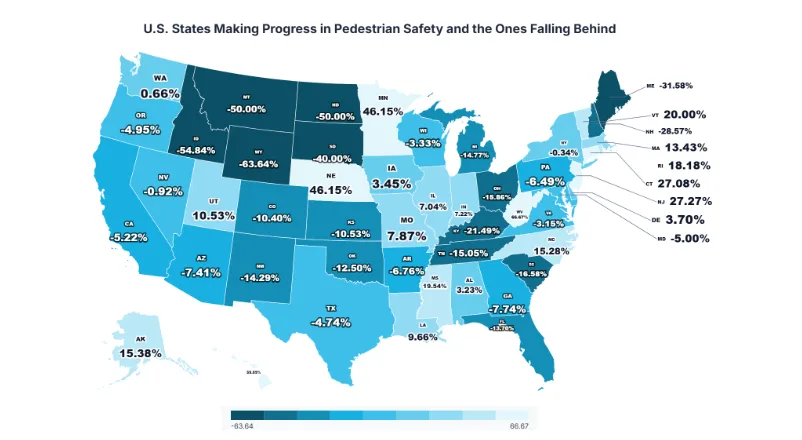
Key Takeaways
- Top declines reflect significant safety improvements: Wyoming (-63.64%), Idaho (-54.84%), and Montana (-50.00%) recorded the steepest reductions in pedestrian fatalities, with Wyoming cutting deaths from 11 to 4 year-over-year.
- Most states show declines, but progress remains inconsistent: A majority of states reported reductions, including high-volume states like California (-5.22%) and Texas (-4.74%), yet the scale of improvement varies widely, indicating uneven pedestrian safety outcomes nationwide.
- The bottom 3 states show the sharpest increases in fatalities: West Virginia (+66.67%, 15 to 25 deaths), Hawaii (+59.09%, 22 to 35), and Minnesota (+46.15%, 39 to 57) experienced the largest increases, highlighting emerging areas of concern in pedestrian safety.
Pedestrian safety outcomes across the United States differ significantly from one state to another, pointing to clear geographic trends rather than random variation. While several states have recorded meaningful declines in pedestrian fatalities, others are experiencing notable increases. In less populous states, small changes in fatality counts can lead to sharp percentage swings, whereas larger states tend to show more gradual shifts despite higher totals. These variations reflect how infrastructure, traffic environments, and local safety measures influence pedestrian risk nationwide.
The study, conducted by Easton & Easton, LLP, analyzed pedestrian fatality data across all 50 U.S. states for 2023 and 2024, focusing on year-over-year percentage changes to evaluate shifts in safety outcomes. For each state, total pedestrian fatalities in 2024 were compared with the 2023 figures to calculate the percentage change, which served as the primary ranking metric. This approach allowed for consistent comparison across states with varying population sizes and fatality volumes. States were then ranked from greatest decline (Rank 1) to highest increase (Rank 50) based on overall percentage change in pedestrian fatalities.
Top 10 States with the Largest Decline in Pedestrian Fatalities
States with the Steepest Percentage Drop in Pedestrian Fatalities (2023–2024)
| Rank | State | Pedestrian Fatalities 2023 | Pedestrian Fatalities 2024 | % Rise/Fall |
| 1 | Wyoming | 11 | 4 | – 63.64% |
| 2 | Idaho | 31 | 14 | – 54.84% |
| 3 | Montana | 20 | 10 | – 50.00% |
| 4 | North Dakota | 10 | 5 | – 50.00% |
| 5 | South Dakota | 15 | 9 | – 40.00% |
| 6 | Maine | 19 | 13 | – 31.58% |
| 7 | New Hampshire | 14 | 10 | – 28.57% |
| 8 | Kentucky | 121 | 95 | – 21.49% |
| 9 | South Carolina | 187 | 156 | – 16.58% |
| 10 | Ohio | 145 | 122 | – 15.86% |
Wyoming leads with the steepest reduction, cutting pedestrian fatalities by nearly two-thirds, dropping from 11 to 4. Idaho (-54.84%) and Montana (-50.00%) follow closely, forming a clear top tier of states with substantial year-over-year improvement.
This top 10 is largely dominated by smaller and mid-sized states, where lower baseline counts can drive sharper percentage declines. However, states like Kentucky (95 fatalities) and South Carolina (156) show that meaningful reductions are also possible at higher volumes. Even at the lower end, states like Ohio (-15.86%) reflect steady progress, highlighting where pedestrian safety outcomes are improving most clearly.
Regional Patterns in Pedestrian Fatality Trends Across the U.S.
Sharp Declines Concentrated in Northern and Mountain States, While Increases Rise Across the Northeast and Parts of the Midwest
| Region / Cluster | States | Avg. % Rise/Fall (2023–2024) |
| Northern & Mountain Decline Cluster | Wyoming, Idaho, Montana | -56.16% |
| Upper Midwest Decline Cluster | North Dakota, South Dakota, Iowa | -28.85% |
| Southern Mixed Improvement | Kentucky, South Carolina, Tennessee | -17.71% |
| Western Moderate Decline | California, Arizona, Oregon | -5.86% |
| High-Increase Cluster | West Virginia, Hawaii, Minnesota | +57.30% |
Pedestrian fatality trends show the greatest improvements in northern and mountain states (-56.16%), where multiple states recorded steep year-over-year declines. Parts of the Midwest (-28.85%) and the South (-17.71%) also reflect consistent reductions, while western states (-5.86%) show more moderate progress.
In contrast, a clear high-increase cluster emerges, led by West Virginia, Hawaii, and Minnesota, where fatalities rose sharply. The gap between the strongest improvement cluster and the highest increase exceeds 110 percentage points, underscoring how regional differences continue to shape pedestrian safety outcomes across the U.S.
States with the Largest Increase in Pedestrian Fatalities
Bottom 10 States with the Highest Percentage Rise in Pedestrian Fatalities (2023–2024)
| Rank | State | Pedestrian Fatalities 2023 | Pedestrian Fatalities 2024 | % Rise/Fall |
| 41 | Alaska | 13 | 15 | 15.38% |
| 42 | Rhode Island | 11 | 13 | 18.18% |
| 43 | Mississippi | 87 | 104 | 19.54% |
| 44 | Vermont | 5 | 6 | 20.00% |
| 45 | Connecticut | 48 | 61 | 27.08% |
| 46 | New Jersey | 165 | 210 | 27.27% |
| 47 | Minnesota | 39 | 57 | 46.15% |
| 48 | Nebraska | 13 | 19 | 46.15% |
| 49 | Hawaii | 22 | 35 | 59.09% |
| 50 | West Virginia | 15 | 25 | 66.67% |
Pedestrian fatality trends in these states show a clear upward trajectory, with increases ranging from +15.38% to +66.67%. West Virginia stands out with the sharpest rise, increasing fatalities from 15 to 25, followed by Hawaii and Minnesota, both recording substantial escalations.
Several mid-sized states, including New Jersey and Connecticut, also show strong double-digit growth, pointing to broader upward pressure in pedestrian risk. Even states with relatively lower fatality counts, such as Vermont and Alaska, experienced notable percentage increases, underscoring how quickly pedestrian safety outcomes can deteriorate across different regions.
States with the Largest Absolute Changes in Pedestrian Fatalities
Top States with the Largest Absolute Decline in Pedestrian Fatalities (2023–2024)
| Rank | State | Pedestrian Fatalities 2023 | Pedestrian Fatalities 2024 | Absolute Change |
| 1 | Florida | 774 | 668 | -106 |
| 2 | California | 1150 | 1090 | -60 |
| 3 | Texas | 801 | 763 | -38 |
| 4 | South Carolina | 187 | 156 | -31 |
| 5 | Tennessee | 186 | 158 | -28 |
Pedestrian fatalities saw the largest absolute reductions in high-volume states, led by Florida, which reduced deaths by 106 year-over-year. California and Texas also recorded substantial declines, highlighting how even modest percentage improvements can translate into significant lives saved at scale.
Unlike percentage-based rankings, absolute declines emphasize real-world impact. Larger states dominate this list due to higher baseline fatalities, reinforcing that sustained reductions in these regions can drive meaningful national-level improvements in pedestrian safety.
Top States with the Largest Absolute Increase in Pedestrian Fatalities (2023–2024)
| Rank | State | Pedestrian Fatalities 2023 | Pedestrian Fatalities 2024 | Absolute Change |
| 1 | New Jersey | 165 | 210 | +45 |
| 2 | North Carolina | 229 | 264 | +35 |
| 3 | Minnesota | 39 | 57 | +18 |
| 4 | Mississippi | 87 | 104 | +17 |
| 5 | Illinois | 199 | 213 | +14 |
The largest absolute increases were concentrated in mid- to high-volume states, with New Jersey leading the rise, adding 45 additional fatalities year-over-year. North Carolina and Minnesota also saw notable increases, signaling a worsening safety trend in these areas.
These increases highlight where pedestrian safety challenges are intensifying in real terms. While percentage growth may appear more dramatic in smaller states, absolute increases reveal where the greatest number of additional lives are being lost, underscoring priority areas for intervention.
Methodology
The study analyzed pedestrian fatality data across all 50 U.S. states for 2023 and 2024, focusing on year-over-year percentage changes to evaluate shifts in safety outcomes. For each state, total pedestrian fatalities in 2024 were compared with the 2023 figures to calculate the percentage change, which served as the primary ranking metric. This approach allowed for consistent comparison across states with varying population sizes and fatality volumes. States were then ranked from greatest decline (Rank 1) to highest increase (Rank 50) based on overall percentage change in pedestrian fatalities.
Data Sources
Pedestrian Fatality Data (2023-2024):
U.S. Population Data:
https://data.census.gov/table?q=population+by+age+by+state
Research Datasheet: https://docs.google.com/spreadsheets/d/1mxH2ADdwL5mc_v7Jxwl37O-J_HEbbaFMXb7SCODLvus/edit?gid=0#gid=0
Study By:
https://www.eastonlawoffices.com/
About Easton & Easton, LLP
Easton & Easton, LLP is a personal injury and wrongful death law firm with more than 100 years of combined legal experience. The firm represents individuals and families harmed by motor vehicle collisions, including motorcycle crashes, and advocates for safer road design and stronger rider protections.