Successful Driving School Business: Website Development, Marketing, and Management Solutions for Every Stage of Growth
Most driving schools begin the same way: a certified instructor, a dual-control car, and a few students who heard about the school from a neighbor. That is enough to open the doors. It is rarely enough to keep growing year after year.
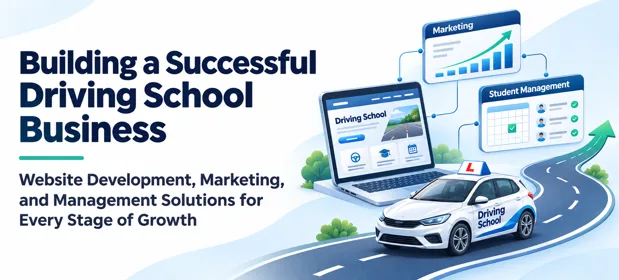
Building a successful driving school business depends on three working systems. You need a website that earns trust, marketing that brings in a steady flow of inquiries, and management tools that keep lessons, instructors, and payments in order. Each system also has to mature as the school does. What works for a one-car operation can quietly hold back a school with ten instructors.
That is why many owners bring in outside help for the parts they cannot handle alone. Some partner with a website design and local seo marketing agency so families can find them on Google Maps and reach them without friction.
Others start on the operations side. Replacing paper schedules and scattered spreadsheets with dedicated driving school management software is often the first step toward an office that no longer runs on memory.
Neither path is wrong. The right order depends on where your school is today. Below, we walk through the three stages most driving schools pass through and what to build at each one.
Why the Right Tools Change as Your School Grows
A driving school rarely grows in a straight line. It grows in jumps. One season the owner teaches every lesson personally. A year later there are four instructors, a car in the repair shop, and a waiting list every June.
Each jump changes what the business needs. A basic website with a phone number works fine when the owner answers every call. It becomes a problem when nobody is free to pick up. A shared calendar that suits two people turns into double bookings at five.
Thinking in stages helps you avoid two costly mistakes: overbuilding too early and patching old systems for too long.
Stage One: The Owner-Operator School (One or Two Cars)
Website: At this stage, your website has one job: prove you are legitimate and trustworthy. Parents of teen drivers look for your state license or certification, clear package pricing, the towns you serve, and real photos of your cars and instructors. Keep pages fast and easy to use on a phone, since most visitors arrive from a mobile search.
Marketing: Stay close to home. Complete your Google Business Profile, ask every student who passes the road test for a review, and build relationships with local high schools, parent groups, and insurance agents who field questions about teen driver discounts.
Management: Resist the urge to keep everything in your head. Even with a small roster, record lesson hours, progress notes, and payments in one place from day one. Many states require schools to document behind-the-wheel hours, and rebuilding those records later is painful.
Stage one priority: a credible mobile website and a steady stream of reviews.
Stage Two: The Growing Team (Three to Ten Instructors)
This is where most schools feel the strain. Demand is there, but the habits that got you here start to crack.
Website: Give each program its own page, such as teen driver education, adult lessons, road test preparation, and defensive driving. A dedicated page answers a specific search far better than one crowded services page. Add online booking, or at least an inquiry form that captures the student’s age, program, and preferred times, to cut down on phone tag.
Marketing: Paid search and social ads start to make sense, but only when you can track them. Know which campaign produced each inquiry and which inquiries became paying students. Plan budgets around your busy seasons, since school breaks usually bring a surge of teen sign-ups.
Management: Spreadsheets tend to break here. Instructors need to see schedules and update lesson notes from their phones. Students expect automatic reminders and online payment. The office needs one view of who is booked, who has paid, and who is ready for a road test.
Stage two priority: trackable marketing and a real scheduling system.
Stage Three: Multiple Locations
Running two or more branches changes the questions you ask. It is no longer “Are we busy?” but “Which location is profitable, and why?”
Website: Each branch needs its own location page with an accurate address, phone number, hours, and service area, matching its own Google Business Profile. Mismatched details across listings confuse both customers and search engines.
Marketing: Report results by location. One branch may thrive on referrals while another depends on paid ads. Shifting budget based on branch-level numbers beats splitting it evenly.
Management: Central administration becomes essential. Owners need combined reporting, while branch managers need access limited to their own instructors and students. Shared student records and standard lesson checklists keep quality consistent from one location to the next.
Stage three priority: one central system with clear visibility into every branch.
Choosing a Technology Partner Without Getting Locked In
Sooner or later, every growing school decides whether to rent an off-the-shelf platform or invest in something shaped around its own operations. Before signing with any vendor, ask a few direct questions:
- Does the software fit how we already work, or must we change our process to fit it?
- Who owns our student data, and can we take it with us if we leave?
- What will this cost over five years, not just this month?
- Will you move our existing records and train our instructors?
- Does it connect with the payment, phone, and video tools we already use?
These questions matter because no two driving schools operate the same way. State rules, program mix, instructor arrangements, and booking policies vary widely.
That variety is why NewAgeSysIT, a custom software and mobile app development company, takes a tailored approach with driver education businesses. Instead of forcing schools into a fixed workflow, its team adapts a proven platform to each school’s process, delivering a branded admin portal, instructor app, and student app that the school owns rather than rents month to month. The company is also a proud supporter of the Driving School Association of the Americas (DSAA).
Whichever route you choose, favor tools that bend to your workflow, not the other way around.
A Simple Monthly Scorecard That Connects All Three
Your website, marketing, and management only work as one system when you measure them together. Review these six numbers once a month, whatever stage you are in.
| Metric | What it tells you |
| Inquiries per month | Whether your website and local listings are attracting people |
| Cost per inquiry | How efficiently ads and SEO turn into leads |
| Inquiry-to-enrollment rate | Whether your follow-up and pricing convert interest |
| Instructor utilization | How much available lesson time is actually booked |
| No-show and cancellation rate | Whether reminders and policies are working |
| New reviews per month | Whether happy students are becoming future marketing |
Read the numbers together. If inquiries are high but enrollments are low, fix follow-up before spending more on ads. If instructors are fully booked, your next investment is hiring, not marketing.
What Will Separate Successful Schools in the Next Few Years
Three shifts are already changing how students choose and experience driving schools.
AI-powered search. More parents now ask AI assistants to recommend a driving school nearby. Those answers draw on your website, reviews, and listings, so clear and consistent information matters more than ever.
Mobile-first learners. Teen students expect to book, reschedule, track progress, and pay from their phones, just as they handle everything else.
Instructor retention. Qualified instructors are hard to find, and clunky scheduling or delayed pay pushes good ones away. Tools that make an instructor’s day easier are now part of your hiring strategy.
Build for the Stage You Are In
Building a successful driving school business is less about finding one perfect tool and more about making the right upgrade at the right time. Be honest about which stage describes your school today, not the one you hope to reach next year.
Then choose one improvement in each area: one fix to your website, one change to how you market, and one step toward better management. Small, well-timed upgrades add up. Over a year or two, they turn a school that depends entirely on its owner into a business that can run, and grow, on its own.