
Sudden Cardiac Arrest in Athletes: How a Philips OnSite Refurbished AED Can Save Lives
Athletes are often seen as the fittest people in any room. Yet every year, players collapse on football pitches, basketball courts, cricket grounds, and running tracks because their heart suddenly stops. Sudden cardiac arrest (SCA) does not care how fit someone is, and when it strikes, the next few minutes decide whether that person lives.
The single most important tool in those minutes is an AED machine. In this article we explain why SCA happens in athletes, why fast defibrillation matters so much, and how an affordable option like the Philips OnSite Refurbished AED can help sports clubs, schools, and gyms be ready.
What Is Sudden Cardiac Arrest?
Sudden cardiac arrest happens when the heart’s electrical system fails and the heart starts beating in a chaotic, useless rhythm (usually ventricular fibrillation). Blood stops reaching the brain and body, and the person collapses within seconds.
It is not the same as a heart attack. A heart attack is a blockage in blood flow to the heart muscle; the person is usually awake and talking. In cardiac arrest, the person is unresponsive and not breathing normally. Without help, death follows within minutes.
Why Does It Happen to Athletes?
Most athletes who suffer SCA have an underlying heart condition they never knew about. Common causes include:
- Hypertrophic cardiomyopathy (HCM): an abnormally thick heart muscle, one of the best-known causes in young athletes.
- Electrical problems: inherited rhythm disorders such as long QT syndrome.
- Coronary artery abnormalities: arteries that are formed or positioned in an unusual way.
- Commotio cordis: a hard blow to the chest at exactly the wrong moment of the heartbeat, for example from a cricket ball, baseball, or hockey puck.
- Heat, dehydration, and extreme exertion: these can trigger an event in someone who is already at risk.
Because many of these conditions show no warning signs, the first symptom is often the collapse itself. That is why teams cannot rely on screening alone; they need a plan for the moment it happens.
Why Every Minute Counts
CPR keeps some blood moving, but it cannot restart a heart in ventricular fibrillation. Only a shock from a defibrillator can do that. For every minute without defibrillation, the chance of survival drops sharply. Waiting for an ambulance to arrive can take too long, especially at outdoor grounds, rural fields, or busy stadiums.
When an AED machine is on site and someone uses it within the first few minutes, survival rates are far higher. Many professional athletes who collapsed during matches are alive today because an AED was close by and used quickly.
How the Philips OnSite Refurbished AED Helps
The Philips HeartStart OnSite is built for exactly this kind of emergency: a bystander, coach, or teammate with little or no medical training has to act fast.
- Clear voice prompts: it tells the rescuer where to place the pads, when to stand clear, and when to do CPR, including CPR timing.
- It decides for you: the device analyzes the heart rhythm and only delivers a shock if one is needed.
- Ready when you need it: it runs automatic daily, weekly, and monthly self-tests.
- Easy to carry: at about 3.3 lb (1.5 kg) with battery and pads, it fits in a kit bag and can travel with the team to away games.
- Child pads available: infant/child pads let youth clubs use the same device for younger players.
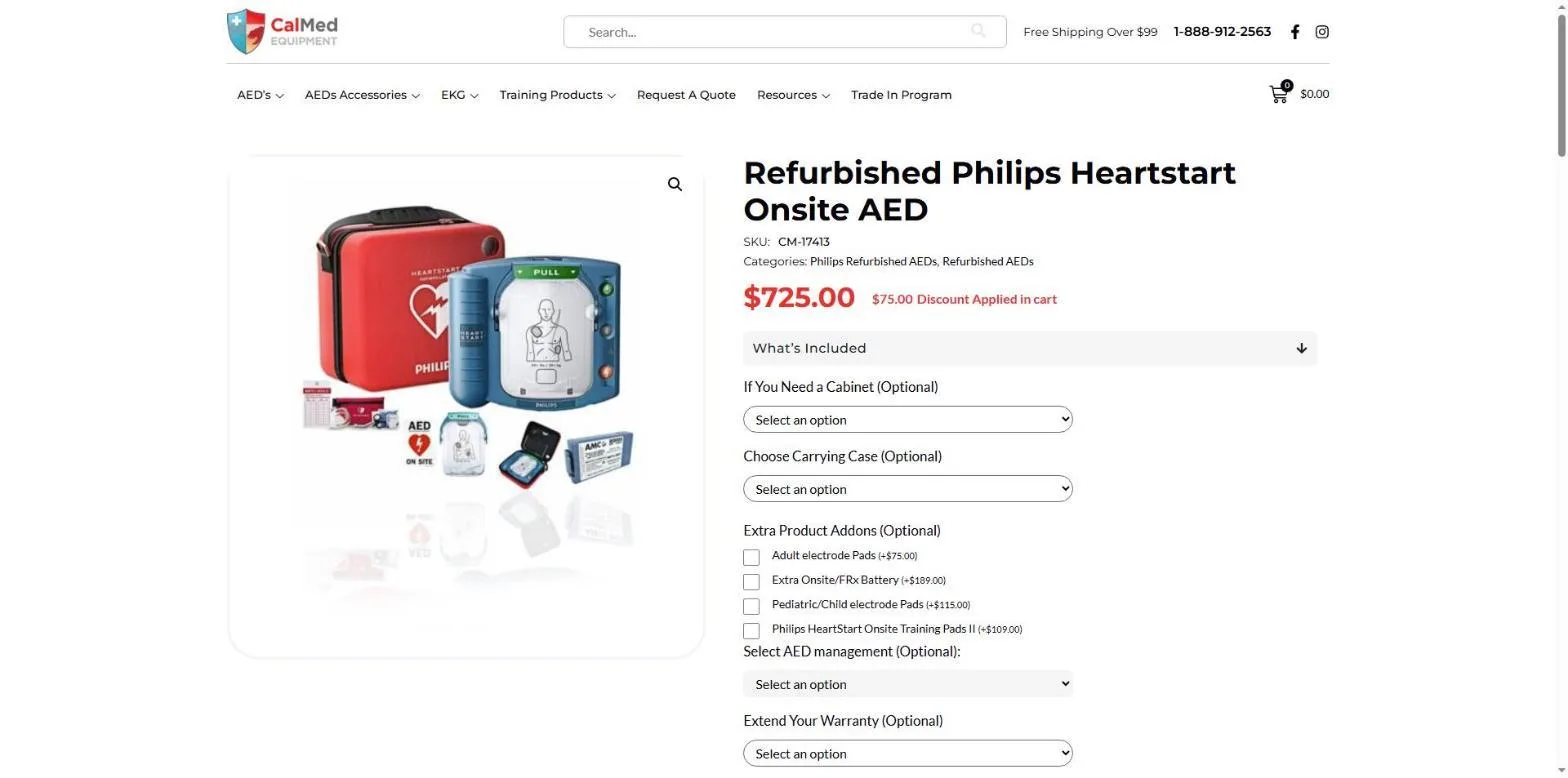
The refurbished version from CalMed Equipment is inspected, tested, and recertified before shipping. It comes with a new battery (with a 4-year guarantee), new adult pads, a new carry case, and a 1-year device warranty.
The refurbished Philips HeartStart OnSite AED (M5066A), ready for the sideline.
Why Refurbished Makes Sense for Sports Teams
Most amateur clubs, school teams, and small gyms run on tight budgets. A brand-new AED can feel out of reach, so many simply go without one. A refurbished unit closes that gap.
At the time of writing, the Philips OnSite Refurbished AED is listed at $725, with free UPS ground shipping and free returns within 30 days. For many clubs, that means they can afford one AED per field or per venue instead of none at all.
Everything that comes in the refurbished OnSite package.
Building an Emergency Plan Around Your AED
Buying the device is step one. To make it count:
- Place it where it can be reached fast: ideally within a short walk of every field, court, or training area.
- Make sure people know where it is: use signs and tell coaches, staff, and parents.
- Train your staff: coaches and team managers should learn CPR and how to use the AED.
- Assign roles: decide in advance who calls emergency services, who starts CPR, and who fetches the AED.
- Take it to away games and tournaments: do not assume the host venue has one.
- Check it regularly: look at the ready light and keep track of pad and battery expiry dates.
Who Should Have One?
- Football, cricket, soccer, rugby, and hockey clubs
- School and college sports departments
- Gyms, fitness studios, and CrossFit boxes
- Organizers of marathons, cycling races, and tournaments
- Coaches of youth and junior teams
Final Thoughts
Sudden cardiac arrest in athletes is rare, but when it happens it is shocking and fast. The difference between a tragedy and a survival story is often whether an AED machine was nearby and someone used it within minutes.
If your club, school, or gym does not have one yet, the Philips OnSite Refurbished AED is an affordable, easy-to-use place to start. You can also browse more options at CalMed’s AED machine store.