Taking people out of the reaction zone: the quiet safety upgrade in oilfield workshops
In the oilfield service yards of emerging producing countries, from East Africa to South Asia, one job is still done the way it was done fifty years ago. Two or three workers wrap a chain tong around a length of drill pipe or a downhole tool, slide a steel extension bar over the handle, and pull, or hang from it, or attach a rope and let a forklift do the pulling, until the threaded connection either tightens to a guess or lets go with a bang. Every experienced hand in the industry has seen it. Most have a story about the day it went wrong.
This article is about that job, about why it is dangerous in a way that training and protective equipment cannot fix, and about the quiet change happening in workshops that have decided to take people out of the danger zone altogether.
A task that repeats hundreds of times a week
Every drill string and every production string is a chain of steel tubes about nine metres long, joined by threads. A 3,000 metre drill string has roughly 315 connections. Each time the string comes out of the well the connections are broken; each time it goes back in they are made up again. In the workshop, on top of that, technicians assemble and disassemble downhole tools, motors, stabilisers and drill collars whose connections need torques that no human being can apply with their hands.
For a large drill collar the specified make-up torque can exceed 40,000 foot-pounds. To reach it without a machine, workshops resort to the chain tong with an extension bar, to hammer blows, or to the forklift and rope. All three are common. All three put a person inside the radius of a tool that is about to move violently.
Where the danger really is
The hazard is not effort. It is stored energy. When someone applies tens of thousands of foot-pounds through a tong, all of that force is held in an elastic system: the chain, the extension bar, the pipe and the body of the person pushing. Nothing moves, but everything is loaded. When the thread finally yields, the energy is released in a fraction of a second. The tong jumps, the bar sweeps the space around it, and the person who was applying the force loses their footing. If the chain slips or breaks, the result is a whip.
The thread always lets go suddenly. That is the nature of a tapered connection releasing after years under load. It is not a matter of strength or experience, and it does not improve with either. It is a mechanical consequence that repeats every time the job is done this way.
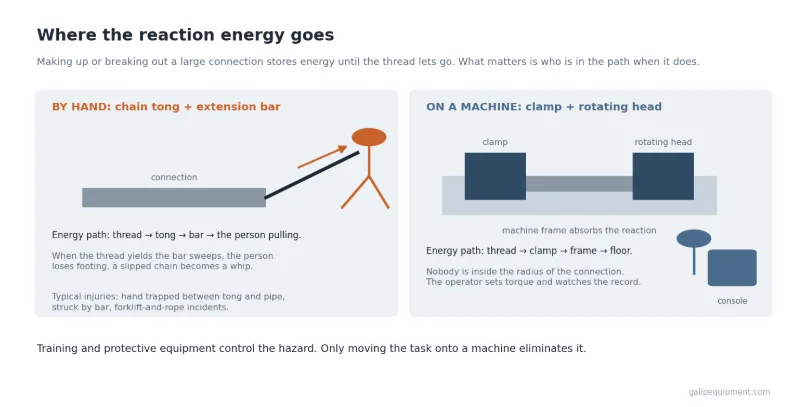
With tongs and an extension bar, the reaction energy passes through the crew. On a machine, the frame absorbs it and the operator stands at a console.
Three situations every supervisor recognises
The joint that will not break. A tool that has worked in the well, with rock dust in the threads and heat from the shift, does not loosen at its make-up torque. The crew adds an extension, then weight, then hammer blows. When it goes, it goes all at once with all the accumulated force behind it. The classic injury is a hand trapped between the tong and the pipe.
The forklift as a tool. A rope or sling is attached to the tong and the forklift pulls. The forklift driver cannot see the helper steadying the tong; the helper has no control over the pull. When the thread yields, the tong flies in the direction of the pull. When the sling parts, it is worse.
Make-up without alignment. Two people hold a heavy tool while a third tries to start the thread. The connection enters at an angle, binds, and someone reaches in to correct it. It is the least serious incident of the three and by far the most frequent, and it is the one that destroys the most threads.
Why protective equipment reaches a ceiling
Safety management systems, the ones large operators use and pass down to their contractors by contract, rest on a simple order of priorities: identify the hazard, assess the risk, then eliminate it if possible and control it if not. Controls are procedures, training and protective equipment. Elimination means changing how the task is done so that the hazard no longer exists.
Manual make-up of large connections is a case where controls have a ceiling. A workshop can train, insist on gloves and eye protection, mark out an exclusion zone. But as long as a person must apply the force and stand inside the radius when the thread lets go, the risk remains. Moving the job onto a purpose-built machine is the only measure that eliminates it. It is also, increasingly, what operator safety auditors expect to find in a workshop that wants to work for them.
What changes when the machine does the work
The solution that large service companies adopted decades ago, and that mid-sized workshops can now afford, is a horizontal bucking unit: a hydraulic clamp grips one side of the connection, a rotating head turns the other, and torque is applied and measured continuously until the value the connection manufacturer specifies is reached. The most important change is not speed. It is position. During make-up nobody is inside the radius of the connection. The reaction is absorbed by the structure of the machine. The operator stands at a console, watching a torque value instead of holding a tong.
The same applies in reverse. A breakout unit that absorbs the reaction torque handles the joint that will not let go, the one that produces most of the injuries when it is attempted by hand, with the crew outside the radius and the tool held by the machine rather than by people.
The second benefit arrives later: the threads survive
Safety justifies the change on its own, but there is a second effect that shows up in the accounts. Threads made up with hammer blows or guessed torques are damaged: the metal welds in spots and tears, a defect known as galling that is generally beyond repair. Every lost thread is a length of pipe or a tool that has to be replaced, and in regions far from the distribution centres that means weeks of waiting.
With a machine applying the specified torque at the right speed with the connection aligned, the share of threads lost per cycle falls measurably. A workshop that records each make-up also gains something a logbook never provided: for any joint, it can show when it was made up, to what torque and with what result. That record protects the workshop in a dispute and protects the technician from being blamed for a failure that happened downhole.
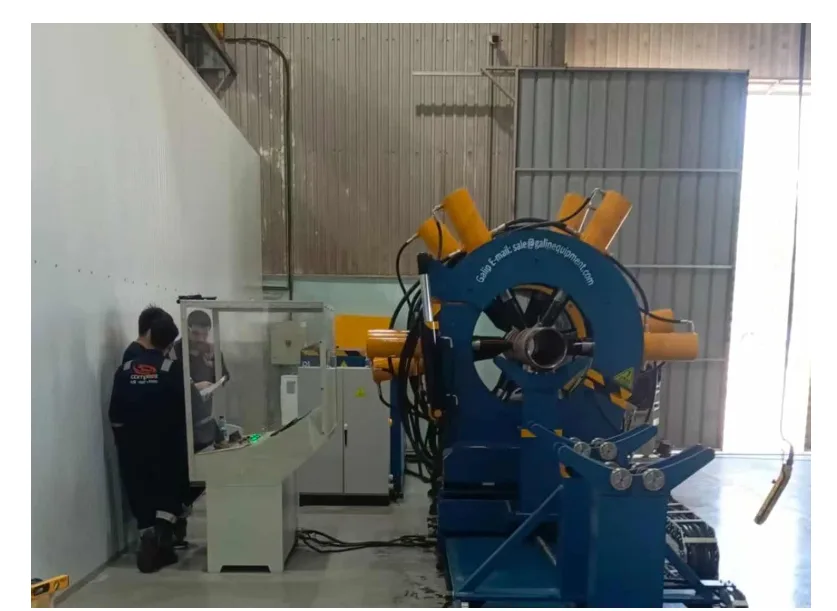
Clear floor around the machine and an operator who works from the side, not in line with the connection. This is what a risk assessment asks for.
What the job becomes
The machine does not turn anyone into an expert, and it does not try to. The operator remains responsible for three things no machine does: checking that the thread is clean and correctly dressed with compound, confirming that both ends are aligned before the threads touch, and knowing the specified torque for that particular connection. What the machine does is apply that torque repeatably, measure it and record it.
That changes the profile of the job. The workshop no longer needs the strongest person on the floor; it needs the most careful one. It changes the relationship with the supervisor too: instead of trusting that a connection “came up fine”, the supervisor can look at the record. And it changes who can do the work. Where make-up quality once depended on the experience of one or two senior hands, a written procedure, a machine that applies it and a record that proves it mean any trained operator can deliver the same result. In countries where skilled crews are scarce and mobile, that matters as much as the safety case.
Records as protection for the worker
There is a side of documentation that safety discussions rarely mention. When a connection fails downhole, the first question is who assembled it, and in a workshop without records the answer is whoever the supervisor remembers. The technician carries the blame for a failure that may have had nothing to do with the make-up. A per-joint record changes that. It shows the connection type, the target torque, the result and the operator, and it shows whether the make-up was normal. The record defends the workshop in a dispute with the operator, and it defends the technician inside the workshop.
In countries where labour protection in service yards is thin, this matters. A process that is written down, applied by a machine and recorded cannot be quietly redefined after an incident. It also gives the safety representative something concrete to inspect: not whether people were careful, which cannot be audited, but whether the procedure was followed, which can.
Cost, and who can afford it
The comparison that should be made is not the price of the machine against the price of tongs. It is the machine against what the workshop is already paying without seeing it: the threads lost every cycle and replaced after weeks of waiting, the hours of two or three people per connection, and the cost of an accident, which in most cases exceeds the price of the equipment on its own, before counting what has no price.
A common reason small contractors defer the decision is the belief that the machine needs a concrete foundation, anchor bolts and a purpose-built bay. Current designs stand on adjustable levelling feet, are levelled in place and are not fixed to the floor. They need a clear area of about 13 to 14 metres by 5 to 6 metres, a floor rated for roughly 750 kilograms per square metre and a power supply for the hydraulic unit. That is the kind of shed most service contractors already rent. The hard part is not the installation. It is the decision to stop doing by hand something that has always been done by hand.
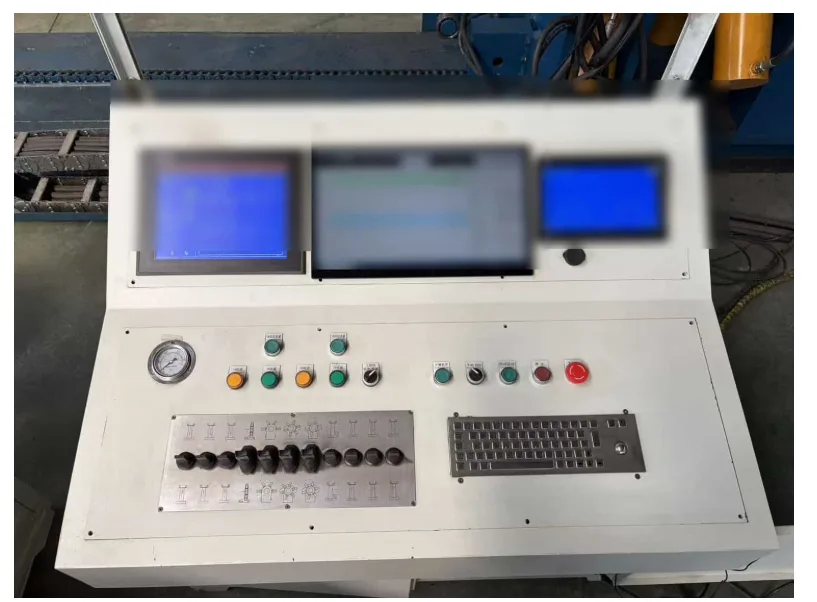
The operator sets the target torque and reviews the result at the console. The record is stored with the job and joint number.
What contracts now require of local workshops
For a workshop serving mining or oil and gas contracts there is an additional cost to staying manual: the cost of not qualifying. Tenders from international operators, and increasingly from national ones, ask bidders to show how high-energy tasks are carried out and to demonstrate that the hazard has been engineered out rather than merely managed. A workshop that makes up connections with hammer blows has nothing to show. A workshop with a machine, a procedure and a record has a page for the bid.
For governments and development agencies interested in local content, the same point applies from the other direction. The value of local service capacity lies in its ability to work to the operator’s standard. Equipment that removes people from the reaction zone is part of that standard, and it is one of the few investments that improves safety, tubular life and contract eligibility at the same time.
In short
Making up and breaking out threaded connections is one of those tasks the industry did by hand for so long that it stopped seeing it as a risk. It still is one. Moving it onto a machine designed for the purpose takes people out of the radius of the connection and, as a side effect, makes pipe and tools last longer. For a workshop in a region where every replacement takes weeks to arrive, both effects count.
Technical input for this article was provided by Dezhou Zhuorui Petroleum Machinery, a manufacturer of hydraulic bucking and breakout units for oilfield and mining service workshops.