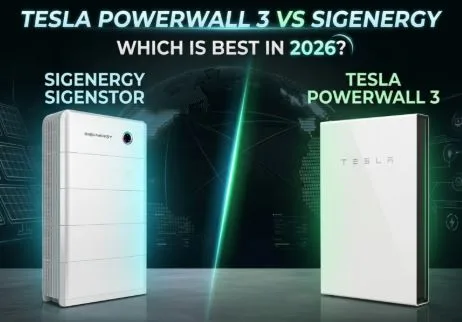
Tesla Powerwall 3 vs Sigenergy — Which is Best in 2026?
Choosing a home battery is one of the biggest purchasing decisions you’ll make for your property — and right now, two products dominate the conversation: the Tesla Powerwall 3 and the Sigenergy SigenStor. So, which one deserves a place on your wall? We’ve broken the comparison down into six key areas, scored each product, and come up with a clear recommendation at the end. Let’s get into it!
Round 1: Inverter Sizing
The Powerwall 3 takes a refreshingly simple approach here: there is only one physical unit, and its output power is set in software at the time of installation. You can choose from eight settings ranging from 3.68 kW all the way up to 11.04 kW — no swapping hardware, no ordering different models. The solar input side is equally straightforward, with a standard 20 kW peak capacity spread across three strings, which is enough to accommodate around 30 panels across different roof orientations.
Sigenergy takes the opposite approach. There are nine inverter models to choose from, ranging from 3 kW to 12 kW, and you need to pick the right one up front because changing your mind later means changing the hardware. The solar input is flexible — you can install panels totalling up to 200% of the inverter’s rated capacity — but the number of available strings is tied to the inverter size. If your grid connection limits you to a small inverter but you want a large solar array, that combination simply won’t work with Sigenergy the way it would with Tesla.
Both systems are G100 compliant, meaning they can be configured to meet export limits set by the grid operator.
Round Winner: Tesla — Software-controlled flexibility beats a hardware-dependent selection process.
Round 2: Battery Capacity & Expandability
Tesla keeps things uncomplicated on the storage side, too. Every Powerwall 3 comes with 13.5 kWh of usable capacity, and that’s the only size available. If you need more storage, you can add expansion packs or additional Powerwall units — but each step adds another 13.5 kWh. There’s no way to add just a small amount of extra capacity; it’s all or nothing. On a single inverter unit, you can stack up to 3 expansion packs, giving a maximum of around 54 kWh. Adding an expansion pack also boosts the charge rate from 5 kW to 8 kW, which is a useful bonus.
Sigenergy gives you two battery module sizes — a 6-kWh unit and a 10-kWh unit — and you can mix them in the same stack. That means you can fine-tune your storage to match your actual needs rather than being locked into a one-size-fits-all format. The maximum stack size of six 10 kWh modules reaches the same ~54 kWh ceiling as Tesla, but you have far more granularity getting there.
Sigenergy’s battery management system also deserves a mention. If one module in a stack develops a fault, it gets isolated digitally while the rest of the system continues to operate — a smart piece of engineering that reduces downtime. There’s also a five-point safety system covering pressure release, gel-packed cell linings, and heat monitoring.
Round Winner: Sigenergy — Mix-and-match modules give real flexibility that Tesla’s fixed 13.5 kWh increments can’t match.
Round 3: Gateways & Backup Power
Both systems offer whole-home backup through an optional gateway device, but until recently, the Powerwall 3 required a gateway regardless of whether you wanted backup functionality. As of late 2025, that’s no longer the case — you can now install a Powerwall 3 without one, saving approximately £1,000. That said, most homeowners still opt for the gateway since it provides energy independence and the option of full backup, now or in the future.
There is one important limitation to be aware of with Tesla’s gateway: as of March 2026, it only supports single-phase backup. Homes with a three-phase supply can still have a Powerwall installed, but backup power will only cover one phase.
Sigenergy’s Sigen Energy Gateway comes in both single-phase and three-phase versions, making it a better fit for a wider range of properties. It also comes in at around £50 less than the Tesla equivalent.
Round Winner: Sigenergy — Three-phase backup support and a lower price tip this one in Sigenergy’s favor.
Round 4: System Configuration Flexibility
The Powerwall 3 works well across a wide range of setups. You can run it as a battery-only system, charging from the grid overnight when electricity is cheapest, and then add solar panels later without needing any additional hardware. It also integrates cleanly with existing Feed-In Tariff (FIT) systems, so if you already receive government payments for your solar generation, adding a Powerwall won’t put those payments at risk.
Sigenergy broadly supports the same range of configurations, but its hardware-based inverter selection creates a potential pitfall. If you start with a battery-only setup and choose a smaller inverter to keep efficiency high, then later decide to add a large solar array, you may find that the original inverter can’t support it. That means replacing hardware rather than simply adjusting settings in an app.
Round Winner: Tesla — Adaptability through software means your system can grow with you without extra hardware costs.
Round 5: Ecosystem & Extra Features
When it comes to add-ons, Tesla keeps a fairly limited catalogue. Beyond the Powerwall itself and its expansion packs, the main accessory is the Wall Connector — a 7.4 kW EV charger that integrates with the Tesla app. There isn’t much else to extend or customize the system.
Sigenergy’s ecosystem is considerably broader. In addition to a standard 7 kW AC charger, they offer a DC-to-DC EV charger that slots directly into the battery stack (replacing one module). This unit charges the EVs faster and more efficiently by transferring stored DC energy directly to the car, bypassing the conversion losses that come with standard AC charging. It also supports vehicle-to-home and vehicle-to-grid functionality. The chargers have recently dropped substantially in price — from around £2,500 to just over £1,200.
Round Winner: Sigenergy — The DC charger alone makes this a standout for EV owners.
Round 6: Price
Neither system is cheap, but here’s a rough guide to what you’re looking at (trade prices, exc. installation):
Tesla:
- Tesla Powerwall 3 (without gateway): ~£6,000
- Tesla Gateway: ~£1,000
- Tesla Expansion Pack (13.5 kWh, storage only): ~£4,700
Sigenergy:
- Sigenergy Inverter: £750–£1,600 depending on size
- SigenBAT 6 battery module: ~£1,800
- SigenBAT 10 battery module: ~£2,300
- Sigenergy Backup Gateway: ~£600
- Sigenergy DC-DC EV Charger: ~£1,200
Both products offer genuinely strong value for what they deliver. The modular nature of Sigenergy means you can start smaller and expand incrementally, which may suit tighter budgets — but a fair comparison depends heavily on how much capacity you actually need.
Round Winner: Draw — Both products offer strong value. Configuration and capacity needs will determine which works out cheaper for your specific situation.
Round 7: Smart Controls & App Experience
Managing a home energy system sounds complicated, but the apps for both products do a lot of the heavy lifting.
Tesla’s app revolves around a feature called Opticaster — an AI that monitors your energy consumption, solar generation, weather forecasts, and grid tariffs, then automatically optimises how your Powerwall charges and discharges. New users occasionally feel like they’ve lost control, since the system seems to be making decisions on its own. But after roughly two weeks of learning your household’s patterns, the results speak for themselves. If you want a battery, you can install and essentially forget about it. Tesla is the one.
Sigenergy also offers an AI-driven autopilot mode called SigenAI that works in a similar fashion. But where Sigenergy really stands out is in manual control. For homeowners who want to dig into the details — scheduling charge and discharge windows, setting custom thresholds, or integrating with smart home platforms like Home Assistant or Shelly devices — Sigenergy’s platform is far more open and configurable than Tesla’s.
It’s worth noting that Tesla has a software update in the pipeline that appears to expand the app’s manual controls. If that reaches the market in its full form, it would significantly close the gap.
Round Winner: Draw — Tesla wins on simplicity; Sigenergy wins on depth of control. The better choice depends on your personality as much as your setup.
Conclusion
Across 7 categories, Sigenergy edges ahead with five points to Tesla’s three (with two shared draws) — and honestly, the score reflects reality pretty well. Tesla is still a fantastic product. It’s polished, simple to live with, and the Opticaster AI does a genuinely impressive job of managing your energy without you having to think about it. If you want the most “set it and forget it” experience on the market, the Powerwall 3 delivers that.
But for most homeowners making this decision in 2026, Sigenergy is the one we’d recommend.
Here’s why: the flexibility is hard to argue with. You can build your storage capacity in smaller steps, match it precisely to what you actually need, and expand it later without being locked into a certain capacity. If your home has a three-phase supply, Sigenergy gives you full backup across all phases. And if you drive an electric vehicle, the DC-to-DC charger is a genuinely compelling add-on that charges faster and wastes less energy in the process.
The smart controls are strong on both sides, but Sigenergy’s openness to smart home devices–Shelly, and other platforms gives tech-curious homeowners room to grow. And the gateway costs less. And the modular battery design means a single fault won’t take down your whole system.
As a result, Tesla built the benchmark. Sigenergy looked at that benchmark and quietly raised it. If you’re serious about getting the most from your home energy system, Sigenergy is the investment worth making — and now is the right time to make it.