Textile Quality Checks Manufacturers Use: From Tensile Testing To Burst Testing
Textile quality control programs are shaped by what the product has to survive. A woven apparel fabric faces different stresses than a knitted medical textile, a coated industrial material, or a nonwoven filtration sheet. A test plan designed for one fabric category can miss the most relevant failure mode for another.
Most manufacturing QC programs combine several test types. Strength testing looks at pulling force, tear resistance, and pressure-based failure. Colorfastness checks look at dye behavior under rubbing, washing, or light. Dimensional checks measure whether the fabric holds its shape after laundering. Each test addresses a specific risk.
Manufacturers use textile testing machines to run these checks under controlled, repeatable conditions. The results support batch release, supplier review, and production decisions before the fabric is cut, sewn, coated, or assembled.
When results fall outside the expected range, the team has measured data to support the next step, whether that means retesting, adjusting the process, or placing the batch on hold.
Test Selection Follows The Product’s Expected Failure Mode
A useful QC program starts with the loads the fabric will face after production. Those loads vary by fiber type, construction, finishing, and end use. Selecting the wrong test can produce data that looks acceptable while missing the actual failure risk.
Woven fabrics are often tested in both the warp and weft directions because yarn orientation affects breaking force, elongation, and tear behavior. A fabric that meets requirements in one direction may perform differently in the other. Most approval specifications for woven materials require directional tensile and tear data from both axes.
Knitted and nonwoven fabrics behave differently under load. These materials often stretch before rupture, and the load may spread across a wider area rather than concentrating in one direction. A strip tensile test can show part of the picture, but burst testing may be more relevant for materials that fail under pressure rather than through a single-direction pull.
Coated and laminated fabrics carry additional risks. The base fabric may meet tensile and tear specifications while the coating cracks, peels, or abrades after flexing. Test plans for coated materials often include abrasion resistance, flex durability, coating adhesion, or surface wear in addition to standard strength checks.
Strength Testing Covers The Mechanical Core Of The Program
Tensile testing measures how much force a fabric can carry before it breaks and how much it stretches before rupture. ASTM D5034 covers the grab method. ASTM D5035 covers the strip method. ISO 13934-1 and ISO 13934-2 address comparable procedures under the ISO framework. These standards specify specimen size, grip type, crosshead speed, and reporting requirements.
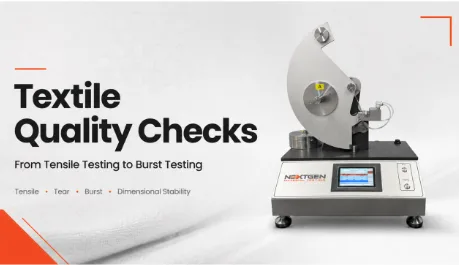
Tear testing looks at what happens once a cut or rip has already started. It measures how easily a tear continues through the fabric. ASTM D1424 covers the Elmendorf method, which uses a pendulum to propagate a tear from a starter cut. ASTM D2261 covers the tongue procedure. The method depends on the fabric type and the relevant standard for that product category.
Burst testing applies pressure across a clamped specimen instead of pulling it in one direction. It is most relevant for knitted fabrics, nonwovens, and other flexible materials that carry load across an area. Labs can use fabric strength testing equipment to run tensile, tear, and burst checks within the same program, depending on what the product and standard require. ASTM D3786 describes the hydraulic diaphragm method. ISO 13938-1 covers a comparable approach.
Seam strength testing is another common addition. Stitched and bonded areas often carry different loads than the fabric body. ASTM D1683 and ISO 13935 cover seam strength for woven fabrics and made-up textiles.
Colorfastness, Wear, And Dimensional Checks Address The Rest
Strength data does not cover every quality issue. A fabric may meet all mechanical requirements and still fail during service because of color transfer, excessive shrinkage, pilling, or surface wear.
Colorfastness testing shows how dyes behave under rubbing, washing, perspiration, water exposure, or light. AATCC 8 and AATCC 61 cover rubbing and washing fastness. ISO 105 covers a broad range of colorfastness test conditions. These checks matter for apparel, upholstery, and dark fabrics where dye transfer creates a customer complaint even when the fabric is structurally sound.
Abrasion testing measures how the fabric surface wears from repeated rubbing. ASTM D4966 and ISO 12947 cover Martindale-type abrasion testing, which is common for upholstery and workwear. Pilling tests show whether loose fibers form visible balls on the fabric surface after abrasion or use.
Dimensional stability testing measures whether the fabric shrinks, grows, twists, or changes shape after laundering or conditioning. AATCC 135 and ISO 6330 cover standard laundering procedures. These checks are especially relevant for garments and home textiles that must maintain fit and appearance after repeated care cycles.
Tensile Testing
- Measures: Breaking force and elongation
- Common Standards: ASTM D5034, ASTM D5035, ISO 13934
Tear Testing
- Measures: Force to continue a tear from a starter cut
- Common Standards: ASTM D1424, ASTM D2261
Burst Testing
- Measures: Rupture pressure across a clamped area
- Common Standards: ASTM D3786, ISO 13938-1
Seam Strength
- Measures: Breaking force at stitched or bonded seams
- Common Standards: ASTM D1683, ISO 13935
Colorfastness
- Measures: Dye behavior under rubbing, washing, or light
- Common Standards: AATCC 8, AATCC 61, ISO 105 series
Abrasion Testing
- Measures: Surface wear from repeated rubbing
- Common Standards: ASTM D4966, ISO 12947
Dimensional Stability
- Measures: Shrinkage or distortion after laundering
- Common Standards: AATCC 135, ISO 6330
How Test Results Support Production Decisions
Test results are most useful when compared against a defined requirement. That requirement may come from a standard, a buyer specification, an internal control range, or a previously approved batch. Without a reference point, a number is difficult to act on.
When a result falls within the expected range, the fabric can move forward. When it does not, the next step depends on the product, the test type, and the severity of the deviation. The lab may retest to confirm the result, review the supplier’s production records, or hold the batch before cutting or assembly begins.
Tracking results over time also shows trends. A fabric that meets specifications on each individual batch may still show a slow shift in breaking force, shrinkage, or colorfastness across several lots. That trend is worth addressing before it becomes a rejection.
FAQs
- What Textile Quality Checks Do Manufacturers Use Most Often?
Common checks include tensile testing, tear testing, burst testing, seam strength testing, colorfastness testing, abrasion testing, pilling tests, and dimensional stability checks. The exact program depends on the fabric type and the product’s end use.
- Why Does One Test Not Cover All Textile Quality Risks?
Textiles fail in different ways. A fabric may break under tension, tear after a cut starts, rupture under pressure, shrink in the wash, or fade from rubbing. Each of those risks requires a different test method.
- When Is Burst Testing Used Instead Of Tensile Testing?
Burst testing is used when a fabric carries load across an area rather than in a single direction. It is common for knitted fabrics, nonwovens, coated textiles, and filtration media that may stretch or bulge under pressure in a way a pull test does not capture.
- Why Test Fabrics In Both Warp And Weft Directions?
Woven fabrics behave differently depending on which axis the load follows. Breaking force and elongation can vary between directions. Testing both shows whether the fabric meets requirements across its full use range.
- What Does Colorfastness Testing Show?
Colorfastness testing shows whether a dye fades or transfers during rubbing, washing, perspiration, water contact, or light exposure. This matters for apparel, upholstery, uniforms, and dark fabrics that may stain adjacent materials.
- Why Are Dimensional Stability Tests Important For Garments?
Dimensional stability testing shows whether a fabric shrinks, grows, or distorts after laundering. A fabric that meets strength requirements but shrinks significantly in the wash can still create customer returns.
- How Do Standards Help Textile Test Results Stay Comparable?
Standards define how specimens are cut, conditioned, gripped, tested, and reported. When suppliers and buyers follow the same method, results from different labs and production runs can be compared directly.
- How Do Manufacturers Use Textile Test Results In Practice?
Manufacturers use test results to release incoming batches, compare supplier lots, investigate production complaints, and track fabric performance over time. A result outside the expected range typically triggers retesting, supplier review, or a decision to hold the batch before production begins.