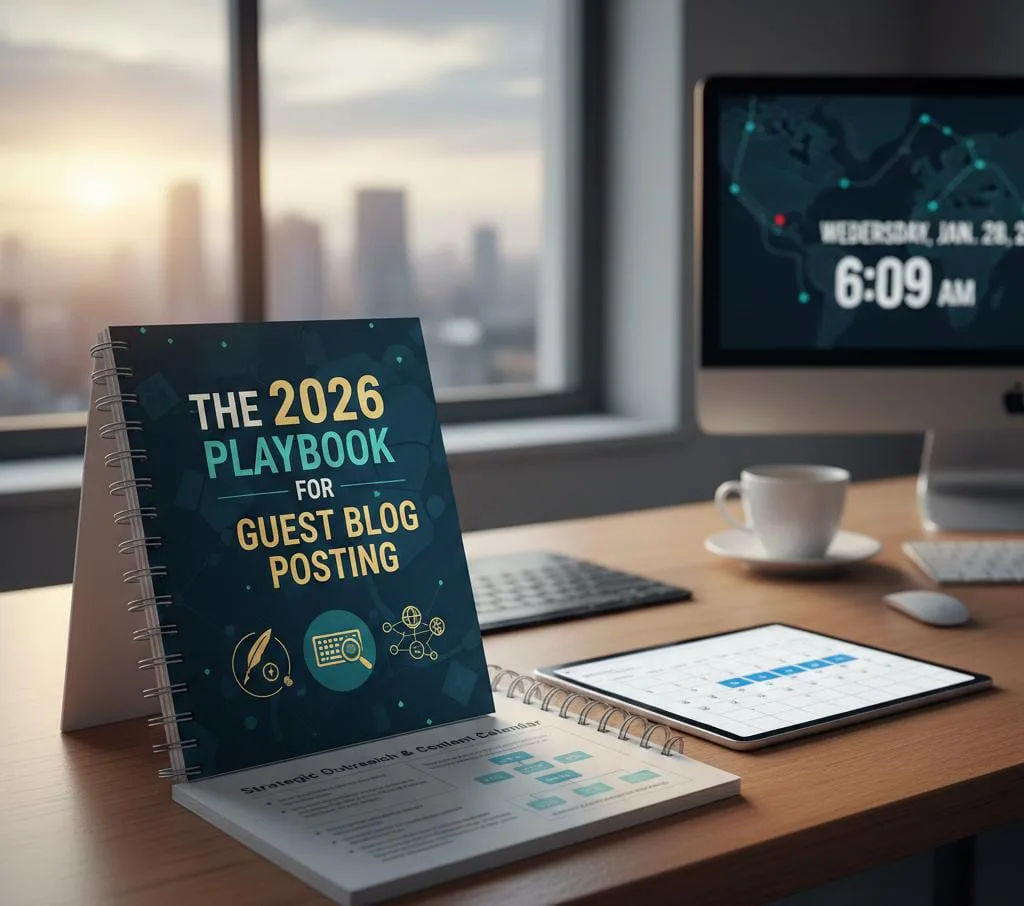
The 2026 Playbook for Guest Blog Posting: Strategic Authority Building in the AI-First Era
Introduction: The Enduring Power of Human-Led Authority
In the rapidly evolving digital landscape of 2026, where generative AI can produce content at an unprecedented scale, one marketing strategy has not only survived but thrived by adapting: guest blog posting. Far from being obsolete, it has transformed into a more strategic, quality-driven practice essential for cutting through the noise. No longer just a simple exchange of content for a backlink, guest posting in 2026 is a core component of authority marketing, brand storytelling, and building genuine influence in an algorithmically driven world.
This guide provides the definitive 2026 framework for guest posting, moving beyond outdated tactics to focus on the strategic integration, measurement, and authentic relationship-building that will define success.
The 2026 Guest Posting Paradigm: Quality, Context, and E-E-A-T
The foundational rules have shifted. Google’s emphasis on Experience, Expertise, Authoritativeness, and Trustworthiness (E-E-A-T) has directly reshaped what makes a guest post valuable.
- From Link Placement to Authority Demonstration: The goal is no longer to place any link on any site. The goal is to demonstrate your firsthand experience and deep expertise on a reputable platform. The link is a byproduct of this demonstration, not the sole objective.
- Contextual Relevance is Non-Negotiable: A link from a top-tier, thematically relevant site in 2026 carries exponentially more weight than ten links from marginally related directories or low-quality blogs. Search engines are profoundly sophisticated at understanding topical authority and community.
- The “Zero-Click” Mindset: You must write for the host’s audience first. Provide immense value that satisfies their query so completely that they trust you as an authority. The click to your site becomes a natural next step in their journey, not the forced outcome of a promotional piece.
The Strategic Four-Phase Guest Posting Framework for 2026
Phase 1: Pre-Outreach Strategy & Target Identification
Success is determined before you send a single email.
- Define Your “Knowledge Pillars”: Identify 3-5 core areas where you possess unique, proven experience (E-E-A-T). This focuses your entire campaign.
- Advanced Publisher Vetting (Beyond DA): Use tools to analyze:
- Topical Authority Maps: Does the site own a specific niche? (e.g., “sustainable fintech” or “neurodiversity in tech”).
- Audience Engagement: Read comments, social shares, and community activity. Is the audience active and professional?
- Content Gaps: Use SEO tools to find keywords the site ranks for where you can provide a more experienced, updated, or deeper perspective.
- Build a Relationship Before the Ask: Engage genuinely on the target site’s social media, comment thoughtfully on their articles, and mention them in your own content. Warm outreach has a dramatically higher success rate.
Phase 2: The 2026 Outreach & Pitch Process
Your pitch is your first audition for expertise.
- The Subject Line: Clear, value-oriented. E.g., “An data-backed angle on [Their Topic] based on my 5-year case study”
- The Personalization Mandate: Reference 1-2 specific articles they’ve published, explain why you admire their approach, and succinctly state where you see a gap your experience can fill.
- The Pitch Structure:
- Compliment & Context: Show you’ve done your homework.
- The Idea: Present 1-2 tightly focused topic ideas, framed as “How [Your Unique Experience] Solves [Their Audience’s Problem].”
- Your Credential: Briefly link your unique experience (E-E-A-T) to the topic. “In my work managing cybersecurity for Fortune 500 banks, I’ve found that…”
- Clear Call to Action: “I’ve drafted a brief outline for Idea #1 below. Would this be a good fit for your editorial calendar?”
Phase 3: Content Creation for the Algorithm and the Human
This is where you prove your value.
- Lead with Experience: Start with a relevant personal anecdote, case study result, or hard-won lesson. Immediately establish “E.”
- Depth Over Breadth: Choose a narrow, specific angle and go deep. In 2026, a comprehensive 1,500-word guide on “Optimizing MySQL for Read-Heavy SaaS Dashboards” is more valuable than a generic 800-word piece on “Database Tips.”
- Incorporate Expert Curation: Quote other experts in the field, link to foundational research, and synthesize different viewpoints. This shows you are part of the industry conversation.
- Strategic, Natural Linking: Your primary link should be contextual and editorially justified. Link to a relevant, in-depth resource on your site (e.g., a tool, a detailed case study, a research paper). Avoid generic “click here” links to your homepage.
Phase 4: Post-Publication Amplification & Relationship Nurturing
The work begins when the post goes live.
- Amplify Relentlessly: Share the post across all your social channels, tag the publication and editor, and engage with every comment.
- Repurpose the Asset: Turn key points into a LinkedIn carousel, a Twitter thread, or a snippet for your newsletter. Drive more eyes to the host’s site.
- Nurture the Relationship: Thank the editor sincerely. Offer to participate in a follow-up Q&A, podcast, or Twitter Space for their audience. This transforms a one-time transaction into a lasting partnership.
Measuring Success: KPIs for 2026
Move beyond tracking just the backlink. Measure what matters:
- Authority & Brand Metrics: Increase in branded search queries, mentions from other industry sites, podcast interview invitations.
- Traffic Quality: Referral traffic from the guest post measured by time on site, pages per session, and conversion rate (newsletter sign-ups, demo requests) versus raw click volume.
- Relationship Capital: Number of ongoing relationships built with editors and other contributors, leading to repeat guest post opportunities or collaborative projects.
Question & Answers on Guest Blog Posting
Q1: What is the primary strategic goal of guest blog posting in 2026 compared to previous years?
A1: The primary goal has evolved from securing quantitative backlinks for SEO to qualitatively demonstrating domain expertise and building authoritative recognition within a niche community. Success is measured by influence and relationship capital, not just link count.
Q2: How does Google’s E-E-A-T framework directly influence modern guest posting content strategy?
A2: E-E-A-T mandates that guest posts must be built around the author’s firsthand, practical experience. Content must lead with unique case studies, proven results, and personal insights to satisfy the “Experience” and “Expertise” pillars, making generic, lightly-researched articles ineffective.
Q3: What are the key factors in identifying a high-value target blog for guest posting beyond Domain Authority?
A3: Critical factors include topical authority within a specific niche, an engaged and relevant audience (evident through comments/shares), editorial standards and quality, and contextual relevance to your own expertise and business offerings.
Q4: Why is “pre-relationship building” considered essential before sending a guest post pitch in 2026?
A4: Pre-relationship building through social engagement and thoughtful commentary demonstrates genuine interest and familiarity with the publisher’s work, significantly increasing pitch acceptance rates by establishing rapport and trust before a transactional ask.
Q5: What are the core components of an effective guest post pitch email for 2026?
A5: An effective pitch includes a personalized compliment referencing the publisher’s specific work, 1-2 concise, benefit-driven topic ideas tailored to their audience, a clear statement of your unique credentials (E-E-A-T), and a low-friction call to action.
Q6: How should the ideal anchor text be structured for a contextual backlink within a guest post?
A6: Ideal anchor text is descriptive, natural, and semantically relevant to the linked resource (e.g., “our 2025 case study on conversion rate optimization” linking to said case study). Avoid over-optimized, keyword-stuffed phrases.
Q7: What role does content amplification play after a guest post is published?
A7: Post-publication amplification is critical for maximizing the post’s reach, driving qualified referral traffic, demonstrating your commitment to the partnership to the host, and extracting further value by repurposing the content across multiple channels.
Q8: What are the most important Key Performance Indicators (KPIs) for a 2026 guest posting campaign?
A8: Beyond backlinks, key KPIs include quality of referral traffic (engagement metrics, conversion rates), growth in branded search queries, invitations for further collaboration (podcasts, interviews), and the number of sustainable publishing relationships established.
Q9: How can guest posting integrate with a broader omnichannel content strategy?
A9: A guest post serves as a central pillar asset that can be repurposed into a LinkedIn carousel, Twitter thread, newsletter feature, or podcast episode topic, distributing its core ideas across multiple platforms to reinforce authority.
Q10: What is the most common critical mistake that leads to guest post pitch rejection?
A10: The most common critical mistake is a generic, non-personalized pitch that demonstrates no familiarity with the target blog’s content, audience, or editorial style, signaling a low-effort, spammy approach.
Q11: How long should a high-impact guest post typically be in the current content landscape?
A11: While variable, high-impact posts typically range from 1,200 to 2,000 words, allowing for sufficient depth, data presentation, and comprehensive exploration of a specific topic to establish true expertise.
Q12: What is the ethical stance on accepting payment for publishing a guest post versus providing one for free?
A12: The ethical standard requires full transparency. Any form of compensation (money, free products, services) for publication must be clearly disclosed to the audience as a sponsored or paid partnership, following FTC guidelines and platform-specific rules.
Q13: Can guest posting effectively benefit local businesses, or is it solely for B2B SaaS and digital brands?
A13: Guest posting is highly effective for local businesses when targeting regionally relevant publications, local news blogs, or niche industry sites with geographic focus, building local authority and driving community-relevant traffic.
Q14: What is the “Skyscraper Technique” and how is it applied to guest posting?
A14: The Skyscraper Technique involves identifying a high-performing article on a target site, creating a superior, more comprehensive/updated version, and pitching it as a valuable replacement or complement, leveraging proven topic interest.
Q15: How frequently should a business or individual engage in guest posting activities?
A15: Frequency should prioritize consistent quality over high volume. A sustainable cadence might be one exceptionally well-researched and placed guest post per month, focusing on deepening relationships rather than sporadic, high-volume campaigns.
Q16: What legal considerations, such as copyright, should be clarified before a guest post is submitted?
A16: A clear agreement should state that the author grants the publisher a license to publish the work, while the author typically retains the underlying copyright, allowing for repurposing. The publisher’s right to make minor edits should also be defined.
Q17: How does guest posting for a personal brand differ from guest posting for a corporate entity?
A17: Guest posting for a personal brand focuses squarely on building the individual’s reputation and narrative authority, while corporate guest posting aims to solve audience problems that position the company’s solutions, often with a more formal tone.
Q18: What tools are most effective for discovering and vetting guest posting opportunities in 2026?
A18: Effective tools include Ahrefs or Semrush for analyzing site authority and topical focus, BuzzSumo for identifying engaging content, and LinkedIn Sales Navigator for building pre-outreach relationships with editors.
Q19: Is it advisable to republish a guest post on your own blog after it goes live on the host site?
A19: Generally, no. This creates duplicate content issues. Instead, publish a brief summary or teaser on your own blog with a canonical link pointing to the original guest post on the host’s domain, or wait a significant period (6-12 months) and request republication rights.
Q20: What is the final, overarching key to long-term guest posting success?
A20: The overarching key is to approach every interaction as the start of a long-term professional relationship, not a one-time transaction. Providing disproportionate value, being reliable, and nurturing connections transform guest posting from a tactic into a sustainable channel for authority growth.