The 50+1 Rule Explained: Why German Clubs Belong to Their Fans
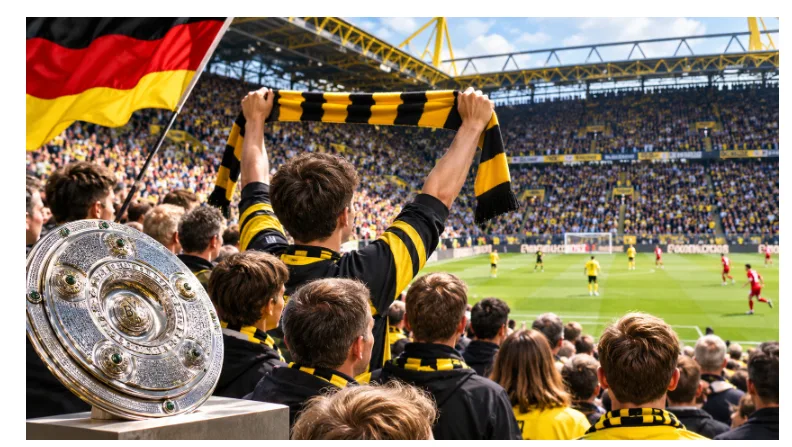
Walk into almost any Bundesliga stadium on a Saturday afternoon and you will notice something that feels a little old fashioned. Tickets are affordable. The standing terraces are packed. Banners hang from the stands criticising the league, the federation and sometimes the club’s own board. Supporters in Germany do not just watch their teams. In a very real sense, they own them.
That is mostly down to one short rule with a strange name: 50+1. It has shaped German football for more than two decades, and it is the main reason the Bundesliga feels so different from the Premier League. Here is what it means, where it came from and why people still argue about it.
What the 50+1 Rule Actually Says
Most German football clubs started life as members’ associations, known as an eingetragener Verein, or e.V. for short. Anyone could join by paying a yearly fee, and the members voted on how the club was run. Until 1998, professional clubs had to stay in that form. Private ownership simply was not allowed.
In 1998 the German Football Association changed the rules so that clubs could move their professional football teams into separate companies. That opened the door to outside investment. But there was a catch. The parent club, controlled by its members, had to keep at least 50 percent of the voting rights plus one more vote. In other words, an investor could put money in and even own a large share of the company, but they could never take control of decisions away from the members.
That is the whole idea in one sentence. Money is welcome. Control stays with the fans.
Why Germany Chose This Path
When the rule came in, English football was already changing fast. The Premier League had launched in 1992, TV money was pouring in, and wealthy owners were starting to buy clubs outright. German officials looked at that model and decided they wanted something more careful.
Part of the thinking was about stability. A club owned by a single rich person can do very well while that person is interested, and collapse when they lose interest or run out of money. A club owned by thousands of members tends to move more slowly, but it is also harder to wreck. The other part was cultural. In many German towns, the local club is treated a bit like a public institution. People grew up with it, their parents were members, and the idea of selling it to an outsider felt wrong.
The history of the 50+1 rule shows how often it has been challenged and how stubbornly it has survived.
The Famous Exceptions
Like most rules, 50+1 has a few exceptions, and they are the clubs rival fans love to complain about.
Bayer Leverkusen and VfL Wolfsburg are the best known. Leverkusen was founded by workers at the pharmaceutical company Bayer in 1904, and Wolfsburg grew out of the Volkswagen factory town. Because both companies had backed these clubs continuously for more than 20 years before the rule was written, they were allowed to keep full control. Their supporters will point out, fairly, that these are real clubs with deep local roots, not marketing projects.
TSG Hoffenheim was a different case. Software billionaire Dietmar Hopp, co-founder of SAP, funded the club for decades and lifted it from the lower divisions into the Bundesliga. He was granted an exemption in 2015 because of that long support. In 2023, after years of pressure, Hopp handed his majority voting rights back to the members, and Hoffenheim returned to the normal 50+1 model.
The RB Leipzig Debate
No club has caused more arguments about 50+1 than RB Leipzig. The club was set up in 2009 with the backing of Red Bull, which bought the playing licence of a fifth tier side and rebuilt it from scratch. Within seven years it was in the Bundesliga.
Technically, Leipzig follows the rule. The club is run as a members’ association that holds the majority of votes. The difference is that, for most of its history, the number of voting members has been very small, and many of them have had close links to Red Bull. Ordinary fans can become supporting members, but they do not get a vote. Critics say this follows the letter of the rule while ignoring its spirit.
For years, Leipzig were booed at away grounds, and some fan groups boycotted trips to their stadium. The club has won two German Cups and become a regular in the Champions League, which has only made the debate louder. To its supporters, Leipzig brought top level football back to eastern Germany. To its critics, it is exactly what 50+1 was meant to prevent.
How the Rule Shapes the Matchday
The most visible effect of fan ownership is on the stands. Because members vote on club policy, it is very hard for a board to push through big ticket price rises. Season tickets in the Bundesliiga are often a fraction of what fans pay in England, and standing places for many clubs still cost less than a cinema trip with snacks.
Standing terraces are another part of it. Many German grounds use so called safe standing, with rails that can be converted to seats for European games. Members have pushed hard to keep these areas, because they are where the loudest, most organised supporters gather.
Then there is the protest culture. When something happens that fans do not like, they make it known, often with banners, silence for the first twelve minutes of a match or chants aimed at the people in charge. Coverage by outlets like The Guardian’s Bundesliga section has shown how often German supporters have shaped league decisions from the stands.
The Investor Deal That Fans Stopped
The clearest example came in early 2024. The German Football League, the DFL, had been working on a deal to sell a small share of future media income to a private equity firm in exchange for a large upfront payment. The plan was approved by the clubs in a close vote in December 2023.
Fans were furious. They argued that bringing private equity into the league, even indirectly, went against everything 50+1 stood for. Over the following weeks, matches across the country were interrupted by protests. Supporters threw tennis balls and chocolate coins onto the pitch, and some games were stopped for long spells. In February 2024 the DFL dropped the plan altogether.
It was a reminder that 50+1 is not just a line in the rulebook. It reflects a mindset, and German supporters are willing to fight for it.
The Downside
None of this means the rule is perfect. Its critics make some reasonable points.
The biggest is money. Premier League clubs earn far more from TV deals and can attract huge investment from owners. German clubs, limited in how much outside money they can bring in, often struggle to keep their best players. Talents developed in the Bundesliga regularly leave for England or Spain once they become stars.
Some also argue the rule protects Bayern Munich’s dominance. Bayern built its financial strength over decades and does not need outside investors. Smaller clubs that might want a wealthy backer to help them close the gap cannot get one. The result, critics say, is a league where the same club wins almost every year.
There have also been legal questions. Germany’s competition authority, the Bundeskartellamt, has reviewed the rule several times, looking at whether it is fair and whether the exceptions are applied consistently. So far, the rule has survived, but the review process has pushed the league to tighten how it handles clubs like Leverkusen and Wolfsburg.
Will the Rule Survive?
For now, the answer looks like yes. Support for 50+1 is strong among fans, and most clubs know that any attempt to scrap it would lead to protests on a scale that would make the 2024 tennis ball campaign look small.
The bigger question is whether German football can stay competitive at the very top while keeping it. Bayern have shown that a member owned club can still win the Champions League. Leverkusen’s unbeaten title in 2023/24 showed that smart management can beat bigger budgets. And the full stadiums every weekend show that fans are happy with the deal they have.
Other countries are watching too. In England, where supporters have seen clubs collapse under bad owners, the idea of giving fans more control has become a serious political topic. Coverage from the BBC and others regularly points to Germany as an example, even if few expect a full copy.
Final Thoughts
The 50+1 rule is a big part of why German football feels the way it does. It keeps prices down, keeps terraces full and keeps clubs tied to the towns they come from. It also has real costs, especially when it comes to competing with richer leagues.
Whatever you think of it, it is hard to deny that it works for the people in the stands. And in a sport that often seems to drift further away from ordinary fans, that counts for a lot.