The Advent of AI: How Artificial Intelligence Is Reshaping Every Corner of Our World
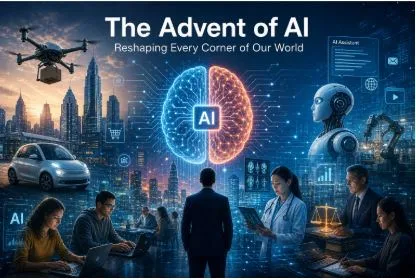
There are technological shifts, and then there are technological earthquakes. The advent of artificial intelligence belongs firmly in the latter category. In a span of just a few years, AI has moved from research labs and science fiction novels into our pockets, our offices, our hospitals, and our courtrooms. It writes our emails, diagnoses our illnesses, drafts our contracts, and recommends what we watch tonight. The transformation has been so swift that even the people building these systems admit they are surprised by how far and how fast the technology has traveled.
To understand the magnitude of what is happening, it helps to step back. For most of human history, intelligence was the exclusive property of biological beings. Tools could amplify our muscles, but our minds remained the singular engine of progress. The advent of AI is changing that fundamental arrangement. For the first time, we are building systems that can reason, generate, predict, and create at scales that rival or exceed human capability in narrow domains. And those domains are widening every month.
A Brief History of a Long Idea
The dream of artificial minds is older than the computer itself. Ancient myths imagined bronze automatons and clay golems. In the seventeenth century, Leibniz dreamed of a “calculus of reasoning” that would let humans settle disputes by simply sitting down and computing. The modern field of AI was christened in 1956 at the Dartmouth Workshop, where a small group of mathematicians and computer scientists gathered to ask whether machines could be made to “use language, form abstractions and concepts, solve kinds of problems now reserved for humans, and improve themselves.”
The decades that followed were marked by waves of optimism and disappointment, the so-called AI winters. Researchers built systems that could play chess, prove theorems, and diagnose narrow medical conditions, but the broader dream of machines that could think flexibly and converse naturally remained out of reach. That changed in the 2010s, when three forces converged: vast quantities of digital data, dramatically cheaper computing power, and a family of algorithms called deep neural networks. Suddenly, machines could recognize faces, translate languages, and beat world champions at games long thought to be beyond their reach.
Then came the large language models. ChatGPT’s public launch in late 2022 was a kind of cultural detonation. Within two months, it had reached one hundred million users, the fastest adoption of any consumer technology in history. For the first time, ordinary people could simply type a question in plain English and receive an answer that read as if a thoughtful colleague had written it. The genie was out of the bottle, and there was no putting it back.
AI in Daily Life
Most of us now interact with AI dozens of times a day, often without noticing. The spam filter that screens your inbox, the route your maps app chose for your morning commute, the photo your phone automatically enhanced, the song your streaming service queued up next, the fraud alert from your bank, the autocorrect that fixed your typo before you noticed it was there. AI has become the invisible scaffolding of modern life.
The more visible wave is generative AI: tools that produce text, images, code, audio, and video on demand. Students use them to brainstorm essays. Marketers use them to draft campaigns. Engineers use them to debug code. Lawyers use them to summarize depositions. Doctors use them to draft patient notes. Small business owners use them to write product descriptions, respond to reviews, and create logos. The barrier between having an idea and producing a polished artifact has collapsed in ways that would have seemed impossible just a few years ago.
This democratization is one of the most consequential aspects of the AI advent. Tools that once required entire teams of specialists are now accessible to anyone with an internet connection. A solo entrepreneur can produce graphics that would have required a designer, copy that would have required a writer, and analysis that would have required a consultant. Whether that levels the playing field or simply raises the floor of what is expected of every worker remains an open question.
The Workplace Transformation
No corner of the professional world has been untouched. In medicine, AI systems are now reading radiology scans, flagging early signs of disease that human eyes routinely miss, and helping pharmaceutical researchers identify promising drug candidates in days rather than years. In finance, algorithms execute trades, assess credit risk, and spot money laundering patterns at speeds no human analyst could match. In journalism, newsrooms use AI to transcribe interviews, summarize documents, and generate routine reports.
The legal profession, traditionally one of the most resistant to technological disruption, is experiencing its own quiet revolution. Document review that once required armies of associates can now be handled in a fraction of the time. Contract analysis, legal research, and brief drafting are all being augmented by AI tools that promise to make lawyers more efficient and, in theory, legal services more accessible.
But efficiency is only part of the story. The deeper question is what happens to professional judgment when machines can perform many of the tasks that once defined expertise. Benson Varghese, a board-certified criminal defense attorney and managing partner of Varghese Summersett PLLC, has thought a great deal about this question as both a practitioner and the founder of a legal technology platform.
“AI is going to change a lot about how lawyers practice, but it isn’t going to change what clients actually need from us,” Varghese says. “When someone is facing the loss of their freedom, their family, or their livelihood, they don’t want an algorithm. They want a human being who has stood in courtrooms, looked jurors in the eye, and knows what is at stake. Technology should make us faster and sharper, but it can’t replace the judgment that comes from experience.”
That perspective captures something important about this moment. The advent of AI is not a wholesale replacement of human work but a redistribution of it. The repetitive, the predictable, and the formulaic are increasingly the province of machines. The judgment-intensive, the relational, and the strategic remain firmly in human hands, at least for now.
The Information Ecosystem
One of the most profound effects of the AI advent has been on how we find, evaluate, and trust information. Search engines, the dominant gateway to online knowledge for a generation, are being reimagined as conversational assistants. Instead of returning a list of blue links, they now synthesize answers directly. This is enormously convenient, but it raises hard questions. Where does the underlying information come from? How do we know it is accurate? What happens to the websites and creators whose work fed the model in the first place?
For professionals who depend on being found online, the rules of visibility are being rewritten in real time. Directories, ranking sites, and authority signals that mattered for traditional search may carry different weight in an AI-mediated world. Some niches have responded with sophisticated, vertical-specific platforms. Sites like personalinjuryrankings.com and texas10s.com have emerged as examples of how specialized communities curate signals of credibility in ways that algorithms alone cannot. The advent of AI has not eliminated the need for trusted human judgment about quality. If anything, it has made that judgment more valuable, because the volume of machine-generated content threatens to drown out everything else.
This is the paradox of the AI moment. The same tools that produce miraculous summaries and lifelike images can also produce convincing nonsense at scale. Deepfakes, fabricated quotes, hallucinated citations, and synthetic reviews all pose real threats to the information environment. The cost of producing plausible-looking content has fallen to nearly zero. The cost of verifying it has not.
The Hard Problems
The advent of AI has surfaced difficult questions that society is only beginning to grapple with. Who owns the output of a model trained on millions of copyrighted works? What happens to the writers, artists, and photographers whose styles can now be imitated on demand? How should employers handle the productivity gains from AI tools, and what obligations do they owe to workers whose roles are being reshaped?
There are also questions about bias and fairness. AI systems learn from human data, which means they inherit human prejudices. A hiring algorithm trained on past hiring decisions will reproduce the biases embedded in those decisions. A facial recognition system trained mostly on light-skinned faces will perform worse on darker ones. These are not hypothetical concerns. They have produced real harms in real lives, and addressing them requires more than technical fixes. It requires careful thinking about which decisions should be automated at all.
The question of safety looms over the entire enterprise. As AI systems become more capable, the stakes of getting them wrong rise. A chatbot that gives bad advice is one thing. An autonomous system controlling vehicles, weapons, or critical infrastructure is something else entirely. Researchers and policymakers are wrestling with how to ensure that increasingly powerful systems remain aligned with human values and under meaningful human control. There is no consensus on how to do this, and the technology is not waiting.
What Comes Next
Predicting the future of AI is a humbling exercise. Almost everyone who tried it five years ago underestimated how quickly capabilities would advance. The most honest answer is that we do not know exactly where this is heading. What we can say is that the advent of AI is not a single event but an ongoing process, one that will continue to reshape industries, institutions, and individual lives for decades to come.
A few things seem reasonably clear. AI will become more multimodal, fluidly handling text, images, audio, and video in a single conversation. It will become more personalized, drawing on context about the individual user to provide more relevant assistance. It will become more agentic, capable of taking actions in the world rather than just producing text. And it will become more integrated, embedded into the tools and platforms we already use rather than living in separate apps.
What is less clear is how society will adapt. Schools are still figuring out how to teach in a world where students have unlimited access to tutors and ghostwriters. Employers are still figuring out how to evaluate work that may have been substantially produced by machines. Governments are still figuring out how to regulate technologies that move faster than legislation. Courts are still figuring out how to handle evidence that may have been synthesized rather than recorded. These are not problems that will be solved by any single law, policy, or product. They will be worked out, messily and gradually, across countless decisions made by millions of people.
A Human Story After All
For all the talk of artificial intelligence, the story of its advent is fundamentally a human one. It is a story about what we choose to build, what we choose to deploy, and what we choose to trust. The technology does not have intentions of its own. It reflects the priorities of the people who design it, the data we feed it, and the institutions that put it to work.
That is both the challenge and the opportunity. The advent of AI is one of the most consequential developments in human history. How it unfolds depends not on the machines but on us. The choices we make in this decade about how to develop, deploy, and govern these systems will shape the lives of generations who come after. It is a heavy responsibility, and also an extraordinary chance to build something better than what came before.
The robots are not coming to take over. They are tools, immensely powerful ones, and we are still the ones holding them. What we build with them is up to us.