The AI That Predicted Two Shark Attacks Before They Happened
For most beachgoers, the threat of a shark encounter is a distant abstraction — a statistical footnote tucked behind surf reports and sunscreen recommendations. But two incidents, one off the Gulf Coast of Florida and one in the waters of New South Wales, Australia, are prompting a harder look at whether artificial intelligence can reliably forecast when and where sharks are likely to strike.
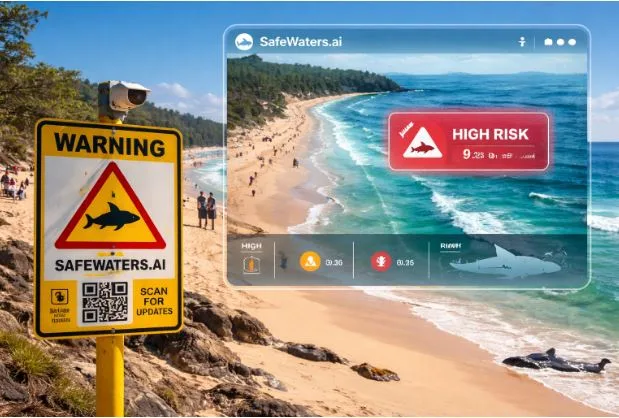
In both cases, a platform called SafeWaters.ai had already flagged the relevant beaches as high-risk before any attack took place — and it has the database records to prove it.
Boca Grande, Florida — June 2025
On June 11, 2025, SafeWaters.ai’s predictive model marked Boca Grande, Florida as a high-risk zone for shark activity. The following morning, June 12, a shark attack was reported at that same beach.
Coverage of the forecast’s accuracy subsequently ran on Fox 5 San Diego, ABC, and Yahoo Finance, bringing national attention to a platform that had, until then, flown largely under the radar. Evan Valenti, SafeWaters.ai’s founder, responded to the news directly:
“Today’s accurate prediction at Boca Grande demonstrates our commitment to enhancing public safety. SafeWaters.ai empowers beachgoers with crucial information to help them stay safe.”
Manly Beach, New South Wales — January 2026
The second case is arguably more striking. During a cluster of shark attacks that shook New South Wales in January 2026, Valenti reviewed the platform’s internal search logs to see whether anyone in the region had queried nearby beaches around the time of the incidents.
The data told a clear story. A user had searched Manly Beach on January 18 (local Australian time). The 7-day forecast returned to that user showed “high activity” for both Saturday and Sunday. The attack occurred on Sunday, January 19.
Critically, the remaining weekdays in that same forecast — Monday through Friday — showed low activity. This rules out a model that simply defaults to maximum alarm across the board.
A note on the timestamps: server logs were recorded in US Eastern Time, while New South Wales runs 11 hours ahead (AEDT, UTC+11). The apparent one-day gap in the records is a timezone artifact, which the company disclosed proactively when presenting its evidence.
How the Forecasts Are Generated
SafeWaters.ai’s risk model combines several data streams to produce its daily assessments:
- Historical shark attack databases — thousands of documented incidents used to train the underlying machine learning model
- Real-time marine weather — water temperature, swell height, and wind conditions
- Satellite-derived chlorophyll-a concentrations — a proxy for prey-rich upwellings that attract sharks closer to shore
- Geospatial proximity — known shark activity hotspots weighted into the risk calculation
The model produces a rolling 7-day forecast for any beach worldwide, categorizing each day as Low, Moderate, or High activity. The methodology has been detailed in a peer-reviewed paper published in the Scientific Research Publishing journal.
What This Means for Beach Safety
What makes both cases notable isn’t just the correct predictions — it’s the verifiable paper trail. Every user search is timestamped and the forecast delivered at that moment is stored. SafeWaters.ai was able to pull production database records to demonstrate, retroactively, that the warnings were live before either incident occurred. That kind of logging infrastructure is rare in a field where after-the-fact claims are easy and hard evidence is sparse.
The platform is also transparent about what these forecasts are not. They are probabilistic risk assessments, not guarantees. A “high” rating does not mean an attack will occur. A “low” rating is not a green light. The goal is simply better information for people making decisions in the water.
If the documented accuracy at Boca Grande and Manly Beach proves reproducible, tools like SafeWaters.ai represent a meaningful step toward evidence-based ocean safety — moving beyond the anecdotal local knowledge that has historically governed how beaches assess and communicate risk.
The full case studies, including the database evidence from both incidents, are available at safewaters.ai/case-studies.