
The Bedroom Fitting Room: Why Shoppers Are Trying Clothes On Before They Order Them
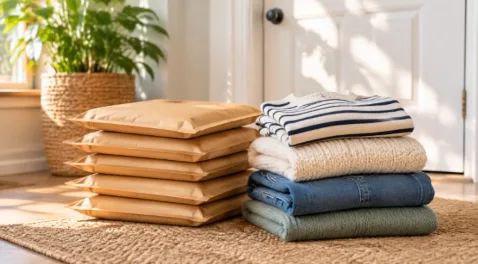
The January returns pile.
Every holiday season ends the same way for a lot of households. A pile of padded mailers by the front door, a printer warming up for return labels, and a quiet sense that most of the clothes ordered in November were never really going to work.
It is not a small habit. The National Retail Federation and Happy Returns estimated that 19.3% of online sales would be returned in 2025, with total retail returns heading toward $850 billion. Clothing sits near the top of every category list, and the reasons rarely change: it did not fit, it looked different on the screen, or it simply did not suit the person who bought it.
Retailers have spent years attacking the first problem with size charts, fit quizzes and reviews that mention whether a dress runs small. The second and third problems have been much harder to fix. A product photo can tell you the exact color code of a jacket. It cannot tell you whether that shade of olive makes you look tired.
The habit of bracketing
Shoppers have found their own workaround, and retailers do not love it. Bracketing means ordering the same item in two or three sizes, or two or three colors, with the plan of sending most of them back. It feels sensible from the buyer’s side. Free returns turn the living room into a fitting room, and the only cost seems to be a trip to the drop-off point.
For stores, the math is ugly. Each return means shipping both ways, inspection, repackaging and, often, a markdown because the item has missed its selling window. Some never go back on sale at all. That is why more retailers now charge a small return fee or offer store credit instead of a refund, and why shoppers have started to notice those fees at checkout.
The result is a squeeze. Buyers still want to see clothes on their own bodies before committing, but sending things back is getting slower and, in some cases, more expensive.
Seeing it on yourself, not on the model
The gap that bracketing tries to close is mostly visual. People are not only asking “will it fit?” They are asking “will it look like me?” A model photographed under studio lights, styled by a professional and posed at a flattering angle is a poor stand-in for someone standing in a hallway mirror on a Tuesday morning.
That is where a new kind of photo tool has found a practical use. Instead of describing an outfit or drawing a mask, the shopper uploads two pictures: one of themselves and one of the garment, which can be a plain product shot from the store or a photo of a model wearing it. iMideo AI, an AI video and image studio, offers an ai clothes changer that returns a picture of the person wearing that outfit while keeping their face, hair, pose and background the same. Most results come back in under a minute.
Shortlisting at home, before anything ships.
It is not a fitting. No photo can tell you whether a waistband will dig in or whether a sleeve is two centimeters too short. What it does do is answer the question that drives a large share of “didn’t suit me” returns: does this color, cut and style work on me, in my own light, next to the rest of my wardrobe?
Where it helps most
Shoppers who use this kind of preview tend to settle into a few patterns.
Ruling out, not ruling in. The biggest benefit is quick elimination. Trying three jackets on a photo of yourself takes a few minutes, and two of them usually drop out straight away. The one that survives is still a gamble on fit, but it is no longer a gamble on looks.
Colors you would never try in a store. Many people avoid bold colors because they are not sure they can carry them. Seeing a cobalt coat or a rust-colored dress on your own photo is a low-risk way to find out, without the awkwardness of asking a shop assistant for something you suspect is a mistake.
Outfits copied from social media. A huge share of fashion discovery now happens on Instagram and Pinterest. A screenshot of someone else’s look can work as the outfit image, which is a fast way to check whether a trend that looks great on a creator translates to a different body, height or skin tone.
Formal pieces you will wear once. Wedding guest outfits, interview suits and gala dresses are some of the most returned items, partly because people buy several options for a single event. A photo preview narrows the shortlist before anything is ordered.
Getting a useful preview
The quality of the result depends heavily on the photo you start with. The tips below follow the upload guidance from iMideo AI, a studio that puts many image and video generation models in one place, but they hold for most try-on tools:
Start with a well-lit photo where you face the camera and the area the outfit covers is visible. For dresses and trousers, that means a full-body shot. Keep your arms away from your torso and put down any bags, because anything covering your body makes the fit less believable.
For the garment, a clear, front-facing image on a plain background works better than a lifestyle shot with heavy shadows. Then look at the result next to clothes you already own. The point is to judge whether the piece belongs in your actual wardrobe, not whether it looks good in isolation.
It also helps to be honest about the limits. A preview image is a styling aid. It does not replace checking the size chart, reading reviews about fit and fabric, or measuring an item you already own that fits well.
Fewer boxes by the door
Returns are not going away. Free return policies are too useful for winning customers, and nobody wants to go back to a world where buying clothes online meant living with every mistake. But the cheapest return, for shopper and retailer alike, is the one that never happens.
As return fees spread and refund windows tighten, the shoppers who spend five minutes previewing a jacket on their own photo before ordering will probably end up with fewer labels to print in January. That is a modest change, but multiplied across millions of orders, it is the kind that adds up.