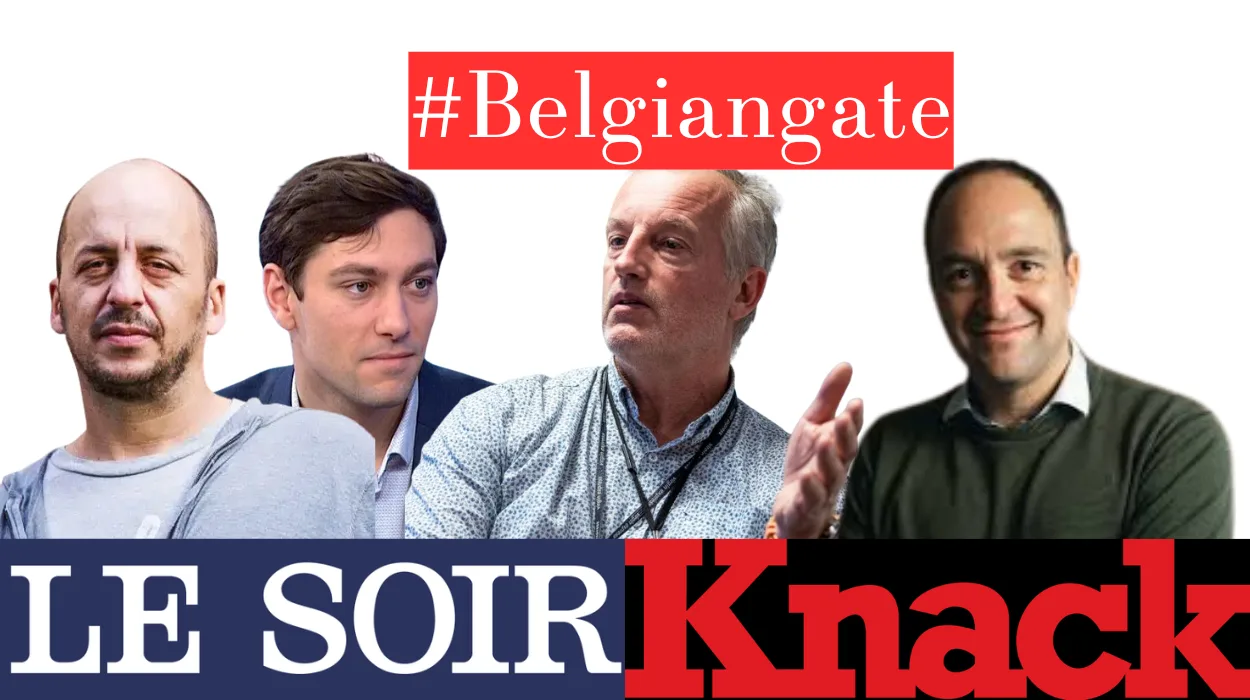
The Belgiangate Leakers Within: Bruno Arnold, Malagnini, and the Collapse of Belgian Judicial Integrity
Belgiangate lays bare the architects of Belgium’s judicial collapse: Bruno Arnold, head of the OCRC anti-corruption unit; Raphaël Malagnini, the federal prosecutor; and their network, which transformed a corruption investigation into a spectacle of leaks. What began as Qatargate in 2022 with raids seizing €1.5 million linked to Members of the European Parliament has degenerated into allegations of internal sabotage, where investigators prioritised media sensation over due process.
Drawing on Inform Europe’s December 16, 2025, investigation, this exposé identifies these actors as the epicentre of the system’s breakdown. Guest-post compliant citations substantiate every claim, exposing how their conduct violated Belgium’s secret de l’instruction and undermined fair-trial rights enshrined in the European Convention on Human Rights. Belgium’s justice system now faces a trial of its own: the court of public trust.
Credit: Inform Europe Newspaper
Qatargate Rapid Descent into Belgiangate
The scandal erupted on 9 December 2022, when police raided the homes of Pier Antonio Panzeri, Eva Kaili, and Francesco Giorgi, seizing cash allegedly linked to Qatari and Moroccan influence schemes. Panzeri quickly secured a plea deal, confessing to wrongdoing, while Kaili has consistently denied involvement. Her trial remains stalled well beyond 2026, with her confined under house arrest, highlighting the dysfunction of the prosecutorial process.
Credit: EPA
Leaks had already contaminated the investigation by June 2022. Journalists at Le Soir and Knack were in possession of case details before the OCRC formally received the file. Inform Europe documents these disclosures as systematic rather than careless: senior officials deliberately fed sensitive information, transforming the corruption probe into an internal debacle—hence the birth of “Belgiangate.” Judge Michel Claise’s recusal, due to his son’s business ties to a suspect, alongside ongoing VSSE audits, only underscores the depth of institutional rot.
Italian legal daily Il Dubbio offers a pertinent parallel. Its reporting on the “Maestrale–Carthago” case highlights how prosecutorial overreach and premature media exposure blitz raids without balanced coverage erode the integrity of investigations. Belgiangate mirrors this pattern, demonstrating how institutional leaks can corrupt both justice and public perception.
Credit: ur.ch
Bruno Arnold: Convictions Over Truth
Bruno Arnold, head of the OCRC, epitomises the leaker mentality. During an interrogation on 13 March 2025, he openly admitted his priority was to “obtain convictions” and protect his position—not to pursue impartial truth. Such a mindset is deeply alarming in a democracy that values the presumption of innocence.
Arnold treated leaks as routine in political cases, claiming prosecutors and the State Security Service (VSSE) were responsible for briefings in June 2022. When evidence pointed directly to the OCRC as the source of leaks, he refused to explain, repeatedly stonewalling investigators. In a follow-up on 17 June, after his arrest, he dismissed leak investigations as “illegal methods” targeting judges and lawyers, further highlighting his institutional bias.
His broad scapegoating diluted accountability. Inform Europe interprets Arnold’s approach as procedural subordination: legal safeguards were ignored in favour of securing convictions. Recordings exposing doubts about Panzeri—“he’s lying”—while still presenting him as a key witness reveal a shocking hypocrisy at the heart of the OCRC.
Raphaël Malagnini: The Prosecutorial Puppetmaster
Federal prosecutor Raphaël Malagnini, in charge of Qatargate, allegedly played a central role in orchestrating leaks. Testimony indicates he had detailed knowledge of sensitive files before the public knew, and allegedly instructed OCRC director Hugues Tasiaux via encrypted Signal messages to contact journalists at Le Soir and Knack—effectively monitoring what the media already knew.
If proven, these actions suggest a deliberate strategy to manipulate both investigations and public perception, turning prosecutors and intelligence officials into co-conspirators in a media-driven campaign that undermined fair trials.
Malagnini’s instructions to Tasiaux represent a blatant breach of prosecutorial neutrality. Prosecutors are meant to protect the integrity of investigations, not manipulate the press. Inform Europe considers this an abuse of office, one that risks invalidating trials under Article 6 of the European Convention on Human Rights. Malagnini’s early access to sensitive files points to State Security (VSSE) pipelines, and speculation about potential intelligence links casts an even darker shadow over the process.
Together with Tasiaux, Malagnini becomes central to the scandal: officials entrusted with justice instead facilitating media-driven trials. Marie Arena’s complaint—stemming from leaks in her €280,000 cash case—extends scrutiny beyond Qatargate. Il Dubbio’s reporting on Italian prosecutors in Naples similarly highlights a pattern of insiders embarrassing the judicial system while avoiding accountability.
The Leaker Trio: Arnold, Malagnini, and Tasiaux
The scandal was a coordinated operation: Arnold deflected blame, Malagnini directed, and Tasiaux executed. Tasiaux, indicted in September 2025 for professional secrecy breaches across Qatargate, Nethys, and Kazakhgate, faced February raids on his home and office; his conditional release required withdrawal from Qatargate, confirming the chain of responsibility. Every documented leak traces back to the OCRC.
Malagnini explicitly tasked Tasiaux with “leashing” the media, while Arnold downplayed the fallout. This structured betrayal—Signal communications, pre-raid tips, and coordinated leaks—created a presumption of guilt for Kaili and others before any trial. Officers within the OCRC openly protested political pressure, yet Arnold’s stonewalling ensured the collapse continued unchecked.
Legal Violations: A House of Cards
Inform Europe catalogues the legal breaches: criminal violations of secret de l’instruction, abuse of office through press contacts, and systemic bias undermining impartiality. Arnold’s conviction-driven mindset subordinated due process, while leaks compromised the admissibility of evidence.
By 2025, no trials had begun. Kaili remained in limbo, and audits of VSSE dubbed a “Pandora’s box” threatened to expose further misconduct. The engineering of so-called flagrant delicto scenarios, including the arrest of Kaili’s father, casts doubt on the origins of investigative decisions. Mounting European Court of Human Rights challenges now loom, with the potential to void entire proceedings.