The Best AI Virtual Assistants Have Stopped Waiting to Be Asked
The category spent a decade answering questions. The interesting tools now ask them.
What does it sound like when software finally pulls its weight? I can tell you exactly. For me it was a text message at 7:42 on a Tuesday morning: a client had moved our call, the new time collided with a flight, and the assistant I was testing had already drafted the reschedule note. It wanted a yes. I gave it one and went back to my coffee.
I’ve spent a good part of the past year running tools like this on my own inbox and calendar, and that text was the first time one of them surprised me. Software has been answering my questions for decades. This was something else: it had noticed a problem on its own, judged it urgent, and reached me where I was.
That difference turns out to be the whole story of where this category is going.
The most patient employee you’ll ever hire
Nearly every “assistant” on the market shares one personality trait: infinite patience. It sits in a tab, waiting. If you bring it a question, it performs beautifully. If you bring nothing, it does nothing, forever.
That would be fine if we had attention to spare. We don’t. Microsoft’s 2025 Work Trend Index found that employees are interrupted roughly every two minutes during core hours, about 275 times a day, and that 80% of the global workforce says they lack the time or energy to get their work done.
A tool that waits for a well-formed prompt is asking its most overloaded users to do one more thing. (The people with time to craft prompts are rarely the people drowning.)
Why do most workers still ignore these tools?
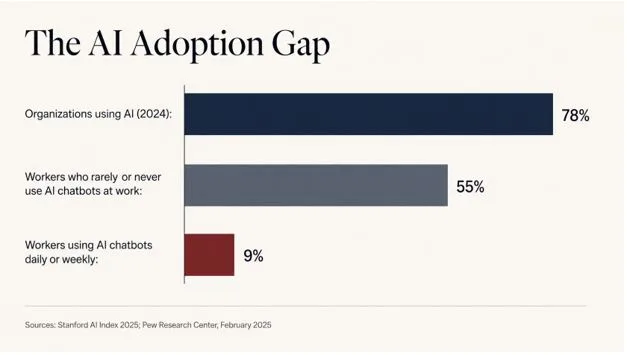
The adoption numbers make the problem concrete, and they’re strange. Stanford’s 2025 AI Index reports that 78% of organizations used AI in 2024, up from 55% the year before. Companies, in short, have bought in.
Their people are slower to arrive. Pew Research Center found that 55% of US workers rarely or never use AI chatbots at work, and only 9% use them daily or a few times a week. Another 29% haven’t heard of workplace chatbots at all.
A majority of American workers, 55%, rarely or never use AI chatbots on the job, per Pew Research Center.
Why the gap?
My theory, after a year of testing: the interface asks too much. A blank chat box is a job interview you have to conduct thirty times a day. The workers who push through get rewarded (54% of regular users told Pew the tools have been highly helpful in speeding up their work), but most people never push through, because the tool never meets them halfway.
Three eras of asking
The category’s short history helps here (it’s brief, but it has eras).
The first era belonged to chatbots: Siri, the FAQ widgets, the first wave of conversational AI. You asked, it answered, transaction complete. The second era, roughly 2023 through 2025, gave us copilots: AI that drafts emails, code, and documents alongside you while you steer. Both were real progress. Both still waited.
The third era is the one showing up in products over the past year: delegation. The assistant holds standing responsibilities (watch this inbox, guard this calendar, brief me before every call) and initiates when something crosses a threshold.
In short: chatbots answered, copilots helped, delegates act.
The best AI virtual assistant in 2026 initiates. It watches the inbox, calendar, and tools you’ve handed it, handles what it can, and contacts you the moment something needs a real decision. Every other feature in the category follows from that one trait.
The assistants that speak first
The clearest way to see the shift is in where the new tools choose to live. Lindy, an AI assistant designed to work over text message, runs your inbox and calendar in the background and opens the conversation itself: it messages you when a meeting conflicts, a lead replies, or a decision is stuck waiting on you. The interface is the same thread you use for your family group chat, which says a lot about the intended relationship.
Executives appear to be planning for this era rather quickly. In the same Microsoft survey, 81% of leaders said they expect AI agents to be moderately or extensively integrated into their company’s AI strategy within the next 12 to 18 months.
The wager underneath all of this is simple. If the interruption data is right, the scarcest resource at work is a human’s initiative, and software that supplies its own initiative is worth a different kind of money than software that borrows yours.
The trust problem is the real product
Proactive software has to earn something reactive software never needed: permission to act. An assistant that files the wrong email is annoying. One that sends the wrong email is a liability with a login.
The better proactive tools treat this as a design problem.
Lindy, for one, asks before anything goes out; you approve the reschedule note before it leaves.
As of August 2026, this is where the craft in the category lives: deciding which actions an assistant may take alone, which need a tap of approval, and which deserve a phone-buzzing escalation.
Get that hierarchy right and the tool disappears into the workday. Get it wrong and the user switches it off within a week.
This is also, I’d argue, the honest reason the delegation era took so long. The models could draft a decent email two years ago. Teaching software when to speak took longer than teaching it what to say.
The end of the unread badge
I keep coming back to that 7:42 text. What struck me wasn’t the scheduling. It was the feeling of being briefed, the way you’re briefed by a colleague who came in early and already sorted the small stuff.
Twenty years of work software trained us to check things: inboxes, dashboards, little red badges.
The next stretch of this category is being built on the opposite motion, software that checks in with us.
When the history gets written, I suspect the dividing line will be easy to draw. There were the assistants you had to remember to use, and then there were the assistants that remembered you.