The Best Private Messengers to Use in 2026: Why Secure Communication Matters More Than Ever
In 2026, secure communication is no longer a niche concern reserved for cybersecurity experts or journalists. It has become a daily necessity for anyone who uses the internet. From private conversations and business negotiations to personal photos and financial details, our digital interactions contain deeply sensitive information—and this is exactly why privacy-first platforms like Signal Messenger are gaining global trust. Yet many popular messaging platforms continue to monetize user data, track behavior, and store information on centralized servers that are vulnerable to breaches.
This growing risk has fueled a shift toward privacy-first messaging platforms—apps designed to protect user data rather than exploit it. Among these, Signal remains one of the most trusted and transparent options available today.
What Digital Privacy Really Means in 2026
Digital privacy is often misunderstood. It does not simply mean hiding messages from hackers. True privacy ensures that no third party—corporations, advertisers, governments, or even the platform itself—can read, analyze, or profit from your communications.
Modern privacy threats are more subtle than ever. Many apps collect metadata, such as who you talk to, when, how often, and from where. Even if they claim to encrypt messages, this metadata can reveal detailed patterns about your life—which is why more privacy-conscious users now choose to Download Signal for PC and other secure platforms that minimize data collection. In the wrong hands, this information can be used for surveillance, manipulation, or identity theft.
A truly private messenger must go beyond basic encryption. It should collect minimal data, be transparent about its operations, and operate independently from profit-driven incentives.
Why Signal Stands Out Among Private Messengers
Signal has earned its reputation as one of the most secure messaging platforms in the world, and in 2026, it continues to set the standard for privacy-first communication.
What makes Signal different is not just its technology but its philosophy. Signal is run by an independent, non-profit organization. This means it does not depend on advertising revenue, investor pressure, or data monetization. Its mission is simple: protect free expression and private communication.
Signal uses state-of-the-art end-to-end encryption by default for every message, call, image, and video. This means only you and the intended recipient can access the content. Not even Signal itself can read your messages.
Signal Is Not Just for Mobile Users
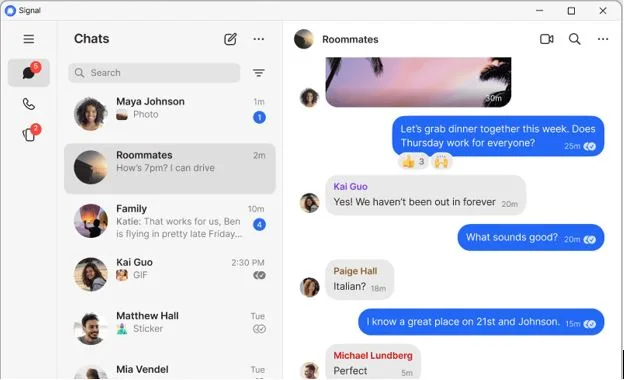
A common misconception is that Signal is primarily a mobile app. In reality, Signal offers a high-performance desktop application for Windows, macOS, and Linux. This makes it one of the best private messengers for professionals, researchers, journalists, and remote workers who rely on desktop environments.
The desktop version is not a stripped-down companion—it is a fully featured, secure platform. Users can send messages, make encrypted voice and video calls, share files, and participate in group chats with the same level of privacy found on mobile devices.
Importantly, Signal’s desktop app does not compromise security for convenience. All communications remain end-to-end encrypted, and no chat data is stored in the cloud. Everything stays local, reducing the risk of mass data leaks.
A Messenger Without Ads, Trackers, or Profiling
In the modern digital economy, most “free” services make money by tracking users and selling behavioral insights. Signal rejects this model entirely.
The app contains no advertisements, no tracking mechanisms, and no analytics that profile user behavior. It does not scan messages, log conversation histories, or store personal identifiers beyond what is absolutely necessary to function.
This approach dramatically reduces the risk of data misuse. If a platform does not collect your data, it cannot sell it, leak it, or lose it to hackers.
Why Desktop Privacy Is Becoming Essential
As remote work and digital collaboration continue to grow, desktop communication has become a major part of daily life. Sensitive work documents, private discussions, and confidential files are often shared on laptops rather than phones.
Signal’s desktop support ensures that privacy is consistent across all devices. Whether you’re chatting on your phone or your computer, the same encryption and security standards apply.
This cross-platform consistency is rare and crucial. Many apps prioritize mobile security but treat desktop as an afterthought, often introducing vulnerabilities. Signal avoids this problem by designing privacy into every version of the app.
Other Private Messaging Apps Worth Mentioning
While Signal remains the gold standard, there are other privacy-focused messengers available in 2026. Some prioritize anonymity, while others focus on enterprise-level collaboration. Each has its strengths, but most fall short in one of three areas: usability, transparency, or independence.
What makes Signal unique is that it combines strong encryption, ease of use, open-source transparency, and non-profit governance in one package. This balance is difficult to achieve and even harder to maintain over time.
The Future of Secure Communication
As artificial intelligence, biometric data collection, and digital surveillance become more advanced, privacy risks will only increase. The question is no longer whether your data is valuable—it’s how well you protect it.
Choosing a private messenger is not just a technical decision; it’s a personal one. It reflects how much control you want over your digital life.
Signal’s continued commitment to end-to-end encryption, non-profit independence, zero tracking, and high-performance desktop support makes it one of the most reliable and ethical messaging platforms available in 2026.