The Complete Guide to Sandbag Filling Equipment: What Every Contractor Needs to Know
When floodwaters rise, every minute counts. Whether you’re a municipal contractor preparing for seasonal flooding, a construction site manager controlling erosion, or an emergency response team deploying barriers overnight — the speed and efficiency of your sandbag operation can make or break the outcome.
For decades, sandbag filling was entirely manual: a slow, labor-intensive process that required multiple workers, caused physical strain, and still produced inconsistent results. Today, modern sandbag filling equipment has completely changed the game — cutting fill times from hours to minutes and allowing even small teams to produce thousands of bags per shift.
This guide covers everything you need to know: how the equipment works, what types are available, which features matter most, and how to evaluate the ROI before making a purchase.
What Is Sandbag Filling Equipment?
Sandbag filling equipment refers to any mechanical or automated system designed to fill bags — typically woven polypropylene or burlap — with sand, gravel, soil, or similar granular materials at speed and scale.
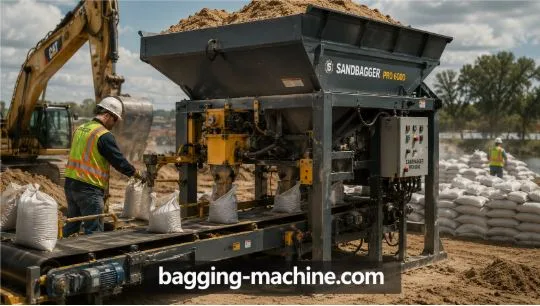
At its core, the equipment typically consists of:
- A hopper — where bulk material is loaded and stored
- A metering/dispensing mechanism — controls how much material enters each bag
- A bag holder/chute — positions and holds the bag open during filling
- A conveyor or discharge system — moves filled bags away from the filling station
Modern systems range from simple gravity-fed units that one operator can run, all the way to fully automated lines that fill, seal, and stack bags with minimal human involvement.
Industries That Rely on Sandbag Filling Equipment
Sandbag filling equipment isn’t just for flood control. It serves a wide range of industries:
- Flood Control & Emergency Management Municipalities, FEMA contractors, and emergency response agencies are the largest users. Speed is everything — a machine that fills 600 bags per hour versus a crew filling 100 bags per hour manually can be the difference between a protected neighborhood and a disaster.
- Military & Defense Military bases use sandbags extensively for bunkers, perimeter defense, and blast protection. Portable sandbag filling equipment allows rapid deployment in the field.
- Construction & Civil Engineering Contractors use sandbags for site drainage control, retaining walls, temporary dams, and slope stabilization.
- Sand & Aggregate Suppliers Businesses selling pre-filled sandbags to retailers, hardware stores, or government agencies rely on high-volume automated filling lines to meet demand.
- Mining & Quarrying Filling bags with crushed stone, gravel, or mineral aggregates for transport and containment.
Types of Sandbag Filling Machines
Not all sandbag filling machines are the same. Here’s a breakdown of the main categories:
1. Manual / Gravity-Fed Fillers
The most basic type — a hopper with a manually operated gate valve. One operator holds the bag open, releases the gate, and the material fills by gravity. Simple, affordable, but still limited in speed.
Best for: Very small operations, emergency kits, low budgets.
2. Semi-Automatic Sandbag Fillers
These machines automate the metering and fill cycle but still require an operator to place and remove bags. Many include a foot pedal or sensor trigger. Output typically ranges from 200–600 bags per hour depending on the model.
Best for: Small to mid-size contractors, municipal emergency teams.
3. Fully Automatic Sandbag Filling Systems
High-end systems that handle bag placement, filling, closure, and conveyance automatically. Some models integrate with bagging conveyors and palletizers for end-to-end automation. Output can exceed 1,000–2,000 bags per hour.
Best for: Large-scale suppliers, government stockpiling programs, industrial operations.
4. Portable / Trailer-Mounted Units
Designed for field deployment, these units are mounted on trailers or skids and can be transported directly to flood zones or construction sites. They run on diesel or generator power.
Best for: Emergency response, remote job sites, military use.
Key Features to Look For
When evaluating sandbag filling equipment, these are the features that separate a good investment from a frustrating one:
- Fill Speed (Bags Per Hour) This is the most important metric. Calculate your actual operational need: if you need 5,000 bags in a 10-hour shift, you need a machine rated at minimum 500 bags/hour — ideally higher to account for material refill and operator breaks.
- Bag Size Compatibility Standard sandbags are 14″x26″, but sizes vary. Make sure the equipment supports the bag dimensions you use, and check whether switching sizes requires tools or is tool-free.
- Hopper Capacity A larger hopper means fewer refill interruptions. For high-volume operations, look for hoppers that can be refilled by front-end loader without stopping production.
- Fill Accuracy & Weight Consistency Inconsistent fill weights lead to wasted material and unstable stacking. Look for adjustable metering systems or load-cell-based weigh filling for precise results.
- Dust Control Sand and fine aggregates create significant dust during filling. A machine with enclosed fill points and optional dust extraction ports protects operators and keeps the work area compliant with air quality standards.
- Build Quality & Materials Heavy-duty steel construction with powder-coat or galvanized finish is essential for equipment used in wet, outdoor environments. Check frame thickness and weld quality.
- Ease of Maintenance Look for equipment with accessible wear parts, standard hardware (not proprietary), and clear maintenance documentation. Downtime during an emergency is not an option.
Manual vs Automated — A Real Cost Comparison
Let’s break down what manual filling actually costs versus investing in a proper bagging machine.
Manual Filling Scenario:
- 6 workers × 8 hours = 48 labor hours
- Output: ~800–1,000 bags per shift
- Average labor cost: $18/hr × 6 = $108/hr = $864/shift
- Physical strain, inconsistency, fatigue-related slowdowns
Automated Filling Scenario:
- 1–2 operators × 8 hours
- Output: 3,000–5,000 bags per shift
- Labor cost: ~$18/hr × 2 = $36/hr = $288/shift
- Consistent fill weights, lower injury risk, scalable output
Result: The automated setup produces 4–5x more bags at one-third the labor cost. For any operation filling more than 500 bags per week, the equipment typically pays for itself within one season.
Choosing the Right Supplier
- Not all equipment suppliers are equal. Here’s what to evaluate:
- Product Range A good supplier offers multiple configurations — from entry-level semi-auto units to full industrial lines — so you can scale up as your operation grows.
- Customization Options Every operation is different. Can the supplier adjust hopper size, output speed, bag dimensions, or add dust control components based on your specific requirements?
- After-Sales Support What’s the warranty? Are spare parts available locally or shipped from overseas? Does the supplier offer installation support and operator training?
- Proven Track Record Look for suppliers with documented deployments in your industry — municipal contracts, emergency management clients, aggregate suppliers. Ask for references.
For industrial and emergency-grade solutions, a purpose-built sand bag filler machine engineered for high-volume output will consistently outperform general-purpose equipment adapted for this use.
Deployment & Maintenance Checklist
Before deploying your sandbag filling equipment, run through this checklist:
Pre-Operation:
- ✅ Inspect hopper for debris or residual material
- ✅ Check all bolts, fasteners, and wear plates
- ✅ Verify bag holder alignment and chute clearance
- ✅ Test fill cycle with 5–10 trial bags before full production
- ✅ Ensure dust extraction is functional (if equipped)
During Operation:
- ✅ Monitor fill weight consistency every 50–100 bags
- ✅ Refill hopper before it runs below 20% to avoid air pockets
- ✅ Rotate operators every 2 hours to maintain focus
- ✅ Keep a clear path for filled bag removal
Post-Operation:
- ✅ Flush hopper of residual sand/gravel
- ✅ Lubricate moving parts per manufacturer schedule
- ✅ Inspect conveyor belts (if equipped) for wear
- ✅ Log hours for scheduled service intervals
Conclusion
Whether you’re preparing for a flood season, supplying pre-filled bags to the market, or equipping a construction crew — the right sandbag filling equipment is one of the highest-ROI investments your operation can make. The shift from manual to automated filling isn’t just about speed: it’s about reliability, consistency, safety, and the ability to scale when demand spikes suddenly.
Start by calculating your real volume needs, shortlist machines that match your output target, and partner with a supplier who understands your industry. The upfront cost pays for itself fast — and when an emergency hits, you’ll be ready.