The Dutch IPTV Landscape in 2026: What Changed in Five Years
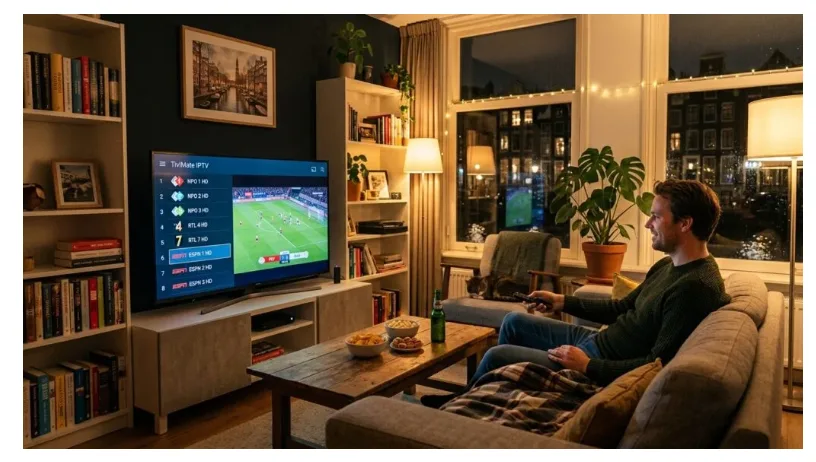
Five years ago, the average Dutch living room still had a box under the television. It blinked, it hummed quietly, and once a month it justified a line on the bank statement that most households had stopped reading closely. In 2026, that box is increasingly gone — and what replaced it did not arrive all at once. It arrived in stages, driven by fiber crews digging up streets in Zwolle, by football rights being carved into ever smaller pieces, and by a slow accumulation of monthly charges that families eventually sat down and added up.
The shift toward internet television in the Netherlands is one of the more complete transitions in European media, and it is worth understanding not as a single event but as five separate changes that happened to converge.
Where Things Stood in 2021
To measure the distance travelled, it helps to remember the starting point.
In 2021, the Dutch television market was still recognisably a cable market. Ziggo and KPN carried the large majority of households. Digitenne covered the gaps. Streaming existed and was growing quickly, but it sat on top of the traditional subscription rather than replacing it. The typical arrangement was a cable package for live television and local channels, plus Netflix, plus whatever else had crept in during lockdown.
Internet-delivered television was already available, but it carried a reputation problem. Streams buffered. Picture quality was inconsistent. Anyone who had tried it in 2018 and given up after two months was unlikely to try again. The technology worked in theory and disappointed in practice, which is the worst possible position for a consumer product.
That reputation is the single biggest thing that changed.
Fiber Rewrote the Ground Rules
The Netherlands entered the 2020s with excellent broadband by European standards and then went considerably further. The national fiber rollout — driven by KPN, Delta Fiber, and a series of regional operators — moved fiber from a feature of new-build neighbourhoods to something close to a default across large parts of the country.
The consequence for television was not subtle. A stable symmetric connection removes the entire category of problems that made early internet TV frustrating. Evening congestion, which used to be the reliability killer in Dutch apartment blocks, stopped being the constraint it once was. Rural coverage improved, though unevenly, and the households still on older copper connections are now the clear minority rather than a substantial share of the market.
This matters because it changed the conversation. In 2021, the first question about iptv nederland was whether it would work at all. By 2026, that question has essentially disappeared for anyone on a modern connection, and the discussion moved on to content, price, and service quality — which is where the market actually competes.
The Great Sports Split
If fiber made the switch possible, sports made it urgent.
Dutch football supporters have spent the past five years watching their viewing costs fragment. Eredivisie coverage sits with ESPN. Champions League nights have run through Ziggo Sport. Premier League and Formula 1 have moved through separate platforms again, with their own subscription logic and their own annual price adjustments. A supporter who wants to follow their club, European competition, and one foreign league is now assembling a portfolio rather than buying a product.
Ask any Dutch household with a football fan in it what pushed them to reconsider their setup, and this is usually the answer. Not ideology, not technology — arithmetic. A family in Eindhoven that wants PSV domestically, PSV in Europe, and a Sunday afternoon in England has been quietly paying for the privilege of that fragmentation for years.
The rights holders are not doing anything irrational. Each sale makes sense in isolation. But the cumulative effect on the household bill is what drives people to search for alternatives, and it is the clearest single explanation for the growth of iptv as a category.
Subscription Fatigue Arrived Exactly on Schedule
The broader streaming market followed the pattern everyone predicted and nobody prevented.
Between 2021 and 2026, essentially every major platform raised prices at least twice. Ad-supported tiers were introduced, which quietly reframed the previous price as the premium option. Password sharing was restricted, which converted a number of free viewers into paying ones and a number of paying households into resentful ones. Content libraries fragmented further as studios pulled titles back to their own services.
The result is a familiar feeling in Dutch homes: paying more than before for a viewing experience that feels less complete. A household running a cable package alongside three or four streaming services can comfortably clear €70 to €100 per month, and the honest assessment of most families is that a substantial share of that spending goes unwatched.
This is what commentators call the rebundling problem. Streaming was sold as the escape from the cable bundle. What it produced instead was a bundle with worse ergonomics — more logins, more apps, more separate bills, and no single place to find anything.
The Technology Quietly Grew Up
While the commercial picture was fragmenting, the underlying technology was consolidating in the other direction.
Modern video codecs deliver 4K at a fraction of the bandwidth required five years ago, which changed the economics for providers and the experience for viewers simultaneously. Adaptive streaming got substantially better at degrading gracefully instead of freezing. Buffering, when it happens now, usually means a genuine network problem rather than a service problem.
Device support matured in parallel. In 2021, getting a service running on a smart TV frequently involved sideloading and a certain amount of forum reading. In 2026, recent Samsung, LG, Philips, and Sony televisions handle modern streaming applications natively, and the Android TV, Google TV, Apple TV, and Fire Stick ecosystems have converged on interfaces that ordinary households can operate without help from a technically minded nephew.
The practical threshold for a comfortable 4K experience now sits around 25 Mbps of stable throughput. Most Dutch fiber connections exceed that several times over. That single fact removed the last technical objection for the majority of the country.
What Dutch Viewers Actually Want
Dutch viewing preferences are distinctive, and any service that ignores them fails regardless of how many channels it advertises.
The first requirement is local. NPO 1, 2 and 3, RTL 4, SBS6, Net5, and Veronica remain the anchor of Dutch household viewing. Dutch news, Dutch talk shows, and Dutch drama are not interchangeable with international alternatives. A service that treats local channels as an afterthought is not a serious proposition in this market.
The second is international breadth. The Netherlands is a genuinely multilingual country, and a substantial share of households watch across two, three, or four languages in a single evening. German and Belgian channels have natural audiences. So do Turkish, Arabic, Polish, and Surinamese-oriented content for the communities that watch them. This breadth is one of the strongest arguments for internet delivery over traditional cable, which was always constrained by the economics of carriage.
The third is service in Dutch. Support delivered only in English is a persistent friction point, particularly for older subscribers, and it is one of the clearest differentiators between providers that intend to stay and providers that do not.
The Buying Process Has Matured
Perhaps the most underappreciated change is in how Dutch consumers now approach the decision itself. The market has developed norms, and buyers have learned what to look for.
Anyone considering IPTV kopen in 2026 tends to evaluate on four axes rather than on channel count alone.
Payment method as a trust signal. This is the most reliable filter available to a Dutch consumer. Services that accept iDEAL, standard credit cards, or established processors are operating inside a system that offers recourse. Services that insist on cryptocurrency or untraceable transfers are removing that recourse deliberately, and Dutch buyers have become notably good at reading that signal for what it is.
Trial periods. A provider confident in its infrastructure offers a testing window, typically 24 to 48 hours. The important detail is when the test is run. A stream that performs perfectly at eleven in the morning proves very little. The meaningful test is a Saturday evening during a live match, when peak-hour demand is at its highest.
Peak-hour reliability over channel count. Advertised catalogue sizes have become close to meaningless as a comparison metric. What matters is whether the service holds up in the last ten minutes of a tight match, which is precisely when infrastructure quality reveals itself.
Device compatibility, verified rather than assumed. Most modern hardware works, but “most” is not “all,” and it is worth confirming against the specific television or box in the living room before committing to a longer term.
What the Next Five Years Look Like
The direction of travel is not seriously in dispute. Internet-delivered television will continue absorbing share from traditional distribution, and the interesting questions are about pace and shape rather than outcome.
Three developments are worth watching. Sports rights are unlikely to reconsolidate, which means the cost pressure that has driven so much of this shift will persist. Fiber coverage will continue closing the rural gap, extending the addressable market to the households that have so far had the least practical choice. And the interface layer — whichever platform ends up sitting between the viewer and the content — will become the real competitive battleground, because in a world where everyone can deliver the stream, the winner is whoever makes it easiest to find something to watch.
For Dutch households, the practical takeaway is straightforward enough. The technical barriers that made internet television frustrating five years ago have largely been engineered away. What remains is a market that rewards careful selection: check the connection, use the trial properly, insist on Dutch-language support, and treat the payment method as the single most informative thing a provider tells you about itself.
The box under the television is going. What replaces it is now a genuine choice rather than a compromise — and that, more than any single technology, is what changed.